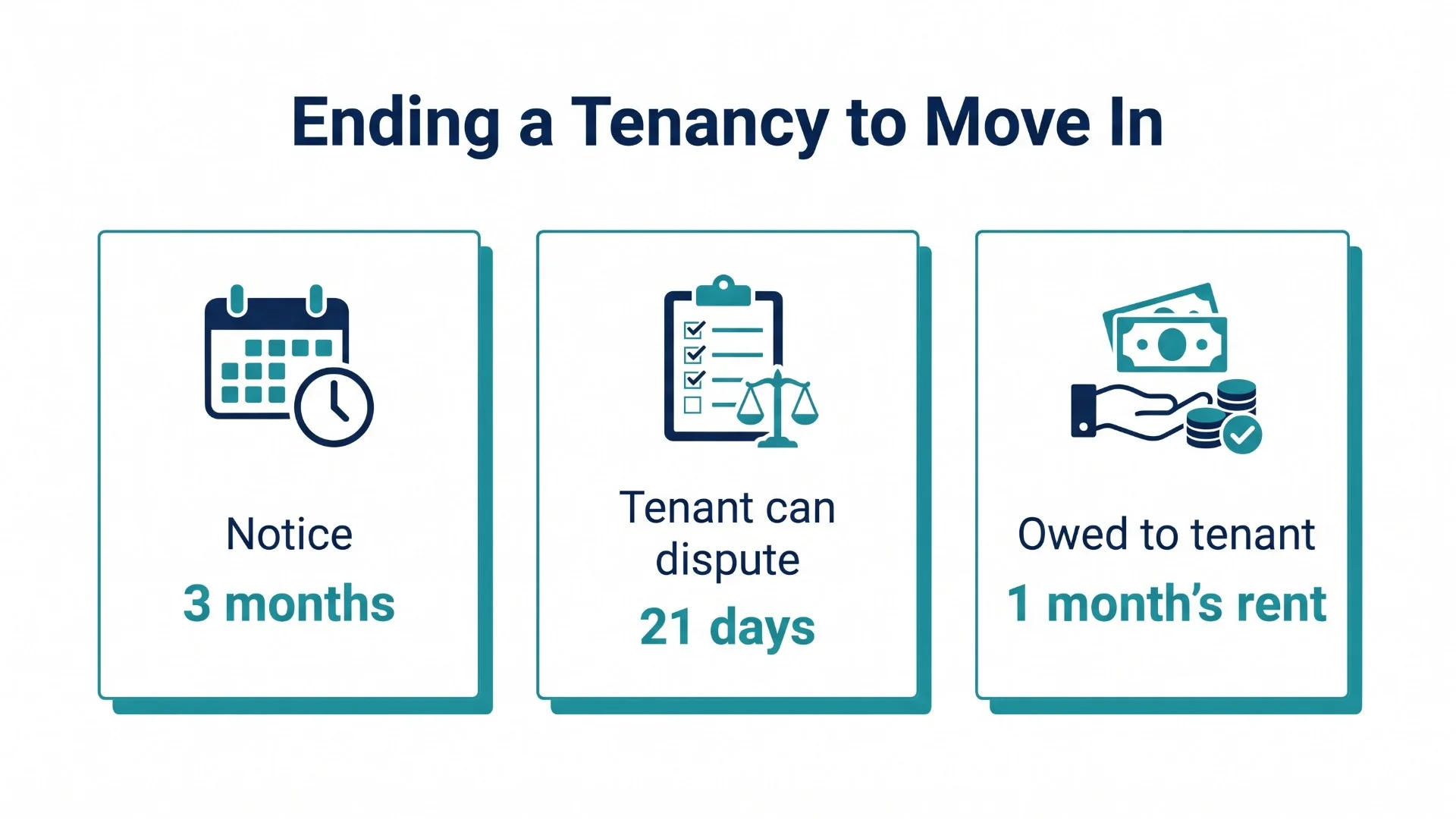
In BC, a landlord who wants to move into a rental unit, or move in a close family member, must give the tenant at least 3 months' notice on a Three Month Notice to End Tenancy for Landlord's Use of Property (RTB-32L) generated through the Residential Tenancy Branch web portal. The tenant has 21 days to dispute it and is owed one month's rent.
At a glance
- Who can move in: the landlord or a close family member: a parent, spouse or child of the landlord, or a parent or child of the landlord's spouse (RTA s.49(1)).
- Notice: at least 3 months, ending the day before rent is due, and not before a fixed term ends (Regulation s.42.2; RTA s.49(2)).
- The form: generated on the RTB web portal; a generated notice carries a Notice ID.
- Dispute period: 21 days (Regulation s.42.3).
- Compensation: one month's rent, plus 12 months' rent if the unit is not used as stated for at least 12 months (RTA s.51).
Who can a BC landlord end a tenancy for, to move in?
Section 49(3) of the Residential Tenancy Act lets a landlord who is an individual end a tenancy if the landlord, or a close family member of the landlord, intends in good faith to occupy the rental unit. The Act defines a close family member narrowly: the individual's parent, spouse or child, or the parent or child of that individual's spouse. A sibling, a cousin or a friend does not qualify.
To use this ground, the landlord must hold at least half of the full reversionary interest in the unit, for more than 3 years, when the notice is given (s.49(1)). A family corporation, where all voting shares belong to one person or that person and their siblings or close family members, can use the same ground for a shareholder or their close family member (s.49(4)).
When is a landlord's-use notice not allowed?

Under section 49(6.1), a landlord must not give this notice if the unit is in a building with 5 or more rental units that is not strata-titled, or that is strata-titled with all the rental units owned by the same owner. The Province's types of evictions page states the same prohibition for personal occupancy.
The notice also has to be in good faith. The landlord must genuinely intend that they or the family member will live in the unit, and RTB Policy Guideline 2A covers how an arbitrator weighs that intention when a tenant disputes the notice.
How much notice does a BC landlord have to give?
At least 3 months after the tenant receives the notice. Section 42.2 of the Residential Tenancy Regulation prescribes that period for landlord, family-corporation and purchaser occupancy. Under section 49(2) of the Act, the effective date must also be the day before rent is due, and for a fixed-term tenancy it cannot be earlier than the end of the term.
| Reason under RTA s.49 | Notice | Tenant's dispute period |
|---|---|---|
| Landlord or close family member moves in (s.49(3), (4)) | 3 months | 21 days |
| Purchaser or their close family member moves in (s.49(5)) | 3 months | 21 days |
| Demolition, or conversion to strata, a co-op, caretaker use or non-residential use (s.49(6)) | 4 months | 30 days |
If the date on the notice is too early, section 53 of the Act deems it changed to the earliest date that complies. That saves the notice, but the move-in date slips.
How does a landlord give the notice?
Through the RTB's notice-to-end-tenancy web portal. Section 52(e) of the Act requires a landlord's notice to be in the approved form prepared, where applicable, under section 53.1 on generated notices, and the Regulation applies that to the landlord, family-corporation, purchaser and caretaker grounds. The Province says that from June 18, 2025, landlord occupancy uses form RTB-32L generated on the portal, and that a generated notice has a unique Notice ID in the top left corner. The portal asks for the birthdates of the landlord and the person moving in; the Province says these are for internal RTB use and do not appear on the notice.
The Province also notes a timing trap: if you generate the notice on the last day of a rental period and plan to serve it in person that day, generate it before 9 p.m. Serve it by a method the Act allows; see serving documents in BC.
What does the landlord owe the tenant?
One month's rent, on or before the effective date (RTA s.51(1)). The tenant can simply withhold the last month's rent instead (s.51(1.1)). A tenant who receives the notice may also leave early by giving at least 10 days' written notice and paying rent only up to their own move-out date, without losing the compensation (s.50).
The larger figure is the penalty. Under section 51(2), the landlord must pay the tenant 12 times the monthly rent unless the landlord shows that the stated purpose was accomplished within a reasonable period after the effective date and that the unit was used for that purpose for at least 12 months, starting within a reasonable period. The RTB may excuse the payment only where extenuating circumstances prevented it (s.51(3)). RTB Policy Guideline 50 deals with these claims.
What if a buyer wants the unit?
The seller gives the notice, not the buyer. Section 49(5) applies once the sale agreement is made in good faith, all its conditions are satisfied, and the purchaser asks the landlord in writing to end the tenancy because the purchaser or a close family member will live in the unit. The Province says the landlord generates form RTB-32P on the portal; the notice must give the purchaser's name and address (s.49(7)), and it carries the same 3 months' notice and 21-day dispute period. If the purpose is not met, the 12 months' rent is owed by the purchaser who asked for the notice (s.51(2)).
What happens if the tenant does nothing?
If the tenant does not apply for dispute resolution within the 21 days, section 49(9) says the tenant is conclusively presumed to accept that the tenancy ends on the effective date and must move out by then. If the tenant does not leave, the landlord applies for an order of possession; see orders of possession in BC and every way a BC tenancy can end.
Frequently asked questions
Is it still called a Two Month Notice in BC?
No, for landlord or purchaser occupancy it is now a Three Month Notice, generated on the RTB portal (RTB-32L for the landlord, RTB-32P for a purchaser). The Regulation sets the period at 3 months and the dispute period at 21 days.
Can I end a tenancy so my brother can move in?
No. A sibling is not a close family member under section 49(1). The ground covers your parent, spouse or child, or your spouse's parent or child.
Can I end a fixed-term tenancy early to move in?
No. Section 49(2)(c) says the effective date cannot be earlier than the date the fixed term ends.
Do I have to pay the one month's rent if the tenant leaves early?
Yes. Section 50(3) says a tenant's early notice does not affect the right to compensation under section 51.
Can I re-rent the unit after six months?
Re-renting before the 12 months are up risks the 12 months' rent compensation under section 51(2), unless the RTB finds extenuating circumstances.
Ending a tenancy to move in is lawful in BC, but it is tightly drawn: the right person, the right building, a generated notice, three months, and a year of genuine use afterwards.
Keep every tenancy record in one place
Free BC landlord and tenant forms and guides.
Free • No signup required