A BC manufactured home park landlord can end a manufactured home site tenancy for "landlord's use" only to convert all or a significant part of the park to another use. The landlord needs every permit first, must give 12 months' notice on form RTB-31, and must pay each tenant $20,000 by the effective date. Tenants have 15 days to dispute.
What counts as landlord use under the MHPTA?
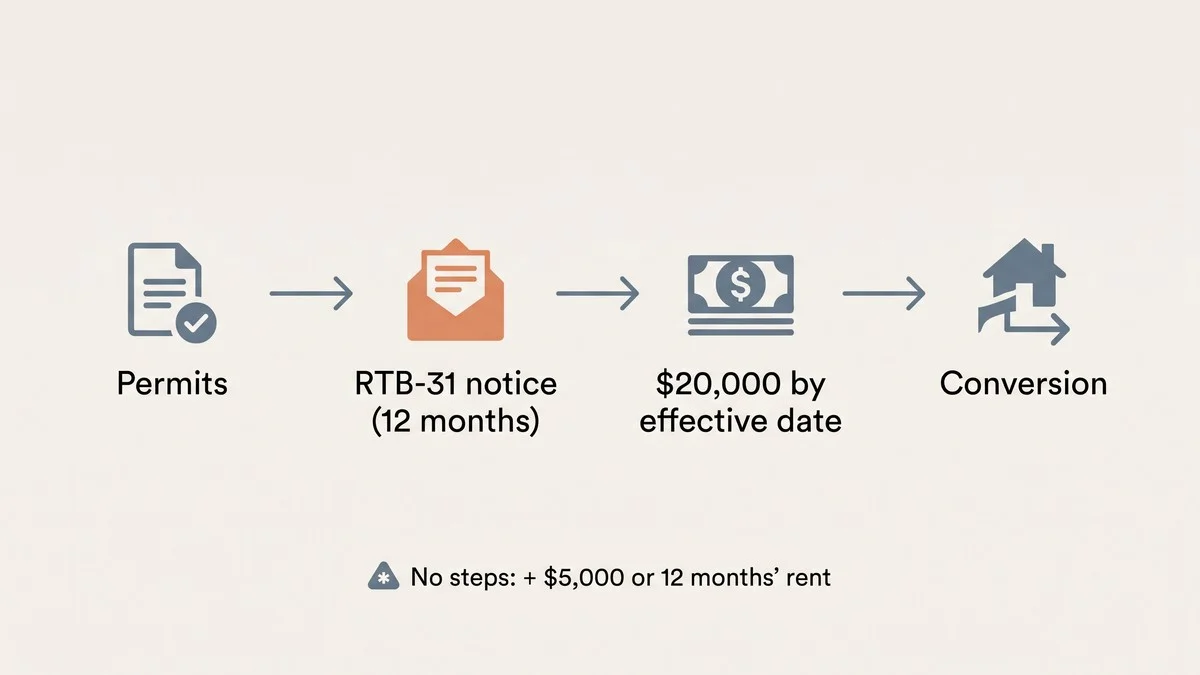
Unlike a house or apartment, there is no MHPTA notice for a park owner or relative to move onto a site. Section 42 of the Manufactured Home Park Tenancy Act covers one ground: converting the park, in good faith, to a non-residential use or a residential use other than a manufactured home park. RTB Policy Guideline 33 reads "significant part" as considerable or material, judged by the project's size against the whole park. A site outside the conversion can't be ended unless it must be vacated for the work to proceed.
The guideline adds one limit that matters for small parks: the section cannot be used to end a single tenancy unless the park has only one site, or only one occupied site, that the landlord plans to convert. Tenants renting a house or apartment under the Residential Tenancy Act have a different set of landlord-use notices; see Ending a Tenancy in BC: Every Way It Can End.
The 12-month notice, step by step
- Permits first. All permits and approvals required by law must be in place before the notice is served.
- Serve RTB-31. The effective date must be at least 12 months after the tenant receives it and fall on the day before rent is due. Notice received March 15 can't end the tenancy before the end of March the next year.
- Pay $20,000 on or before the effective date (Regulation s.33.1(1)).
- Carry out the conversion. If steps aren't taken within a reasonable period after the effective date, the landlord owes a further $5,000 or 12 months' rent, whichever is greater, unless the RTB excuses it for extenuating circumstances (s.44(2)–(3)).
What must the RTB-31 notice contain to be valid?
To be effective, a landlord's notice to end a manufactured home site tenancy must be in writing, signed and dated by the landlord, give the address of the site, state the effective date and the grounds, and be on the approved form (MHPTA s.45). For a park conversion the approved form is the RTB-31 12 Month Notice to End Tenancy for Conversion of Manufactured Home Park.
A wrong effective date does not void the notice. If the date is earlier than the Act allows, it is deemed changed to the earliest date that complies (s.46). Missing a signature, the site address or the grounds is a different matter: those go to whether the notice is effective at all.
A worked example of the dates
Take a site where pad rent is due on the 1st of each month, and a landlord who mails the RTB-31 on May 10, 2027.
| Step | Date | Why |
|---|---|---|
| Notice mailed | May 10, 2027 | Landlord's choice of service |
| Notice treated as received | May 15, 2027 | Mail counts five days after mailing |
| Last day to dispute | May 30, 2027 | 15 days after receipt (s.42(4)) |
| Earliest effective date | May 31, 2028 | At least 12 months after receipt, on the day before rent is due (s.42(2)) |
| $20,000 paid by | May 31, 2028 | On or before the effective date (s.44(1)) |
If the landlord wrote "May 15, 2028" on the form, the date would be deemed to be May 31, 2028 (s.46). Under the MHPTA, a notice attached to the door or left in the mailbox counts as received on the third day after (s.83). The equivalent rules for house and apartment tenancies are in Serving Documents in BC.
Leaving early and extra compensation

A tenant can leave before the effective date on at least 10 days' written notice, paying rent only to that date, and still keeps the $20,000 (s.43). If the home can't be moved, because permits can't be obtained or no site exists within a reasonable distance, and no tax is owing on it, the tenant may apply for the home's latest assessed value minus $20,000 (s.44.1; Regulation s.33.2).
A tenant who had already paid rent for a period after their early end date gets the extra refunded by the landlord (s.43(2)). For a home assessed at $95,000 that cannot be moved, the claim would be for $75,000 on top of the $20,000.
Both a dispute of the notice and a claim for extra compensation start with an application for dispute resolution and end at an RTB hearing.
What evidence supports a claim that the home cannot be moved?
Guideline 33 puts the proof on the tenant, and lists what helps:
- Permits: the steps you took to get the permits or approvals needed to move the home, under the Manufactured Home Act or local government rules, and why they could not be obtained.
- No site nearby: the parks you contacted, and written confirmation from them that no site is available. The arbitrator decides what is a reasonable distance, and may consider whether the site is in a different community, how far away it is, and geographic barriers.
- No taxes owing: a certificate or written statement from the taxing authority for the home. Which one you get depends on where the home is.
- Assessed value: the most recent assessment under the Assessment Act; the claim exists only if it is above $20,000.
How to organise and submit that evidence on time: Preparing Evidence for an RTB Hearing.
What happens to a home that has to be left behind?
The abandonment rules in the Manufactured Home Park Tenancy Regulation apply. Normally a landlord who disposes of abandoned property can keep sale proceeds to cover the costs of removing, storing, advertising and disposing of it. But where the tenant could not get the permits to move the home, or could not find a site within a reasonable distance, the landlord may not claim from the tenant any shortfall in those costs, unless the tenant owes rent or fees under the tenancy agreement (Regulation s.40.92).
Common mistakes on a park conversion notice
- Serving before every permit and approval is in hand (s.42(1)).
- Serving sites that are not part of the conversion and do not need to be vacated for it (Guideline 33).
- Paying the $20,000 after the effective date instead of on or before it.
- Treating the 10-day early exit as giving up the compensation. It does not (s.43(3)).
- Letting the 15-day dispute window pass while negotiating informally.
Frequently asked questions
Can a park owner end my pad tenancy to move in?
No. The MHPTA's landlord-use ground is conversion of the park only. Other grounds are unpaid rent (10-day notice) and cause (one month).
How is the 12 months counted?
From the day the tenant receives the notice; notice handed over in person counts that day, by mail five days after mailing. A date that is too early is automatically corrected to the earliest valid date (s.46).
Is the $20,000 tied to my rent?
No. It is a flat amount set by the regulation (s.33.1(1)). Only the later penalty for not converting is linked to rent: the greater of $5,000 or 12 months' rent (s.33.1(2)).
What happens if my dispute is dismissed?
If the arbitrator dismisses the tenant's application or upholds the notice, and the notice meets the form and content rules in s.45, the RTB must grant the landlord an order of possession (s.48(1)).
Know your rights as a BC tenant
Notices, disputes and hearings, explained in one place.
Free • No signup required