In BC, a landlord can charge a late rent fee of no more than $25, and only if the tenancy agreement provides for it. For a returned (NSF) cheque, the landlord can pass on the bank's own service fee plus an administration fee of up to $25, again only if the agreement allows the administration fee (Residential Tenancy Regulation s.7).
At a glance
- Late rent: an administration fee of up to $25 (Regulation s.7(1)(d)).
- Returned cheque: the bank's actual service fee (s.7(1)(c)) plus up to $25 (s.7(1)(d)).
- The condition: the $25 fee can be charged only if the tenancy agreement provides for it (s.7(2)).
- What a fee cannot do: it does not end a tenancy. Unpaid rent is dealt with by a 10 Day Notice, and repeated lateness by a One Month Notice.
How much can a BC landlord charge for late rent?
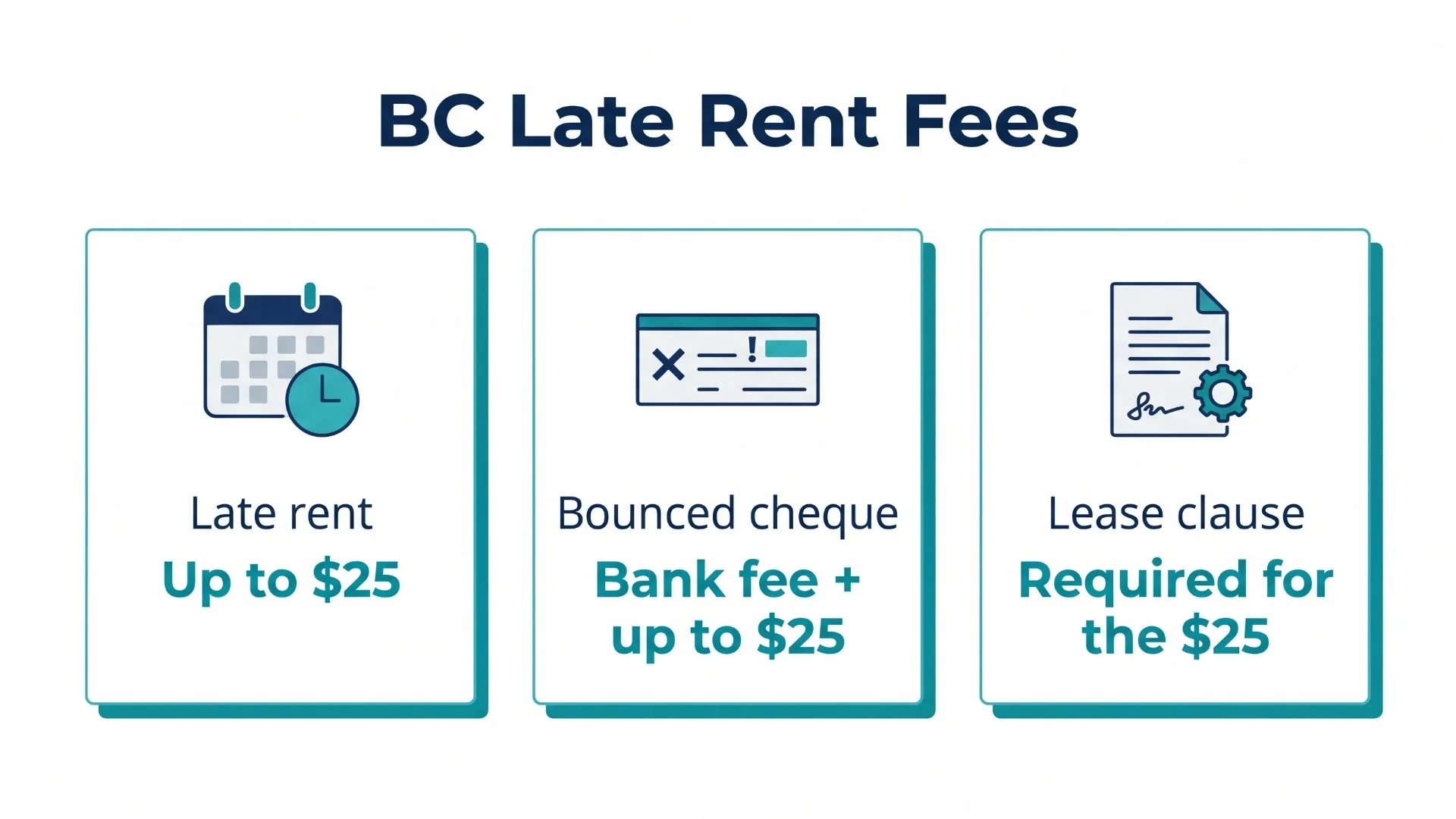
A BC landlord can charge an administration fee of not more than $25 for late payment of rent. That figure comes from section 7(1)(d) of the Residential Tenancy Regulation, which lists the only non-refundable fees a landlord may charge. The same paragraph sets the same $25 ceiling for a tenant's cheque returned by a financial institution.
The $25 is a ceiling, not a daily or weekly rate. A clause that adds $10 a day, a percentage of the rent, or interest on late rent goes beyond what section 7 allows. Section 5 of the Residential Tenancy Act says landlords and tenants cannot contract out of the Act or the regulations, and section 6(3) makes a term inconsistent with them unenforceable.
Does the tenancy agreement have to mention the late fee?

Yes. Section 7(2) of the Regulation says a landlord must not charge the $25 administration fee unless the tenancy agreement provides for that fee. If your agreement is silent, you cannot add a late fee part-way through the tenancy by sending a letter or posting a notice.
When you prepare a new agreement, put the fee in plainly: the amount (no more than $25), that it applies to late rent and to a returned cheque, and the day rent is due. Our guide to what you can and can't add to a BC tenancy agreement covers the other terms that do and don't hold up.
What can a landlord charge when a rent cheque bounces?
Two separate amounts. Section 7(1)(c) lets the landlord recover the service fee the financial institution actually charged the landlord for the returned cheque. Section 7(1)(d) then allows an administration fee of up to $25, but only if the tenancy agreement provides for it.
| Situation | What the landlord may charge | Needs a clause in the agreement? |
|---|---|---|
| Rent paid late | Up to $25 | Yes (s.7(2)) |
| Cheque returned by the bank | The bank's actual service fee | No |
| Cheque returned by the bank | Plus an administration fee of up to $25 | Yes (s.7(2)) |
| Guest staying over | Nothing: guest fees are prohibited (s.5(1)) | Not allowed at all |
Keep the bank's notice of the returned item. If the tenant disputes the charge, it shows what the bank actually took.
What other fees does the Regulation allow?
Section 7(1) is a short list. Besides the late and returned-cheque fees, a landlord may charge the direct cost of replacing keys or access devices, the direct cost of extra keys the tenant asks for, a fee of up to the greater of $15 and 3% of the monthly rent when the tenant asks to move to another unit in the same property (only if the agreement provides for it), a move-in or move-out fee that a strata corporation charges the landlord, and a fee for services or facilities the tenant asks for that the tenancy agreement does not require the landlord to provide.
Section 5 of the Regulation goes the other way. A landlord must not charge a guest fee, whether or not the guest stays overnight, or a fee for keys when the landlord is the one who changed the locks.
Does a late fee replace a 10 Day Notice?
No. The fee is a charge; it is not a remedy for unpaid rent. If rent is unpaid on any day after it is due, section 46 of the Act lets the landlord give a 10 Day Notice to End Tenancy, and the tenant then has 5 days to pay the overdue rent or dispute the notice. Our guide to giving a 10 Day Notice for unpaid rent (RTB-30) walks through it.
Repeated lateness is a separate ground. Section 47(1)(b) allows a One Month Notice for cause when the tenant is repeatedly late paying rent, and RTB Policy Guideline 38 says three late payments are the minimum number sufficient to justify that notice. The guideline adds that a landlord who does not act in a timely manner after the latest late payment may be found to have waived reliance on it. See the One Month Notice for cause (RTB-33).
Can a landlord take a late fee out of the next rent payment or the deposit?
Not on their own say-so. Rent paid is rent. If a tenant pays the rent but not the fee, record the fee as a separate amount owing rather than treating part of the rent as unpaid. A landlord may keep part of a security deposit only with the tenant's written agreement or an RTB order (RTA s.38(4)); otherwise the landlord applies for dispute resolution to recover what is owed. Our BC deposit guide explains the 15-day rule at move-out.
Common mistakes
- A fee above $25. The excess cannot be enforced.
- A daily late fee. The Regulation allows one administration fee, not a running charge.
- No clause in the agreement. Without one, the $25 fee cannot be charged at all.
- Charging a guest fee. It is prohibited, and contravening section 5(1) is an offence under section 32 of the Regulation with a fine of up to $5,000.
- Treating the fee as rent for a 10 Day Notice. A notice for unpaid rent is for rent; keep fees separate on the ledger.
Frequently asked questions
Is a $50 late fee legal in BC?
No. Section 7(1)(d) of the Residential Tenancy Regulation caps the late payment administration fee at $25. A higher figure in a tenancy agreement is unenforceable above that limit.
Can a BC landlord charge interest on late rent?
The Regulation's list of fees a landlord may charge does not include interest on late rent. Stay within the $25 administration fee, and only where the tenancy agreement provides for it.
My agreement has no late fee clause. Can I add one now?
Not on your own. Section 7(2) requires the fee to be in the tenancy agreement, and changing an agreement needs both parties. A new agreement can include it.
Can I charge both the bank's NSF fee and the $25?
Yes, if your agreement provides for the administration fee. Section 7(1)(c) covers the bank's actual service fee and section 7(1)(d) the administration fee of up to $25.
Is e-transfer rent that arrives a day late subject to the fee?
If rent arrives after the due date in the agreement and the agreement provides for a late fee, the $25 administration fee can apply. Keep the transfer confirmation as your record of when it arrived.
The rule is short: one fee, $25 at most, and only if the agreement says so. Everything else about late rent runs through the notices the Act provides.
Put your fees in the agreement
Free BC landlord and tenant forms, ready to fill in.
Free • No signup required