A BC rent receipt is mandatory when the tenant pays in cash: section 26(2) of the Residential Tenancy Act says a landlord must provide a receipt for rent paid in cash. For e-transfers, cheques or pre-authorized debit, the law does not require one, but the Province tells both sides to keep records of every rent payment.
At a glance
- Cash rent: the landlord must give a receipt (RTA s.26(2)), and the standard terms of every BC tenancy agreement repeat it.
- Other methods: no receipt is required by law, but both sides should keep records.
- Post-dated cheques: unused ones go back to the tenant by the last day of the tenancy.
- After a notice to end: a receipt marked "for use and occupancy only" helps show the tenancy was not reinstated.
BC Rent Receipt Checklist
When a BC landlord must give a rent receipt, what it should show, and the records both sides should keep.
Get Free PDF →When does a BC landlord have to give a rent receipt?
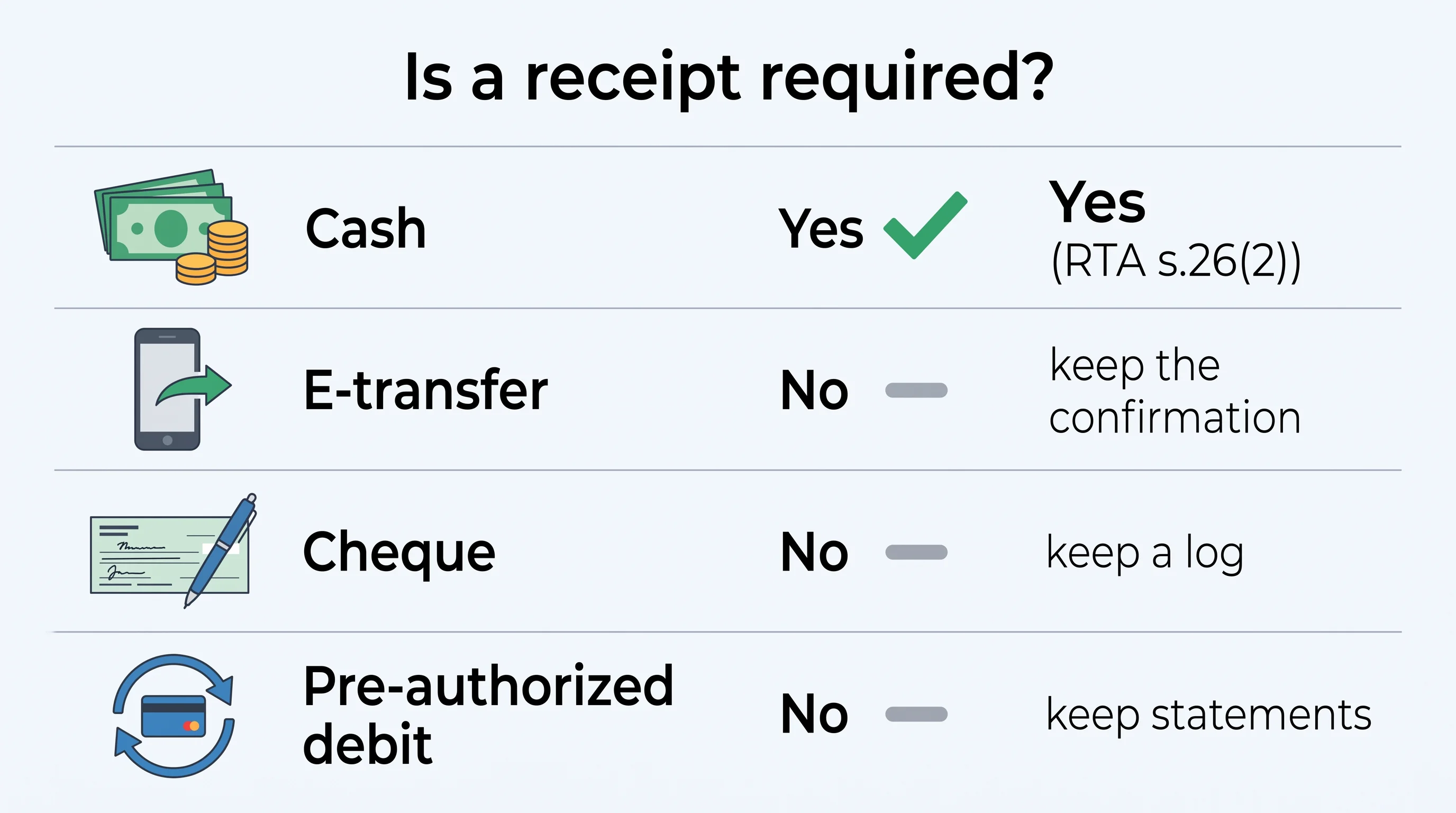
Whenever rent is paid in cash. Section 26(2) of the Residential Tenancy Act says, in full, that a landlord must provide a tenant with a receipt for rent paid in cash. The same duty is in the standard terms the Residential Tenancy Regulation writes into every tenancy agreement: term 5(3) of its Schedule says the landlord must give the tenant a receipt for rent paid in cash.
Because it is in the Act, a landlord cannot contract out of it. A clause saying "no receipts" has no effect; see what you can and can't add to a BC tenancy agreement.
| How rent is paid | Receipt required by law? | Record to keep |
|---|---|---|
| Cash | Yes, RTA s.26(2) | A copy of the receipt |
| E-transfer | No | The transfer confirmation |
| Cheque or post-dated cheques | No | A log of cheques received and cashed |
| Pre-authorized debit | No | Bank statements |
The Province's paying rent page adds that the tenancy agreement must show the rent amount, the due date and the preferred payment method, that landlords and tenants should keep their records of rent payments, and that tenants who pay in cash should get a receipt.
What should a rent receipt show?
The Act does not prescribe a form or list required contents, so the aim is a receipt that would answer an arbitrator's questions on its own. A good receipt shows:
- The rental unit's address
- The tenant's name and the landlord's or agent's name
- The amount received and how it was paid
- The date it was received
- The period it covers, for example "rent for November 2026"
- Any amount still owing for that period
- The signature of the person who took the money
Keep a copy. If the rent is ever disputed, the RTB will look at each side's records.
Do other payments need a receipt?
The Act's receipt rule is about rent paid in cash, but records matter for every payment. A late fee of up to $25 or an NSF charge can only be charged if the tenancy agreement provides for it (Regulation s.7), and a security or pet damage deposit has to be accounted for at the end of the tenancy. Our guide to BC deposits covers that.
Receipts run the other way too. If a tenant pays for an emergency repair, section 33(5) of the Act says the landlord must reimburse them once they claim it with a written account and a receipt for each amount.
Why does a receipt matter after a notice to end tenancy?
Because taking rent after the notice's effective date can look like agreeing to continue the tenancy. RTB Policy Guideline 11 says a landlord may accept rent up to the effective date without waiving the notice, but if the landlord keeps accepting rent for the period after that date without issuing receipts saying it is for "use and occupancy only", it could be implied that both sides intend the tenancy to continue.
So if you have given a 10 Day Notice for unpaid rent or another notice and the tenant pays for a later period, write "for use and occupancy only" on the receipt and tell the tenant in writing.
What happens to post-dated cheques?
Standard term 5(4) of the Regulation's Schedule requires the landlord to return any post-dated rent cheques still in their possession to the tenant on or before the last day of the tenancy. If you collect post-dated cheques, log them so you can account for each one.
Common mistakes
- Taking cash with no receipt. It breaches the Act and leaves the landlord with no proof either.
- A receipt with no period. "Paid $1,800" does not say which month it covers.
- Keeping no copy. A receipt the landlord cannot produce helps only the tenant.
- Taking later rent after a notice without a "use and occupancy" note. It risks the notice.
- Forgetting post-dated cheques at move-out. They must go back by the last day.
How Tenon10 helps
Tenon10 creates the BC tenancy agreement, where the rent amount, due date and payment method are set out, and sends rent reminders so payments arrive on time. It tracks deposits and their return dates and runs move-in and move-out inspection reports. See automating BC rent reminders in Tenon10.
Frequently asked questions
My landlord refuses to give me a receipt for cash rent. What can I do?
Ask in writing, citing section 26(2) of the Residential Tenancy Act. If the landlord still refuses, you can apply to the RTB for dispute resolution for an order that the landlord comply. Until then, consider paying by a traceable method if your agreement allows it.
Is an e-transfer confirmation enough?
The law does not require a receipt for an e-transfer, and the bank's confirmation is a record of the payment. Keep it.
Can a landlord charge for a receipt?
The Regulation lists the fees a landlord may charge, and a receipt is not one of them. Do not charge for one.
What does "use and occupancy only" mean?
It tells the tenant the money is accepted for the time they stay after a notice's effective date, not as rent under a continuing tenancy, as described in Policy Guideline 11.
How long should I keep rent records?
The RTA does not set a period. For landlords, the CRA expects rental income records to be kept for six years, which covers any tenancy dispute too.
The rule fits in a sentence: cash means a receipt. Good practice goes further, with a dated record of every payment, for the right period, kept by both sides.
BC Rent Receipt Checklist
When a BC landlord must give a rent receipt, what it should show, and the records both sides should keep.
Get Free PDF →Put the rent terms in writing
A BC tenancy agreement sets the amount, the due date and how rent is paid.
Free • No signup required