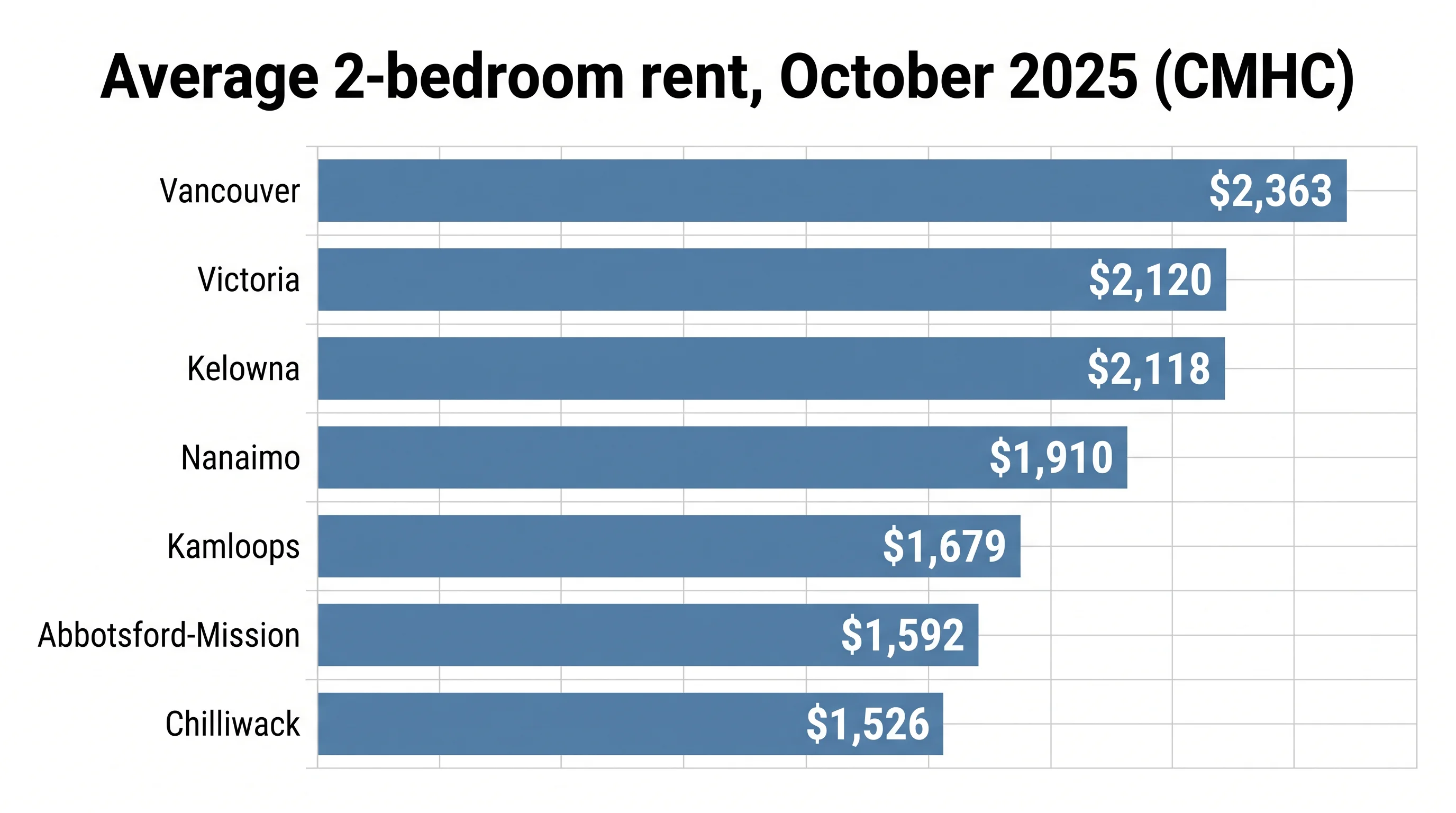
BC average rent by city, from CMHC's 2025 Rental Market Survey taken in October 2025: a two-bedroom purpose-built apartment averaged $2,363 a month in the Vancouver area, $2,120 in Victoria and $2,118 in Kelowna, and $2,065 across BC centres of 10,000 people or more. Vacancy rose in most large markets.
At a glance
- Survey: CMHC Rental Market Survey, October 2025, privately owned purpose-built apartments.
- BC (centres of 10,000+): two-bedroom average $2,065, up 3.6% on the same units; vacancy 3.5%, up from 1.9%.
- Fastest same-unit growth: Prince George 9.4%, Nelson 6.6%, Squamish 5.9%, Abbotsford-Mission 5.3%, Victoria 5.1%.
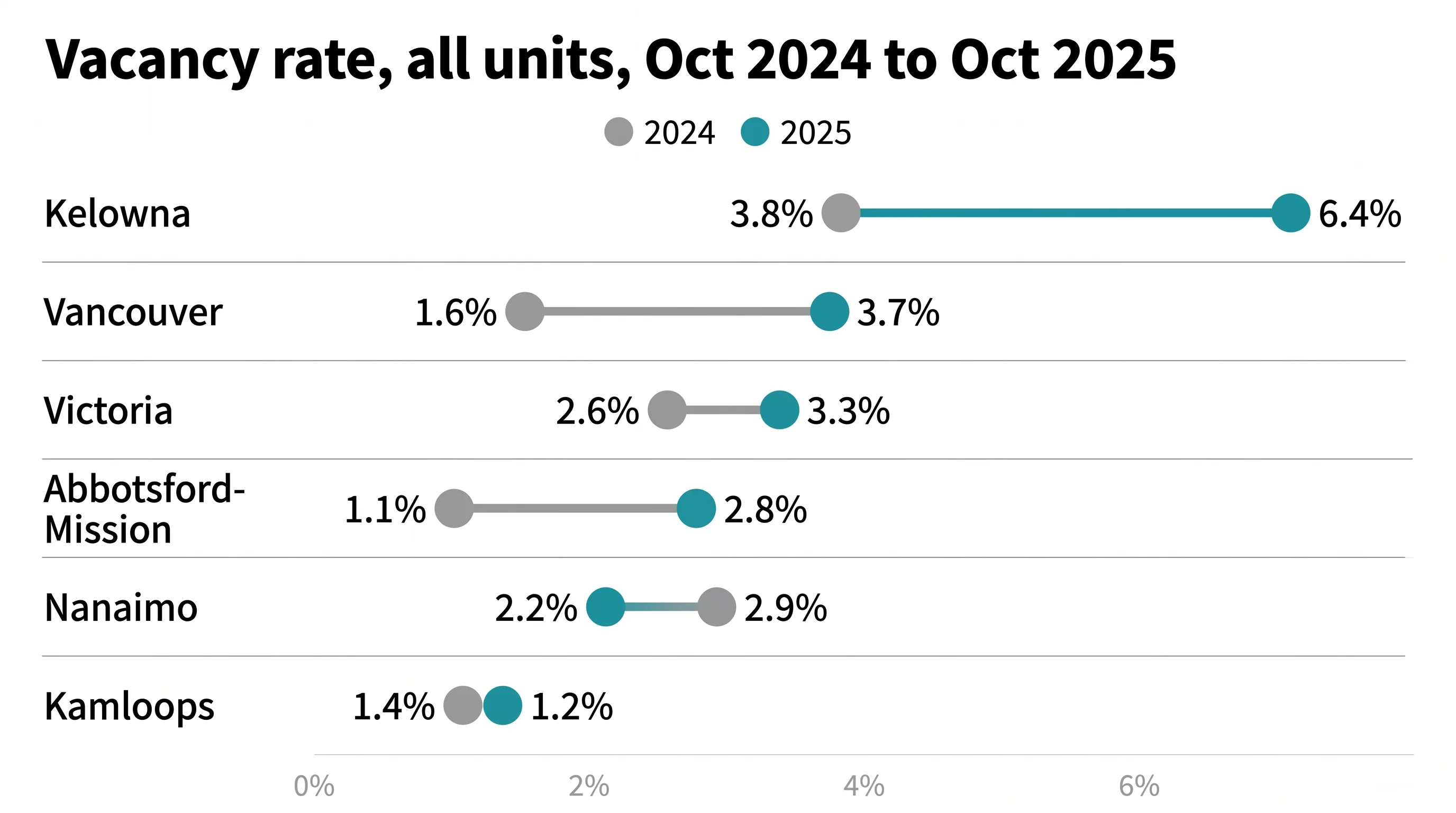
- Biggest vacancy jump: Kelowna, 3.8% to 6.4%; Vancouver, 1.6% to 3.7%.
- No BC centre showed a statistically significant same-unit fall in two-bedroom rent.
Reading BC Rent Data: A Checklist
How landlords and renters can use CMHC's October 2025 Rental Market Survey without misreading it.
Get Free PDF →Where do these numbers come from?
They come from CMHC's Rental Market Survey, which counts rents and vacancies in privately owned purpose-built rental apartments every October. The figures here are from the 2025 survey, published in CMHC's 2025 Rental Market Report and its data tables. They do not cover condos rented by individual owners, basement suites or houses, and they are averages of all surveyed units, occupied and vacant, not asking rents on new listings.
CMHC reports two kinds of change. The average rent compares this year's average with last year's, but the mix of units changes. The same-unit estimate compares only units surveyed in both years, so it is the better measure of how much rents actually moved. We use both below.
What is the average rent in BC's largest cities?
In BC's metropolitan areas the October 2025 two-bedroom average ranged from $1,526 in Chilliwack to $2,363 in Vancouver.
| Metropolitan area | 2-bed average, Oct 2024 | 2-bed average, Oct 2025 | Same-unit change | Vacancy, all units 2024 → 2025 |
|---|---|---|---|---|
| Vancouver | $2,314 | $2,363 | 2.2% | 1.6% → 3.7% |
| Victoria | $1,993 | $2,120 | 5.1% | 2.6% → 3.3% |
| Kelowna | $1,935 | $2,118 | 2.4% | 3.8% → 6.4% |
| Nanaimo | $1,787 | $1,910 | 3.5% | 2.9% → 2.2% |
| Kamloops | $1,531 | $1,679 | suppressed | 1.4% → 1.2% |
| Abbotsford-Mission | $1,493 | $1,592 | 5.3% | 1.1% → 2.8% |
| Chilliwack | $1,402 | $1,526 | suppressed | 1.3% → 3.0% |
"Suppressed" means CMHC did not publish the estimate because the sample was too small or too variable. Within the Vancouver area, the City of Vancouver two-bedroom average was $2,647 and the West End and Downtown $3,081; within Greater Victoria, the City of Victoria was $2,078 and Langford, View Royal, Colwood and Sooke $2,378.
What about BC's smaller cities?
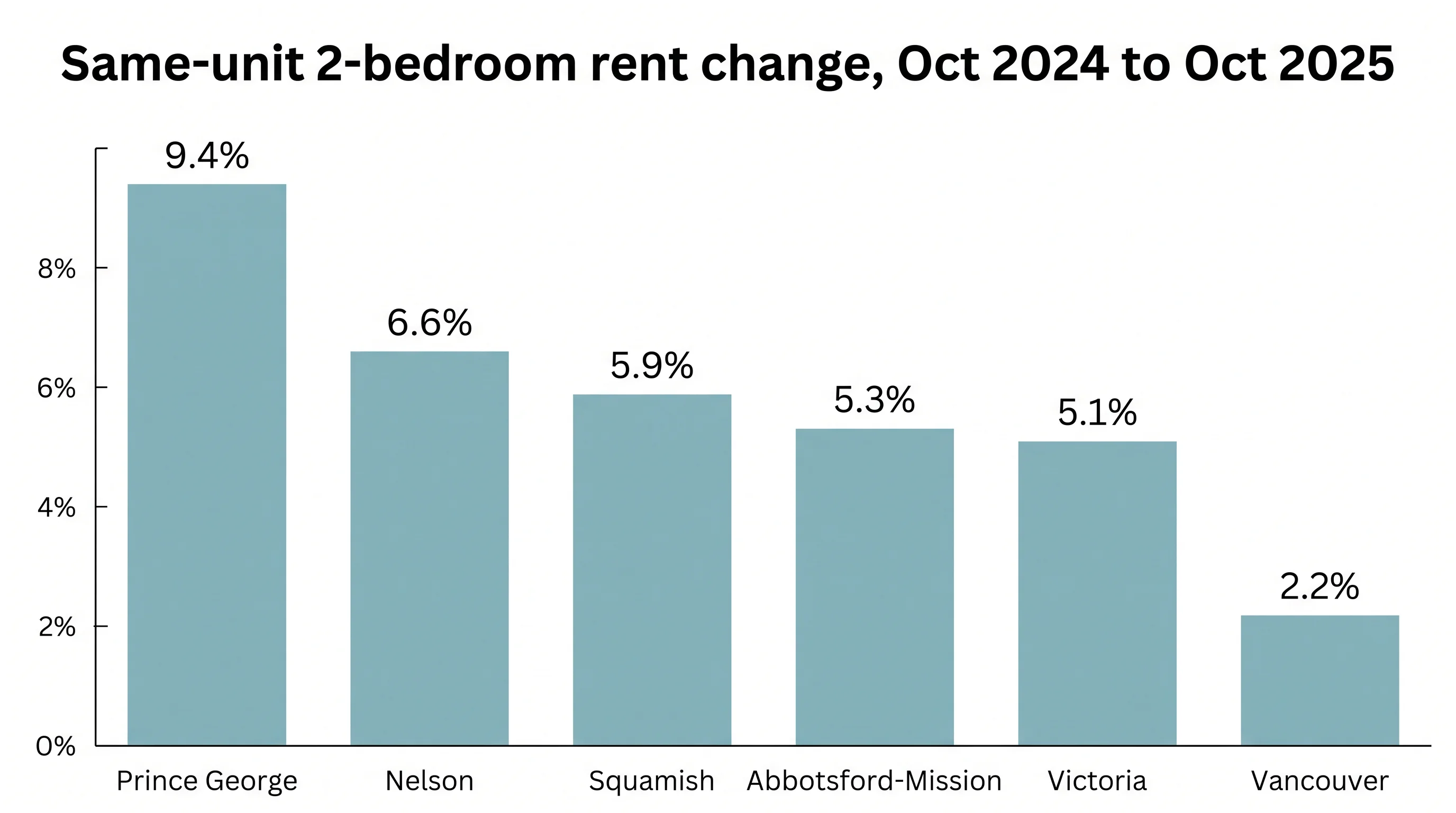
Smaller centres show the fastest rent growth in the survey. Prince George's two-bedroom average rose to $1,409, with a same-unit increase of 9.4%.
| Centre | 2-bed average, Oct 2025 | Same-unit change | Vacancy, all units 2025 |
|---|---|---|---|
| Squamish | $2,180 | 5.9% | 0.2% |
| Courtenay | $1,735 | suppressed | 3.3% |
| Campbell River | $1,689 | not significant | 1.2% |
| Vernon | $1,619 | suppressed | 3.2% |
| Parksville | $1,563 | 4.0% | 0.9% |
| Penticton | $1,473 | suppressed | 2.2% |
| Prince George | $1,409 | 9.4% | 4.5% |
| Nelson | $1,359 | 6.6% | 0.4% |
| Fort St. John | $1,177 | 4.7% | 2.4% |
Are rents falling anywhere in BC?
Not by CMHC's measure. The raw two-bedroom average dipped in Squamish ($2,191 to $2,180), Port Alberni ($1,296 to $1,287) and Prince Rupert ($1,208 to $1,154), but CMHC's same-unit estimate for those places was either an increase (Squamish, 5.9%) or not statistically significant. No BC centre recorded a statistically significant same-unit fall in two-bedroom rent between October 2024 and October 2025.
What did change was vacancy. Across BC centres of 10,000 or more, the overall vacancy rate rose from 1.9% to 3.5%. It rose most in Kelowna and Vancouver, and fell in Kamloops, Nanaimo, Squamish and Fort St. John.
What do the numbers mean for landlords and renters?
For landlords, higher vacancy in Kelowna and Vancouver means vacant units may take longer to fill, so condition and presentation matter more. Two-bedroom units tell the same story: CMHC's two-bedroom vacancy rate rose from 3.6% to 5.2% in Kelowna, from 1.6% to 3.3% in Vancouver, from 2.8% to 3.9% in Prince George and from 2.7% to 3.0% in Victoria. For renters, more choice in those markets can mean room to negotiate on a new lease, such as the start date, a parking spot or the length of the term. Tight markets still exist: in Squamish, Nelson and Parksville, fewer than one unit in a hundred was vacant, so expect competition for any listing there. For anyone already in a tenancy, the rules on increases are set by the Residential Tenancy Act, not the market: see the 2027 rent increase limit for landlords or the renter's guide, and how to dispute an increase.
Common mistakes reading rent data
- Comparing averages across years as if they were the same units. Use the same-unit change.
- Treating the average as an asking rent. It includes long-term tenants.
- Applying apartment data to condos and suites. They are surveyed differently or not at all here.
- Reading a suppressed or not-significant figure as zero. It means CMHC could not measure it reliably.
How Tenon10 helps
Tenon10 creates the BC tenancy agreement, sends rent reminders, runs move-in and move-out inspection reports and tracks deposits and their return dates. If you own a rental in BC while living elsewhere, see managing a BC rental from Ontario.
Frequently asked questions
What is the average rent in Vancouver in 2025?
CMHC's October 2025 survey put the two-bedroom purpose-built average at $2,363 across the Vancouver metropolitan area and $2,647 in the City of Vancouver.
Which BC city has the highest vacancy?
Among BC's metropolitan areas, Kelowna, at 6.4% for all units in October 2025.
Which BC city had the fastest rent growth?
Prince George, with a same-unit two-bedroom increase of 9.4% between October 2024 and October 2025.
When does CMHC publish the next survey?
CMHC surveys every October and publishes its Rental Market Report afterwards. Check its site for the 2026 results.
Does this data include condos?
No. These figures are for privately owned purpose-built rental apartments. CMHC reports rented condominiums separately, and basement suites and rented houses are not in these tables either.
CMHC's 2025 survey shows BC rents still rising on the same units, more slowly in Vancouver and Kelowna, faster in Victoria and the north, with more vacant units than a year earlier in most large markets.
Reading BC Rent Data: A Checklist
How landlords and renters can use CMHC's October 2025 Rental Market Survey without misreading it.
Get Free PDF →Renting in BC?
Start with a BC tenancy agreement and a move-in inspection report.
Free • No signup required