In BC, the Residential Tenancy Branch (RTB) uses the useful life of building elements in Policy Guideline 40 to value damage claims: compensation usually covers only the remaining life of what was damaged, not a brand-new replacement. A 5-year-old dishwasher with a 10-year life, replaced for $900, may justify about $450.
Why does the BC RTB use useful life?
Compensation under RTA ss.7 and 67 should put the claimant back where they were, not better off. Replacing a worn item with a new one is "betterment", so the RTB may reduce an award by the item's age (Policy Guideline 40). The table is a default: a warranty or skipped maintenance can show a longer or shorter life, and the person claiming must file what evidence they have.
Guideline 40 notes that actual life varies with use, weather and climate, installation, maintenance and quality of materials. If a claimant has evidence of an item's useful life and does not file it, the RTB may decline to rely on the table to fill the gap. The same guideline applies to manufactured home park tenancies under MHPTA ss.7, 26 and 60.
How long does the RTB say common items last?
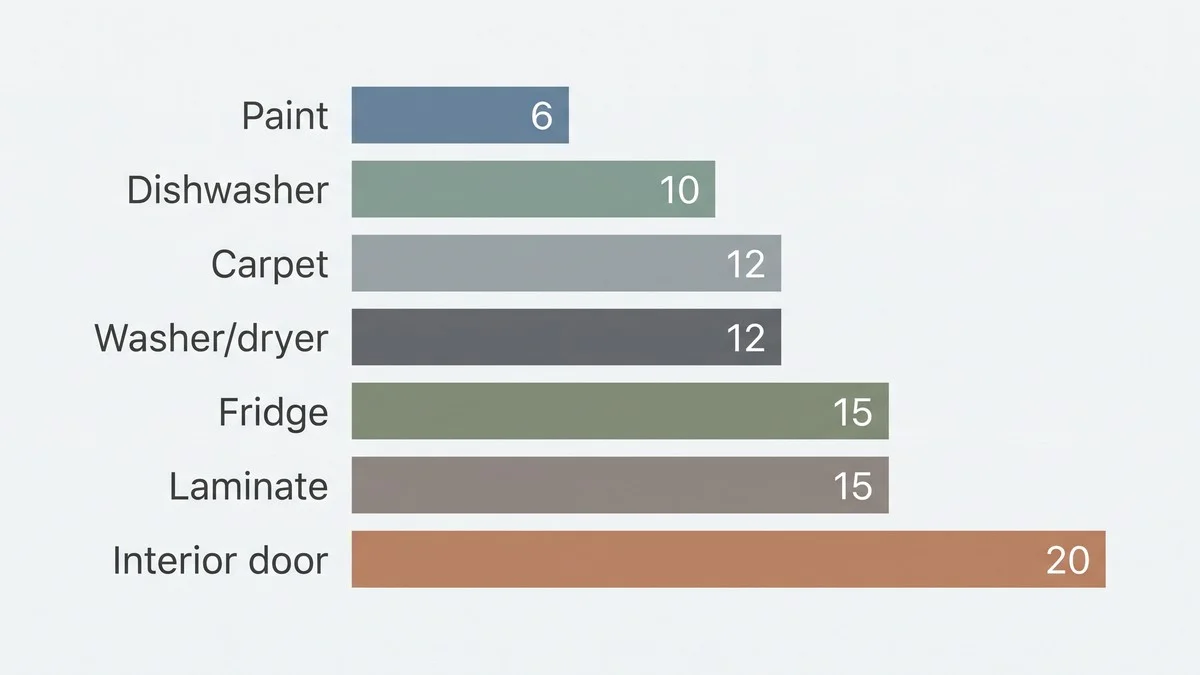
| Item | Estimated useful life (years) |
|---|---|
| Interior paint | 6 |
| Exterior paint | 10 |
| Carpet | 12 |
| Hardwood (until refinishing) | 10 |
| Hardwood (until replacement) | 30 |
| Laminate flooring | 15 |
| Engineered wood, linoleum or ceramic tile | 20 |
| Vinyl flooring | 25 |
| Drywall | 35 |
| Wallpaper | 15 |
| Dishwasher, microwave or garburator | 10 |
| Washer or dryer | 12 |
| Fridge, range or oven | 15 |
| Laminate countertop or laminate/particle board cabinets | 15 |
| Blinds and other window coverings | 15 |
| Window or door screen | 5 |
| Hollow-core interior door | 20 |
| Toilet | 20 |
| Faucets and light fixtures | 15 |
| Hot water tank or furnace | 15 |
| Thermostat, smoke or CO detector | 10 |
For an item the table does not list, the RTB may approximate its life from a similar item in the table.
A rough working is: replacement cost × remaining years ÷ useful life. In a hypothetical case, carpet laid 9 years ago and replaced for $2,400 has 3 of 12 years left, or about $600.
How to work out a claim, step by step
- Confirm it is damage, not reasonable wear and tear. Useful life only matters once a breach is proven.
- Find the install date from invoices, a previous condition inspection report or photos.
- Look up the useful life in the table, or use a warranty or manufacturer's figure if you have one.
- Work out the remaining life at the date of the damage, not the date of the hearing.
- Use the cost of a like-for-like replacement, even if you chose something dearer.
- Apply the formula, then consider whether full cost or nominal damages fits better (below).
Worked example (hypothetical). A landlord repainted a unit four years before the tenancy ended. The tenant's damage means the whole unit must be repainted for $1,500. Interior paint has a 6-year life, so 2 years remain: $1,500 × 2 ÷ 6 = about $500. Had the paint been 7 years old, it would have been past its useful life and a nominal amount at most might be justified.
When can an award be higher or lower?
- Full cost: where the repair leaves no improvement, such as patching a wall a tenant's car hit, or where damage was intentional or grossly negligent.
- Nominal damages: where an item was past its useful life but still working, such as 50-year-old floor finish.
- Like for like: replacing damaged carpet with dearer vinyl plank may be valued at the cost of new carpet.
- Used items: the RTB may count an item's age when it was installed.
- Antique, rare or collectible items: these may gain value with age, so a professional appraisal or documented insured value helps prove the claim.
Evidence can move the result either way. In Guideline 40's own example, a landlord who proved that original, 50-year-old floor finish was in excellent condition before the damage may recover more than nominal damages.
Damage must first be more than wear and tear; see damage or wear and tear in BC and condition inspections, and more in the BC Deposit Series.
Useful life and the security deposit
A landlord cannot simply deduct a depreciated figure from the deposit. Within 15 days after the later of the end of the tenancy and receiving the tenant's forwarding address in writing, the landlord must either repay the deposit with interest or apply for dispute resolution to claim against it (RTA s.38(1)). An amount may be kept only if the tenant agrees in writing at the end of the tenancy, the RTB orders it, or it is an earlier RTB order that remains unpaid (s.38(3)–(4)). The timing is set out in the 15-day rule for BC deposits.
Common mistakes
- Claiming the new-item price for something halfway through its life.
- No install date. The claimant carries the burden of proof (RTB Rules of Procedure, rule 6.6).
- Upgrading and claiming the upgrade, such as vinyl plank in place of carpet.
- Ignoring maintenance records. Skipped manufacturer maintenance can support a shorter life; a warranty can support a longer one.
- Late or unreadable evidence. See preparing evidence for an RTB hearing.
Frequently asked questions
Is the Guideline 40 table binding?
No. It is a guide the RTB may rely on when no better evidence exists, such as a warranty or proof of condition.
Can a landlord charge for repainting after a long tenancy?
Interior paint has a 6-year estimated life, so paint older than that often has little remaining value to claim.
Does useful life apply to additional rent increases?
Yes. The RTB may refer to the table when deciding whether a component was near the end of its life or will recur within 5 years.
Does it apply to tenants' claims too?
Yes. Guideline 40 applies to compensation claims by either landlord or tenant.
The item was second-hand when installed. Does that change things?
It can. The RTB may count the item's age at installation when working out how much useful life was left.
The fridge was 20 years old but still worked. Is anything owed?
Possibly a small amount. Guideline 40 says an item at or past the end of its useful life that still functions likely has some value, so nominal damages may be awarded if it is damaged or destroyed.
Is the remaining life measured at move-out or at the hearing?
At the time the damage occurred. Guideline 40 adjusts for betterment by looking at the damaged item's remaining useful life at that point.
Record condition from day one
The BC Condition Inspection Report (RTB-27) is your evidence of what each item looked like at move-in.
Free • No signup required