In mobile home parks and land lease communities in Ontario, a tenant who owns the home and rents the site is covered by the Residential Tenancies Act, 2006 plus the extra rules in Part X (ss.152-167). They cover written park rules, your right to sell the home without the landlord's consent, assignment to a buyer, limited entry and exit fees, and a one-year notice for demolition or repairs.
Everything else in the Act, from rent increases to repairs, still applies. This guide explains what Part X adds for residents. For more renter guides, see the Ontario Tenant Resource Center.
Mobile Home Parks and Land Lease Communities: Tenant Checklist
A one-page checklist for Ontario residents who own their home and rent the site: park rules, selling, assignment, fees, repairs and notice.
Get Free PDF →Who does Part X cover?
Part X applies to tenancies in mobile home parks, and with necessary modifications to land lease communities (s.152). The Act defines them in s.2(1):
- Mobile home: a dwelling designed to be made mobile and used as a permanent residence.
- Land lease home: a permanent dwelling, other than a mobile home, where the owner of the dwelling leases the land it sits on.
- Park or community: the land with the occupied homes, plus the common structures, services and facilities the landlord keeps.
"Your mobile home" in Part X means a home you own, sitting in your landlord's park (s.153).
Park rules must be in writing

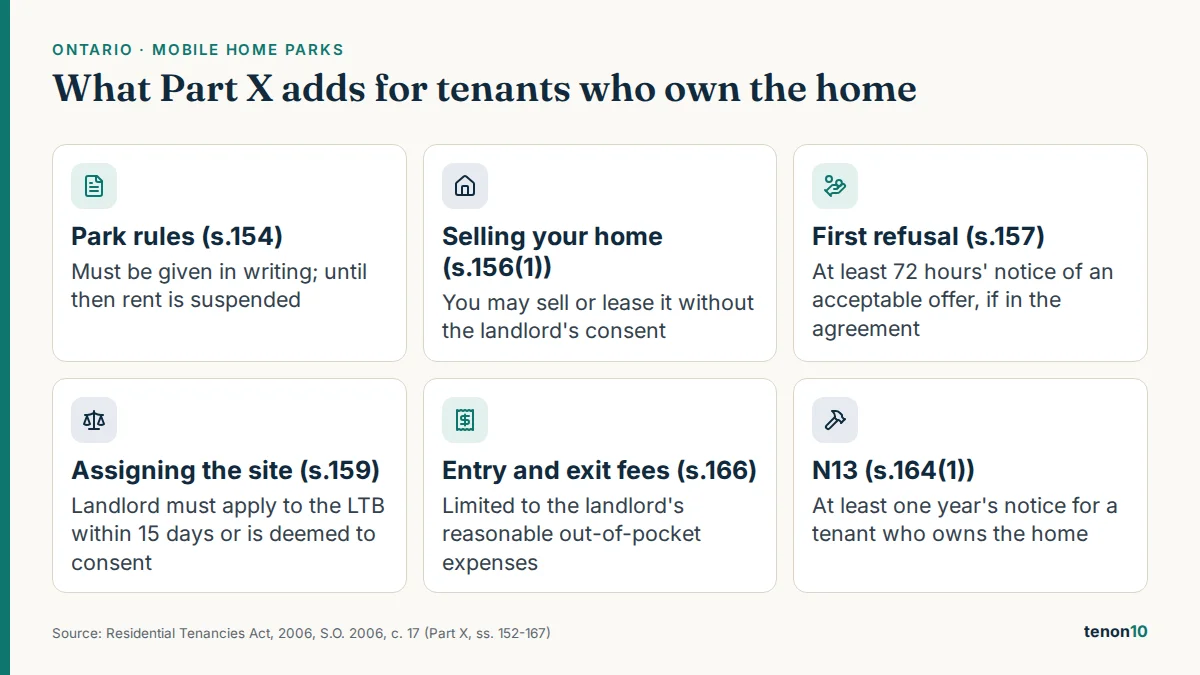
If the landlord sets park rules, each tenant must get a written copy, and written notice of any change (s.154(1)). Until the landlord does, the tenant's obligation to pay rent is suspended and the landlord cannot demand it. Once the landlord complies, it may require the withheld rent (s.154(2)-(3)). That means the rent is paused, not forgiven.
Property taxes on your home

If you reimburse the landlord for property taxes on your home, the landlord must promptly give you a copy of any Municipal Property Assessment Corporation (MPAC) information on its value (s.155(1)). Your obligation to pay that tax amount is suspended while the landlord has not passed on the latest information, or has not obtained MPAC information in the previous 12 months without having made reasonable efforts (s.155(2)-(3)).
Selling your home
- No consent needed. You may sell or lease your home without the landlord's consent (s.156(1)).
- The landlord as your agent? Only under a written agency contract; a lease clause forcing you to use the landlord as agent is void (s.156(2)-(3)).
- Right of first refusal. If your agreement gives the landlord one, give the landlord at least 72 hours' notice of an acceptable offer before accepting it. The landlord may buy at the offer's price and terms, never at a lower price (s.157).
- For-sale signs. The landlord cannot stop a sign in your window unless the ban applies to everyone and the landlord provides a free, prominent, publicly accessible bulletin board instead (s.158).
Passing the site to your buyer
If you have sold or agreed to sell the home and ask the landlord to consent to assigning the site to the buyer, the landlord cannot refuse unless the Landlord and Tenant Board finds the grounds reasonable. The landlord must apply within 15 days of your request, setting out its grounds; otherwise it is deemed to consent (s.159). See subletting vs assignment for how assignment works generally.
On that assignment, the landlord may raise the buyer's rent by no more than the prescribed amount: the greater of $50 a month and the guideline-plus-AGI increase the landlord could have taken before the first anniversary had you stayed (s.165; O. Reg. 516/06, s.50).
Fees, suppliers and repairs
- Entry and exit fees. Charges for moving a home in or out, installing or removing it, or testing water or sewage are limited to the landlord's reasonable out-of-pocket expenses (s.166).
- Your choice of supplier. The landlord cannot restrict who you buy goods or services from, though it may set reasonable standards for mobile home equipment (s.160).
- Park upkeep. On top of the general repair duty, the landlord handles garbage removal, roads and snow clearing, water, sewage, fuel, drainage and electrical systems, common buildings, and damage it causes to your property through wilful or negligent conduct (s.161). If repairs stall, see the T6 application.
Site rent still follows the ordinary rules: A rent increase needs at least 90 days' written notice (s.116) and, unless an exception applies, stays within the guideline, which is 1.9% for 2027 (s.120). For an above-guideline increase for government-required infrastructure work, such as roads, water, sewage, drainage or electrical systems, the Board may set the number of years over which it is taken (s.167).
If the landlord ends the tenancy for demolition or repairs
For a tenant who owns the home, an N13 under s.50 needs at least one year's notice, ending at the end of a rental period or fixed term (s.164(1)). Any compensation owed under s.52, 54 or 55 is the lesser of one year's rent and $3,000 or a prescribed amount, whichever is greater (s.164(2)). See the N13 guide.
If a home is left behind
After a tenancy ends, the landlord cannot dispose of the home without notice by registered mail to your last known address and in a local newspaper. It may act 60 days after those notices if you make no claim. If you claim within six months, you can get the home back if the landlord kept it, or the sale proceeds above its reasonable costs and any rent arrears if it sold (s.162).
Frequently asked questions
Does the Residential Tenancies Act cover land lease homes in Ontario?
Yes. Part X applies to land lease communities as if they were mobile home parks (s.152(2)).
Can my park landlord stop me from selling my home?
No. You may sell without consent (s.156(1)); a landlord can only object to assigning the site through a Board application within 15 days (s.159).
Can the landlord charge a fee to move my home out?
Only its reasonable out-of-pocket expenses (s.166).
Mobile Home Parks and Land Lease Communities: Tenant Checklist
A one-page checklist for Ontario residents who own their home and rent the site: park rules, selling, assignment, fees, repairs and notice.
Get Free PDF →Key takeaways
- Park rules must be given in writing; until then rent is suspended.
- You can sell your home without consent; site assignment needs a Board ruling to refuse.
- Entry and exit fees are limited to out-of-pocket costs.
- A demolition or repair N13 needs a year's notice for a home owner.
Primary source: the Residential Tenancies Act, 2006, Part X.
Know your rights on site
Free Ontario tenant forms with plain-language instructions.
Free • No signup required