Overview
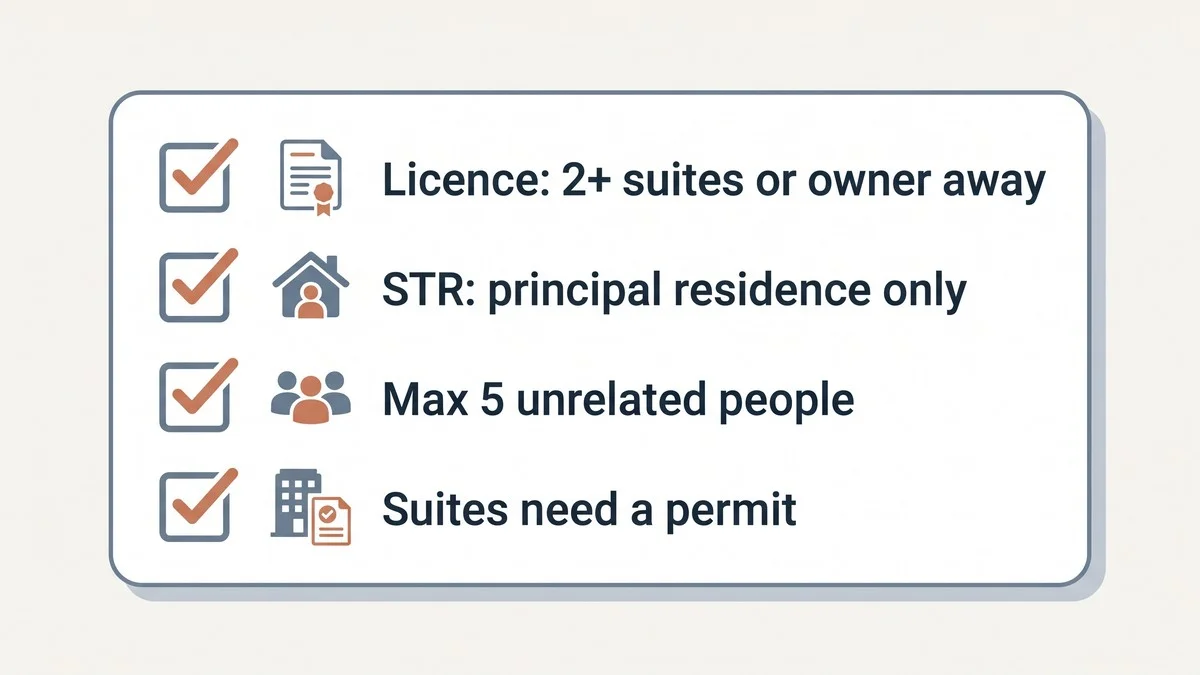
Renting out property in Kamloops means following two sets of rules: the City of Kamloops's zoning and business licence bylaws, amended in May 2025, and BC's Residential Tenancy Act for every long-term tenancy. The city's rules turn on how many suites you rent, whether you live on the property, and whether stays are short-term.
Key Points
When does a long-term landlord need a business licence?
According to the city's short-term rental page, a business licence is required to rent, for 30 days or more:
- two or more suites on one property (for example, a basement suite plus a carriage house or garden suite); or
- a house with a suite, where the owner does not live on the property.
What are the short-term rental rules?
A licence is required for stays under 30 days, and for monthly rentals under 90 days advertised on a platform. The licence number must appear on every listing, and the platform must remove a non-compliant listing at the city's request. A short-term rental must:
- be a room or unit (a basement suite, carriage house or the whole house) on the owner's principal residence;
- take one booking at a time on the lot;
- keep the whole dwelling to five unrelated people, or, for a family of three or more, no more than two renters in total;
- pass an inspection, and the host signs a good neighbour agreement;
- have strata approval if it is in a strata, plus proof of ownership and principal residence.
It is not allowed on a property with two or more suites, with an illegal suite, or alongside a home daycare, residential care home or client-facing home business. Kamloops is also on the province's list of communities where the principal residence requirement applies, and hosts must register with the provincial registry. See registering as a host.
Working out the guest limit
The city counts everyone living in the dwelling long term, including family, boarders and lodgers, toward the cap. Two examples of how that plays out:
- An owner who lives alone with one roommate has two unrelated people in the home, so no more than three short-term guests can stay at once to stay within five.
- A couple living with their child is a family of three, so the combined total of boarders, lodgers and short-term guests is limited to two.
The province has required every short-term rental host and platform in BC to be on the provincial registry since May 1, 2025. The city notes that the province monitors compliance, issues compliance orders and administers penalties under the provincial rules, which include complying with local zoning and business licence bylaws.
Suites in Kamloops after the 2024 zoning changes
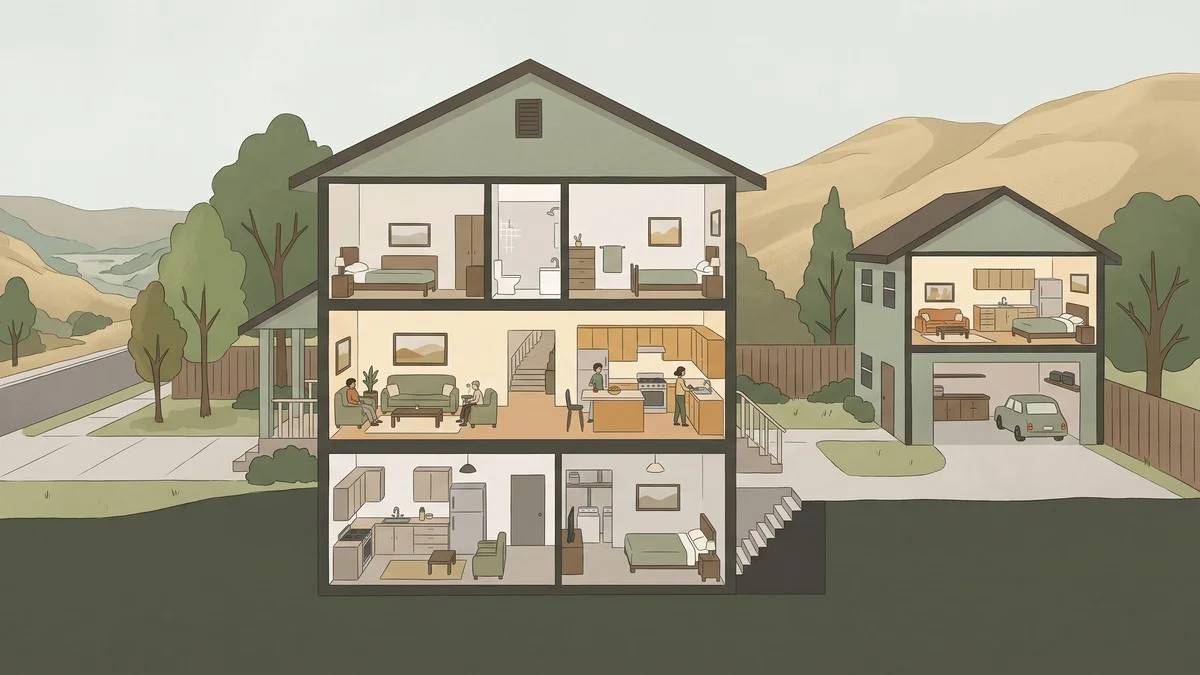
The city's residential suites page says its zoning was updated in June 2024 to comply with the province's Bill 44 small-scale housing changes:
- one residential suite (a carriage suite, garden suite or secondary suite) is permitted on lots zoned R5, R6, R7, R8, CR1, CR2, CR3 or A1, except in a duplex or on a lot in the Rayleigh Waterworks District;
- multiple dwelling units, which may include suites, are permitted on lots zoned R1, R2, R3 or R4;
- carriage and garden suites may be strata-titled, but secondary suites may not.
Zoning is not the whole test. Every suite must also meet the BC Building Code, the Subdivision and Development Control Bylaw and other regulations, and the city warns that servicing limits can restrict the number of units below what zoning allows.
How to check whether a suite is legal
A legal suite in Kamloops is one constructed or upgraded under a valid building permit, which is how the city confirms life-safety items such as smoke alarms and egress. Legalizing an older suite may need renovations to meet the Building Code. Useful city tools:
- Residential Suite Registry, an interactive map of suites built under a permit and in line with zoning, which owners can use to stand out to renters and tenants can use to check a suite;
- CityMap, where the zoning layer is off by default and is switched on under Planning and Development, then Zoning;
- Property Information Portal, for property-by-property detail; and
- Secondary Suite Construction Requirements Guide and the Residential Suite Compliance Policy.
Applying for and renewing a Kamloops business licence
The city's business licensing FAQ sets out the process under Business Licence and Regulation Bylaw No. 9-60 and Fees and Charges Bylaw No. 44-14:
- Apply online through eApply with a MyCity account, or at the kiosk at 105 Seymour Street. You need the business name, address, contact details, start date and a short description, and a $15 non-refundable application fee.
- Other licence fees are invoiced after the application is reviewed and are due on receipt.
- Processing takes two to four business days for a home-based or non-resident business and 12 to 16 for a commercial one, longer where inspections are needed; ask Business Licensing which category your rental falls into.
- Renew by January 1 each year. Invoices go out around mid-November, and a $25 late charge is added to payments received after January 15.
Which BC rules apply to every long-term tenancy?
- Use a written tenancy agreement; see the RTB-1 guide.
- A security deposit is capped at half a month's rent.
- Rent can rise once every 12 months with three full months' notice, up to 2.2% in 2027; see the 2027 limit.
- The tenant must get a copy of the signed agreement within 21 days (RTA s.13(3)).
- At move-out, the landlord has 15 days from the later of the tenancy ending and getting the tenant's forwarding address in writing to return the deposit or apply to claim against it (s.38).
Action Steps
- Count the suites you rent and decide whether you need a business licence (contact Business Licensing, 250-828-3481).
- Confirm every suite was built under a building permit.
- For short-term rentals, get the city business licence and register with the provincial registry before listing.
- Sign tenants to BC's standard agreement.
Frequently asked questions
I live upstairs and rent out one basement suite long term. Do I need a licence?
The city's FAQ names two long-term cases that need a licence: two or more suites on a property, or a house with a suite where the owner does not live on the property. One suite rented while you live there is not one of them, but confirm with Business Licensing before you rely on it.
Can I run a short-term rental if I also have a carriage house and a basement suite?
No. Kamloops does not permit a short-term rental on a property with two or more suites.
Who handles a dispute with my tenant?
The Residential Tenancy Branch, not the city. See how to file a dispute resolution application, and the BC Landlord Resource Center for the rest of the provincial rules.
Start your Kamloops tenancy right
Fill in BC's standard Residential Tenancy Agreement online.
Free • No signup required