When a tenant refuses pest control in Ontario, a landlord's options run through the Landlord and Tenant Board (LTB), not the door. Check the 24-hour notice was valid (RTA s.27), offer accommodation, then serve an N5 for substantial interference and claim wasted-visit costs on an L2 (s.88.1). Never force entry or change locks.
The notice went out, the pest control provider is booked, and the tenant says no. Or the tenant lets the technician in, but nothing has been prepared and the treatment cannot go ahead. In a multi-unit building one refusal can undo the treatment of every unit around it. This guide sets out what a landlord can and cannot do under the law in force after the Bill 60 changes of September 21, 2026. For the wider rules on who pays for pests, see our overview of pest control responsibilities in Ontario.
Does a tenant have to allow pest control in Ontario?
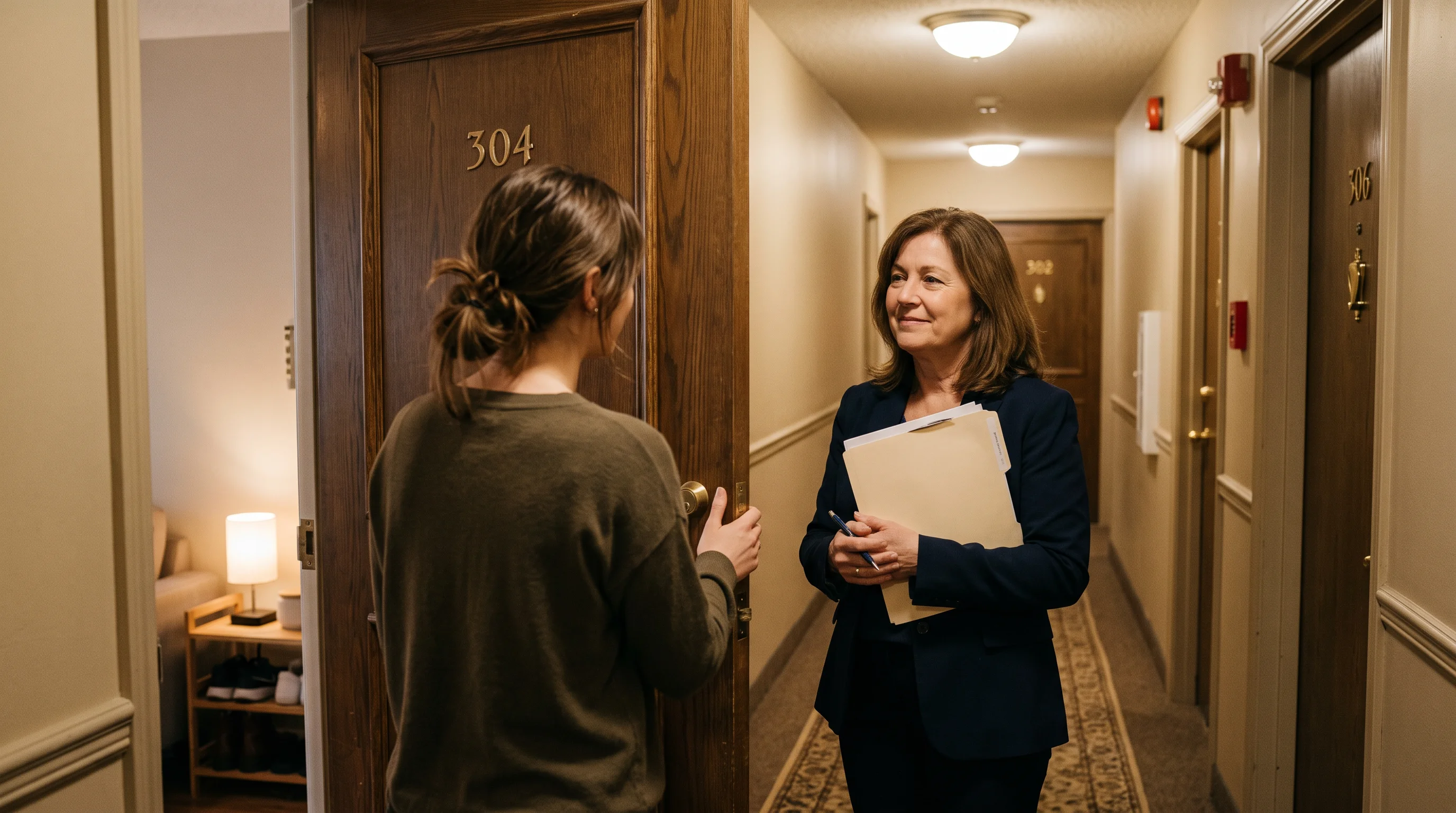
Yes, if the landlord gave valid written notice: in Ontario the entry is then lawful without the tenant's consent. Section 27(1) of the Residential Tenancies Act, 2006 (RTA) lets a landlord enter "in accordance with written notice given to the tenant at least 24 hours before the time of entry" to do work in the unit or carry out a reasonable inspection, and section 27(3) requires the notice to state the reason, the day and a time between 8 a.m. and 8 p.m. Our guide to the notice to give before a pest treatment covers the details.
So the first question when a tenant refuses is: was the notice valid? Check that it was in writing, gave at least 24 hours, named the reason, day and a time within 8 a.m. to 8 p.m., and was delivered in a recognised way (by hand, in the mail box, posted on the door under Rule 3.2 of the LTB Rules, or by email only if the tenant consented in writing). If any of that is missing, re-serve the notice before going further.
What must an Ontario landlord not do when a tenant refuses entry?
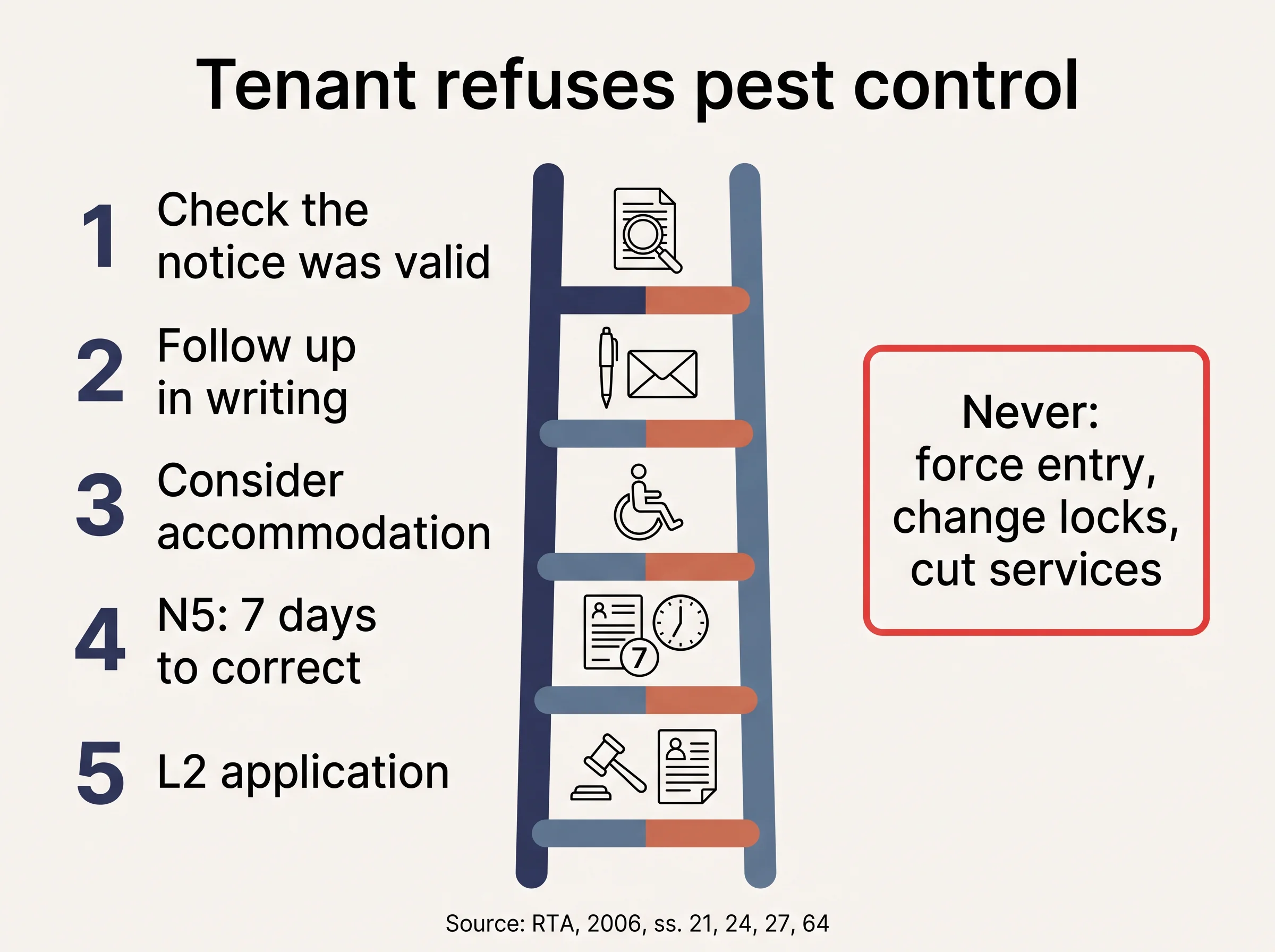
An Ontario landlord must not force the door, change the locks, cut services or treat a routine treatment as an emergency; each can lead to a tenant application and a fine. The RTA rules:
- Do not force the door or change the locks. Section 24 of the RTA forbids altering the locking system without giving the tenant replacement keys.
- Do not cut services or threaten. Section 21 forbids withholding vital services, and section 23 forbids harassing, obstructing, coercing, threatening or interfering with a tenant.
- Do not call it an emergency when it is not. Section 26(1)(a) allows entry without notice "in cases of emergency." A routine treatment for bed bugs, cockroaches or mice is normally not one.
A tenant can bring a T2 application for illegal entry or harassment (RTA s.29(1), paragraphs 4 and 6), and section 31 lets the LTB order an abatement, compensation and an administrative fine.
What should an Ontario landlord do first after a refused pest treatment?
Put it in writing. After a refused visit in Ontario, send the tenant a short letter with the date and time of the notice, what happened at the door, why the treatment matters for the building, a new date with a fresh notice, and an offer of help with preparation. That letter is often enough. It is also the first exhibit if the matter reaches the LTB. Our tenant communication templates guide shows how to keep the tone firm and factual.
When must an Ontario landlord accommodate a tenant who cannot prepare the unit?
When the reason is a disability, such as a tenant who cannot lift, bag or move furniture, Ontario's Human Rights Code requires the landlord to accommodate to the point of undue hardship. The Ontario Human Rights Commission says that before sanctioning someone for conduct, an organization must first consider whether a disability is the cause. Practical accommodations include arranging help to prepare the unit, a later date, or a treatment method with less preparation if the provider offers one.
When can an Ontario landlord serve an N5 for refusing pest control?
An Ontario landlord can serve an N5, Notice to End your Tenancy for Interfering with Others, Damage or Overcrowding, when a tenant keeps refusing after valid notice and the conduct substantially interferes with the landlord's lawful rights or other tenants (RTA s.64(1)). Section 64(1) covers conduct that "substantially interferes with the reasonable enjoyment of the residential complex" or "substantially interferes with another lawful right, privilege or interest of the landlord or another tenant." Entering on a valid section 27 notice is one of the landlord's lawful rights; other tenants whose units keep getting reinfested may be affected too.
Whether a refusal is "substantial" is for the LTB to decide on the facts. On a conservative reading, one missed appointment that the tenant quickly rescheduled is unlikely to be enough on its own, while repeated refusals after clear notice, in a building where the infestation is spreading, make a stronger case.
| N5 rule | What the Act says |
|---|---|
| First N5: termination date | At least 20 days after the notice is given (s.64(2)(a)) |
| Chance to fix it | The notice must require the tenant to stop the conduct or correct the omission within 7 days (s.64(2)(c)) |
| If the tenant complies | The notice is void if the tenant complies within 7 days (s.64(3)), for example by allowing and preparing for the treatment |
| When the landlord can apply | Not before the 7-day period ends (s.70), and no later than 30 days after the termination date (s.69(2)), using the L2 application |
| Second N5 within 6 months | If it happens again more than 7 days but less than 6 months after the first N5, a second notice with at least 14 days can be given and cannot be voided (s.68) |
Use the current LTB forms: the N5 and L2 on the LTB forms page are dated 2026/09, and the LTB stops accepting earlier versions of those two forms on November 30, 2026. Our complete guide to N5 notices walks through filling one in.
Can an Ontario landlord recover the cost of a wasted pest control visit?
Yes, through the LTB: section 88.1 of Ontario's RTA lets a landlord apply for "reasonable out-of-pocket expenses" caused by a tenant's conduct that substantially interferes with the landlord's reasonable enjoyment or lawful rights. A refusal often costs money: a cancellation fee, a second trip, or treating neighbouring units again. On the L2 form this is Part 3, Reason 5. It can be claimed while the tenant is in possession, or up to one year after the tenant moves out (s.88.1(2)). Keep the provider's invoice showing the wasted visit.
If the tenant's conduct caused damage instead (for example, damage to the unit from an infestation the tenant wilfully or negligently caused), section 89 and L2 Part 3, Reason 4 apply. Do not claim the same cost twice: section 88.1(4) excludes costs recoverable under section 89.
Is obstructing pest control a by-law issue in Toronto?
Yes. In Toronto, Chapter 629 requires every occupant to "co-operate with the landlord in complying with the requirements of this chapter," and the chapter requires all properties to be kept free of pests. In apartment buildings covered by Chapter 354 (RentSafeTO), section 354-3.3F says "No person shall obstruct the extermination of the pests." Those are municipal enforcement tools, separate from the LTB. See our guide to Toronto's pest control rules for rentals.
Choosing a licensed pest control provider in Ontario: what should you confirm?
In Ontario, confirm that the business holds an operator licence and the person treating holds an exterminator licence under the Pesticides Act. A provider that sends clear preparation sheets, explains its products and will return at a time that suits the tenant prevents many refusals. See our guide to hiring a licensed exterminator in Ontario.
How can Tenon10 help when a tenant refuses entry?
Tenon10 keeps the paper trail an LTB application needs. On plans that include scheduled maintenance, you can book each pest control visit for a unit, with the 24-hour and 8 a.m. to 8 p.m. rules checked and a Notice of Entry emailed to tenants. Email is valid service only for tenants who consented to it in writing. Free N5 and L2 forms are on our forms pages.
Frequently asked questions
Can a tenant refuse pest control in Ontario?
A tenant can object, but a valid 24-hour written notice under RTA section 27 makes the entry lawful without consent. Repeated refusal can lead to an N5 and an LTB application.
Can an Ontario landlord evict a tenant for refusing pest treatment?
Possibly, through an N5 and an L2 application, if the LTB finds substantial interference and the tenant did not correct it within 7 days. The LTB must consider all the circumstances under section 83 and can refuse or delay the eviction.
Can I charge an Ontario tenant for the missed appointment?
You can apply to the LTB for reasonable out-of-pocket expenses under section 88.1 (L2, Part 3, Reason 5). You cannot simply add a fee to the rent.
Can I enter anyway if the tenant says no?
The RTA authorizes entry on valid notice, but do not use force or change locks. If a tenant physically blocks the door, leave, document it and use the LTB routes.
What if the tenant cannot prepare the unit?
If the reason is disability-related, an Ontario landlord must accommodate to the point of undue hardship under the Human Rights Code. That can mean arranging help with preparation or choosing a later date.
Which Ontario guides cover refused entry and N5 notices?
- Pest control notice to tenants in Ontario
- N5 Notices in Ontario: A Complete Guide
- The 24-Hour Notice of Entry Rule in Ontario
- The LTB process, end to end
- Tenant communication templates for Ontario landlords
Have the record ready before you need it
Every scheduled visit, Notice of Entry and maintenance request for your Ontario units, in one place in Tenon10.
Built for Canadian landlords and property managers.