

Mice in an Ontario rental are the landlord's to treat and seal out: O. Reg. 517/06 s.46 (or the city's by-law) requires the building be kept reasonably free of rodents and openings sealed, and RTA s.20 makes that the landlord's duty. Raccoons and squirrels are a building problem too, but removal follows Ontario's Fish and Wildlife Conservation Act.
Late fall is when mice start looking for a warm way into Ontario buildings, and raccoons and squirrels start looking at attics. In a rental, the questions follow quickly: is this the landlord's problem or the tenant's, can the animal just be trapped and driven away, and what if it is a bat? For insects and the general split of duties, see our overview of pest control responsibilities in an Ontario rental.
Who deals with mice and rats in an Ontario rental?
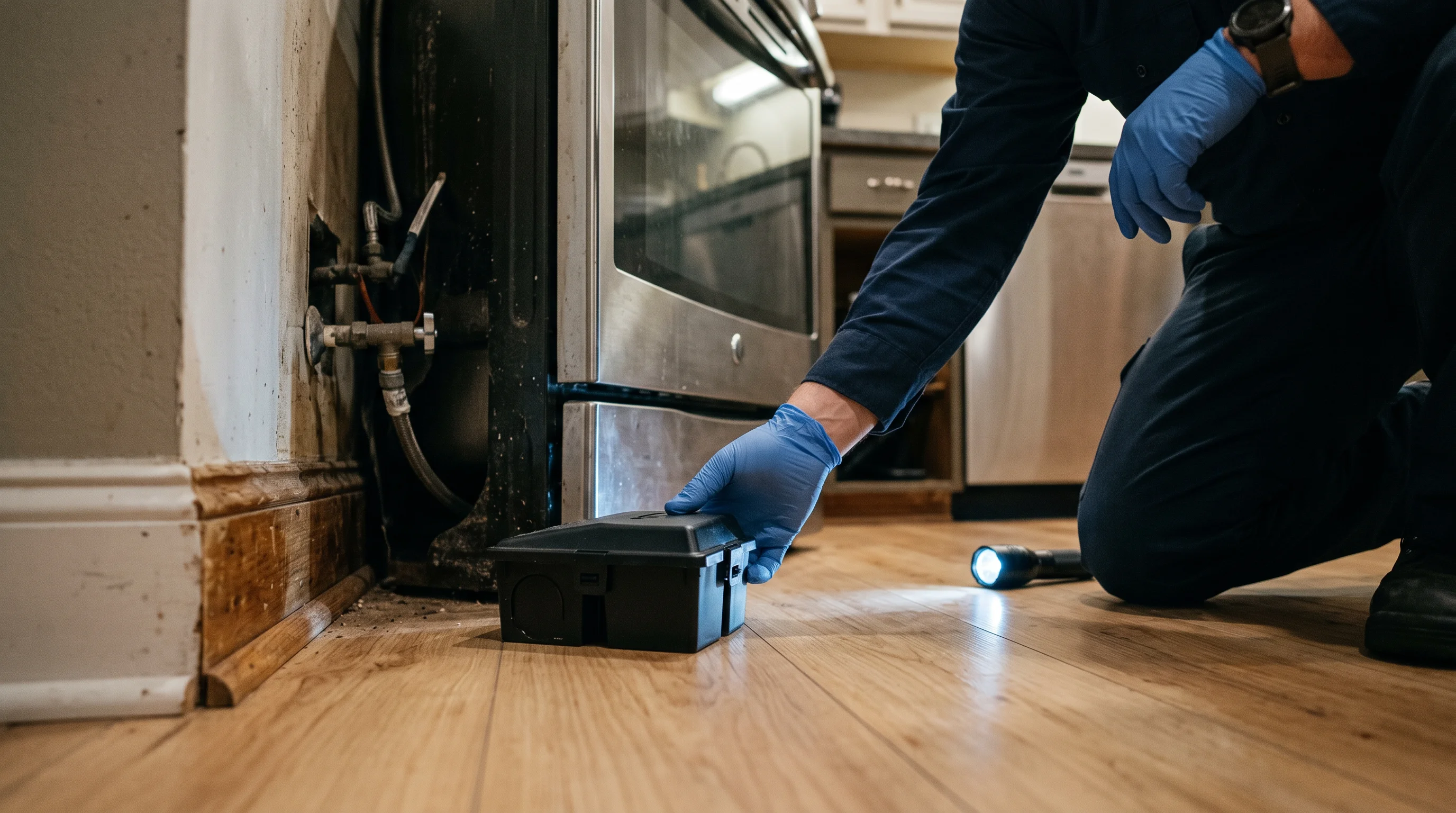
The landlord, as a rule. Section 20(1) of Ontario's Residential Tenancies Act, 2006 (RTA) makes the landlord responsible for keeping the building and every unit in a good state of repair and fit for habitation, and for complying with health, safety, housing and maintenance standards. The provincial maintenance standards in O. Reg. 517/06 are specific about rodents:
- s.46(1): a residential complex "shall be kept reasonably free of rodents, vermin and insects";
- s.46(2): extermination methods must follow municipal and provincial law; and
- s.46(3): openings and holes in a building with rental units "shall be screened or sealed to prevent the entry of rodents, vermin, insects and other pests."
Section 6(1) also requires foundations, walls and roofs to be maintained so as to reasonably protect against deterioration, including from rodents, vermin or insects.
Where a city has its own property standards by-law, that by-law generally applies instead of the provincial regulation (RTA s.224). Toronto's Chapter 629 is typical: every property "shall at all times be kept free of pests," pests include rats and mice, and exterior openings must be protected to prevent the entry of pests. Our guide to maintenance standards in Ontario explains the layers.
How do the rules for rodents and wildlife differ in Ontario?
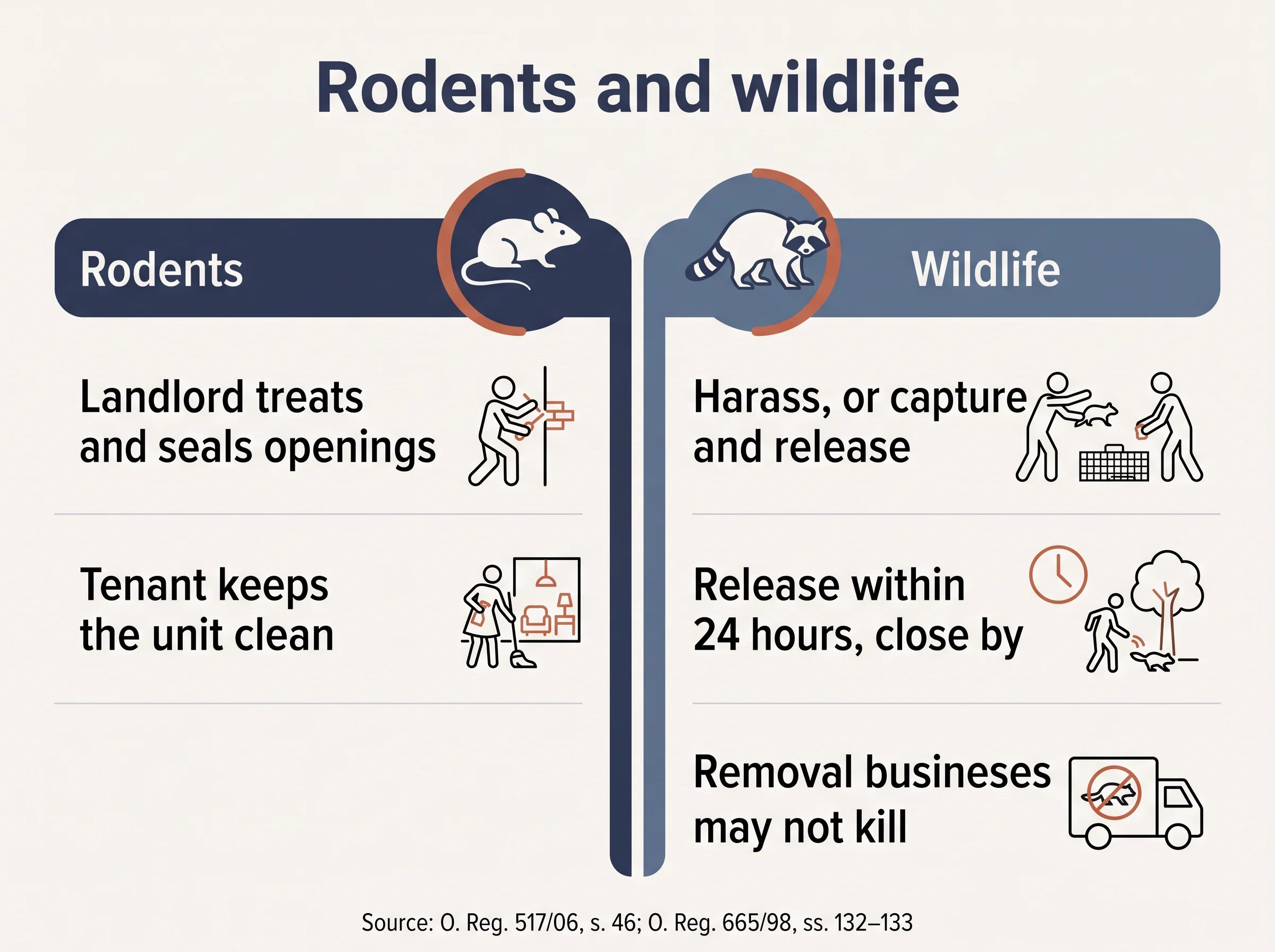
In Ontario, both are the landlord's to arrange, but rodents are mainly a maintenance-standards question while raccoons, squirrels and other wildlife also bring provincial wildlife law into how the animal is removed:
| Mice and rats | Raccoons, squirrels and other wildlife | |
|---|---|---|
| Who arranges it | Landlord (RTA s.20) | Landlord (RTA s.20); the building is the landlord's land |
| Main standard | O. Reg. 517/06 s.46, or the city's by-law | The same standards; Toronto's Chapter 629 counts a mammal infestation injurious to humans or property as a pest |
| Who does the work | A licensed exterminator for pesticide or rodenticide work (Pesticides Act) | The owner or a lawful agent under O. Reg. 665/98 s.132 |
| Key removal rule | Extermination methods must follow municipal and provincial law (s.46(2)) | Live-captured wildlife released within 24 hours close to the capture site (O. Reg. 665/98 s.133) |
| Sealing entry points | Required (O. Reg. 517/06 s.46(3)) | Repair the entry point straight away; relocation often does not solve the problem |
When is an Ontario tenant responsible for mice?
Rarely for the bill: an Ontario tenant pays only for undue damage they, an occupant or a guest caused wilfully or negligently (RTA s.34), and the landlord would have to prove that to the Landlord and Tenant Board (LTB) on an L2 application under section 89. A tenant does have duties. Section 33 makes the tenant responsible for "ordinary cleanliness of the rental unit," and Toronto's Chapter 629 requires every occupant to maintain the property in a clean and sanitary condition and to co-operate with the landlord. Open food, garbage left inside and blocked access for the technician all make rodent control harder.
Mice that come in through gaps in the building are a building problem. The conservative approach is to treat, seal, and then deal with any housekeeping issue in writing.
Who deals with raccoons and squirrels in an Ontario rental?
The landlord: wildlife in a roof, attic or wall of an Ontario rental is still a building problem, so the landlord's section 20 duty and the municipal standard apply. Toronto's Chapter 629 defines a pest to include a "mammal, bird or insect infestation injurious to humans or property." How the animal is removed is governed by Ontario's Fish and Wildlife Conservation Act, 1997.
What does Ontario wildlife law allow?
Section 31(1) of the Fish and Wildlife Conservation Act, 1997 says that if a person believes on reasonable grounds that wildlife is damaging or about to damage their property, they may, on their land, harass the wildlife to deter it, or capture or kill it. Section 31 also says the person must not harass, capture or kill more wildlife than is necessary to protect the property (s.31(4)) and must not cause it unnecessary suffering (s.31(5)). Moose and woodland caribou are excluded entirely, and white-tailed deer and American elk only with ministry authorization or in prescribed circumstances (s.31(3)).
Who can remove wildlife for an Ontario property owner?
The owner may use an agent (s.31(2)). O. Reg. 665/98, s.132, lists the classes of agent, including licensed trappers, the landowner's immediate family on the landowner's own land, municipal wildlife control staff, and "persons whose business is primarily the business of removing nuisance wildlife if they harass wildlife or if they capture and release it if it is capable of being released." In other words, a wildlife removal business can deter or capture and release, but that class is not authorized to kill.
What are Ontario's capture and release rules?
Section 133 of O. Reg. 665/98 requires a person who captures live wildlife under section 31 to release it within 24 hours "as soon as possible into the area in close proximity to the capture site," unless the ministry directs otherwise, or to take a sick, injured or immature animal to an authorized wildlife custodian. Wildlife may not be released on private property without the owner's permission. The province's guidance page, Harass, capture or kill a wild animal damaging private property, puts the distance at within 1 km of the capture site, says killing is a last resort, and says the den of a furbearing mammal or black bear may not be destroyed without ministry approval (fox and skunk dens excepted). It also notes that relocation often does not solve the problem, so the entry point should be repaired straight away.
What should Ontario tenants do about mice or wildlife?
Ontario tenants should report the problem in writing and leave treatment, sealing and wildlife removal to the landlord:
- Report it in writing with dates, sounds, droppings or damage, and photos.
- Do not try to remove wildlife yourself. Section 31 speaks of a person acting on their own land, and the building is the landlord's. Ontario does let an occupant use Class D (domestic) pesticides in their own unit (O. Reg. 63/09, s.54), but treating the building, sealing it and removing wildlife are for the landlord to arrange.
- Store food and garbage securely and allow access on proper notice.
- If nothing happens, call the city's property standards office (311 in Toronto), then consider a T6, Tenant Application about Maintenance, which must be filed within one year (RTA s.29(2)).
What should Ontario landlords do about mice or wildlife?
Ontario landlords should inspect promptly on proper notice, use licensed or lawful providers, and seal the way in:
- Inspect promptly, and inside the unit give 24 hours' written notice under RTA s.27 (see our guide to notice before a pest treatment).
- Use a licensed exterminator for any pesticide or rodenticide work, and a lawful agent for wildlife.
- Seal and screen entry points as part of the job.
- Keep the reports, invoices and notices with the unit's file.
Choosing a licensed pest control or wildlife provider in Ontario: what should you confirm?
For mice and rats in Ontario, the person applying a pesticide needs an exterminator licence and the business an operator licence under the Pesticides Act; a landlord cannot rely on the domestic-use exemption to apply even Class D (domestic) products in a tenant's unit (O. Reg. 63/09, s.54(2)). For wildlife, ask whether the business is acting as a nuisance wildlife agent under O. Reg. 665/98, how it will exclude the animal and repair the entry, and how it handles young. See our guide to hiring a licensed exterminator in Ontario.
How can Tenon10 help with mice and wildlife in a rental?
Tenants can report mice or wildlife through maintenance requests in Tenon10, so there is a dated written record. On plans that include scheduled maintenance, you can book the pest control visit for the unit and email tenants a Notice of Entry after Tenon10 checks the 24-hour and 8 a.m. to 8 p.m. rules (email counts as service only where the tenant agreed to it in writing).
Frequently asked questions
Is the landlord responsible for mice in Ontario?
Yes, as a rule. The building must be kept reasonably free of rodents and openings must be sealed (O. Reg. 517/06, s.46, or the city's by-law), and section 20 of the RTA makes compliance the landlord's duty.
Can I trap a raccoon and drive it to the country in Ontario?
No. Captured wildlife must be released within 24 hours close to where it was caught, under section 133 of the provincial hunting regulation. Ontario's guidance says within 1 km of the capture site.
Can a wildlife removal company kill the animal in Ontario?
Not as a nuisance wildlife business. A business whose main work is removing nuisance wildlife is a prescribed agent for harassing or for capturing and releasing, not for killing (O. Reg. 665/98, s.132(1), paragraph 4).
Can an Ontario tenant withhold rent until the mice are gone?
No. Withholding rent is not a remedy under the RTA. Use a written request, the city's property standards office and a T6 application to the LTB.
Can a landlord seal bats out of an Ontario attic?
Not without checking first. The little brown myotis, which often uses attics for summer colonies, is listed as endangered in Ontario, and the province's species-at-risk law changed on March 30, 2026. Check the current rules with the Ministry before excluding bats or sealing a roost.
Which Ontario guides cover pests and maintenance?
- Pest Control in an Ontario Rental: Who's Responsible, and What to Document
- Maintenance Standards in Ontario
- Cockroaches in an Ontario apartment building
- Toronto's pest control rules for rentals
From the first report to the sealed gap
Maintenance requests, scheduled pest control visits and entry notices for your Ontario rentals, kept together in Tenon10.
Built for Canadian landlords and property managers.


