

A landlord must give at least 24 hours' written notice before pest control in Ontario, stating the reason, the day and a time of entry between 8 a.m. and 8 p.m. (RTA s.27). Every follow-up visit needs its own notice, and the provider's preparation sheet should go with it so the tenant can get the unit ready.
A pest treatment only works if the exterminator can get into every unit on the day, and the tenants have prepared. Get the notice right and most treatments go ahead without a dispute. Get it wrong and the visit is wasted, the infestation spreads, and the entry itself can become the subject of a tenant application. For the wider set of letters a landlord sends, see our guide to tenant communication templates for Ontario landlords, which covers what must be in writing and how each notice can be delivered.
How much notice before pest control in Ontario?
At least 24 hours, in writing. Section 27(1) of Ontario's Residential Tenancies Act, 2006 (RTA) lets a landlord enter a rental unit "in accordance with written notice given to the tenant at least 24 hours before the time of entry" for listed reasons. Two of them cover pest control:
- paragraph 1: to carry out a repair or replacement or do work in the rental unit; and
- paragraph 4: to carry out a reasonable inspection to decide whether the unit is in a good state of repair and complies with health, safety, housing and maintenance standards.
Section 27(3) sets the contents: the notice "shall specify the reason for entry, the day of entry and a time of entry between the hours of 8 a.m. and 8 p.m."
Without written notice, a landlord may enter only in an emergency or if the tenant consents at the time of entry (s.26(1)). A routine treatment is rarely an emergency, so plan on giving notice. The general rules are in our guide to the 24-hour notice of entry rule in Ontario.
What should an Ontario pest treatment notice say?
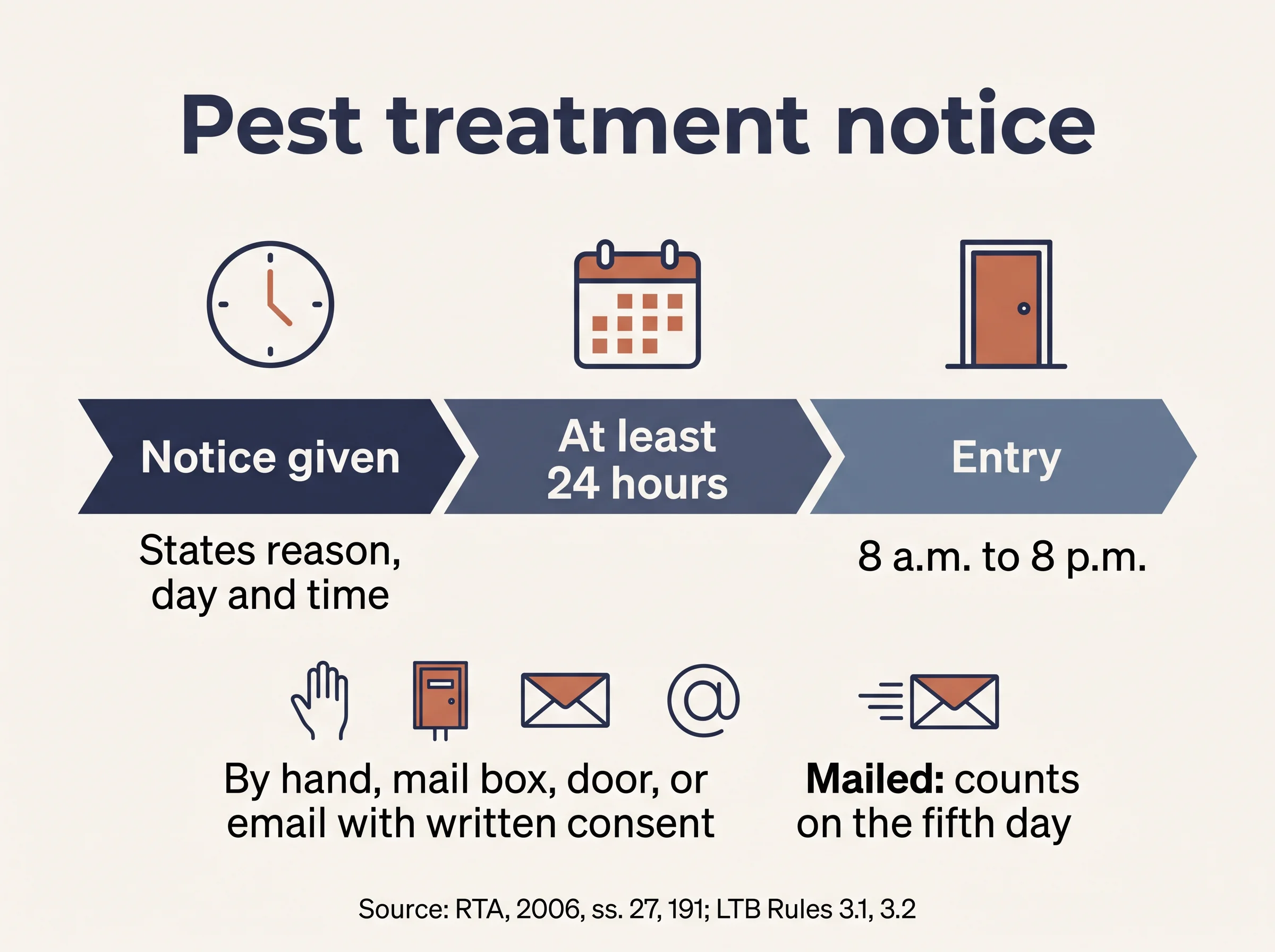
An Ontario pest treatment notice must state the reason for entry, the day and a time between 8 a.m. and 8 p.m. (RTA s.27(3)); good practice adds who is entering, the preparation steps and a contact for questions or accommodation:
| Item | Required? | Example |
|---|---|---|
| Reason for entry | Yes (s.27(3)) | Bed bug treatment of the unit by a licensed pest control provider |
| Day of entry | Yes | Thursday, November 12 |
| Time of entry, between 8 a.m. and 8 p.m. | Yes | 10:00 a.m., or a short window such as 10 a.m. to 12 noon |
| Who is entering | Good practice | The landlord's representative and the provider's licensed technician |
| Preparation steps | Good practice | Attach the provider's preparation sheet |
| Time out of the unit | Good practice | As the provider instructs, if any |
| Contact for questions or accommodation | Good practice | Name, phone and email |
The Act speaks of "a time of entry." A specific time or a short window is the conservative choice. A notice that names the whole day, such as "between 8 a.m. and 8 p.m.", may be challenged as not specifying a time: the LTB's Interpretation Guideline 6 cites the Divisional Court's decision in Wrona v. Toronto Community Housing Corporation, which held a six-hour window was not enough.
Sample wording
Notice of Entry, Residential Tenancies Act, 2006, section 27
To: [tenant names], [unit and address]
The landlord will enter your rental unit on [day, date] at [time] (between 8 a.m. and 8 p.m.) for the following reason: pest control treatment for [pest] by a licensed pest control provider. [Name] from the landlord's office will attend with the provider's technician.
Please prepare the unit as described on the attached preparation sheet. If you need help preparing, or need a different time because of a disability or another reason, contact [name, phone, email] as soon as possible.
A follow-up visit may be needed. If so, you will receive a separate written notice.
[Landlord or agent name], [date the notice was given and how]
How should an Ontario landlord deliver a notice of entry so it counts?
In Ontario, a notice of entry counts once it is handed over, left in the tenant's mail box, posted on the unit door (LTB Rule 3.2), or emailed to a tenant who consented in writing; the 24 hours start only then:
- By hand to the tenant, or to an apparently adult person in the unit (RTA s.191(1)).
- In the mail box where the tenant's mail is ordinarily delivered (s.191(1)(d)).
- Posted on the door. Rule 3.2 of the LTB Rules of Procedure says "a notice of entry under section 27 of the RTA may also be served by posting it on the door of the rental unit."
- By email, only with written consent. Rule 3.1 allows email service only if the person receiving it has consented in writing to service by email. Under Rule 3.9, an emailed document is served the day it is sent.
- Not by regular mail for short notice. A mailed notice is deemed given on the fifth day after mailing (s.191(3)).
Keep a copy of every notice with a note of how and when it was delivered. If the treatment is ever disputed, that record is your evidence.
What goes on a pest control preparation sheet in Ontario?
In Ontario, the preparation sheet comes from the pest control provider, because the steps depend on the pest and the method. Typical items for bed bugs include laundering bedding and clothing and drying it on high heat, bagging items, emptying closets and drawers, and moving furniture away from walls. For cockroaches, they usually include emptying kitchen cupboards and cleaning food residue. Health Canada's bed bug guidance gives similar household steps.
Three rules keep a preparation sheet fair and enforceable:
- Keep it reasonable. Ask only for what the provider needs. A tenant should not be asked to do anything unsafe.
- Give time. Twenty-four hours is the legal minimum for entry, but bagging a whole unit takes longer. For a heavy preparation job, give notice several days ahead.
- Offer accommodation. Under the Human Rights Code, a housing provider must accommodate disability-related needs to the point of undue hardship. The Ontario Human Rights Commission's policy explains the duty. Say in the notice who to contact for help.
When does the exterminator give its own notice in Ontario?
In Ontario, the exterminator gives its own notice before an indoor fumigation with a Class B fumigant gas (O. Reg. 63/09 s.60); for most other treatments, the landlord's section 27 notice is the notice. Under section 60 of O. Reg. 63/09, the exterminator must deliver written notice at least 24 hours and not more than seven days ahead to every occupant aged 16 or over of every dwelling unit in the building, and to others, including the medical officer of health, police and fire department. The notice must say that occupants are to vacate and stay out of the building, and any attached building, during the fumigation. That notice is in addition to the landlord's entry notice, not a substitute.
In a Toronto apartment building covered by Chapter 354 of the Toronto Municipal Code (RentSafeTO), the owner must also post pest control treatment information on the tenant notification board, including the date of treatment, the name of the licensed operator and the nature of the treatment. See our guide to Toronto's pest control rules for rentals.
Choosing a licensed pest control provider in Ontario: what should you confirm?
In Ontario, confirm that the business holds an operator licence and the person treating holds an exterminator licence under the Pesticides Act, and ask the provider for its preparation sheet before you write the notice. Our guide to hiring a licensed exterminator in Ontario covers what each licence means.
What if an Ontario tenant will not let the treatment happen?
In Ontario, a valid section 27 notice authorizes the entry; the tenant's consent is not required. If a tenant blocks it or does not prepare, the routes are at the LTB, not at the door. Our guide on what a landlord can do when a tenant refuses pest control entry covers them.
How can Tenon10 help with pest control notices?
On plans that include scheduled maintenance, Tenon10 lets you book a pest control visit for a unit, checks the 24-hour and 8 a.m. to 8 p.m. rules before it is sent, and emails tenants a Notice of Entry for the visit. Email is valid service only for tenants who consented to it in writing, so post or hand the notice to everyone else. Tenants can also send maintenance requests in Tenon10, which gives you a dated written report to start from.
Frequently asked questions
How much notice does a landlord need to give for pest control in Ontario?
At least 24 hours' written notice, under RTA section 27. The notice must state the reason, the day and a time between 8 a.m. and 8 p.m.
Can an Ontario notice of entry be sent by text message?
Text is not a method listed in the RTA or the LTB Rules, and email works only if the tenant consented in writing to email service. Hand delivery, the mail box, or posting on the unit door are the safe methods in Ontario.
Does the Ontario landlord need to be present for pest control?
The RTA does not require it. Many Ontario landlords send a representative with the provider so someone can answer the tenant's questions.
Do I need a new notice for each follow-up treatment in Ontario?
Yes, unless the tenant consents at the time of entry (RTA s.26(1)(b)). A line in the first notice saying a follow-up may be needed does not authorize the second entry.
Can pest control treatment be on a Sunday in Ontario?
RTA section 27 does not exclude any day of the week. It does limit entry to between 8 a.m. and 8 p.m.
Which Ontario guides cover notices and pest control?
- Tenant Communication Templates: What Ontario Landlords Must Put in Writing, and How to Say It
- The 24-Hour Notice of Entry Rule in Ontario
- Bed bugs in an Ontario rental: who pays and who treats?
- Cockroaches in an Ontario apartment building
- Pest Control in an Ontario Rental: Who's Responsible, and What to Document
Schedule the visit and the notice together
Book pest control visits for Ontario units and keep each Notice of Entry with the unit's record in Tenon10.
Built for Canadian landlords and property managers.


