When there are bed bugs in an Ontario rental, the landlord arranges and pays for professional treatment, because RTA s.20(1) and O. Reg. 517/06 s.46 require the building to be kept reasonably free of insects. A tenant can be charged only if the Landlord and Tenant Board finds they caused it wilfully or negligently (RTA ss.34 and 89).
Bed bugs are the pest that turns a good tenancy into a dispute fastest. They hide in seams and furniture, they move between units, and a single treatment rarely ends the problem. The tenant's job is to report quickly, prepare the unit and let the treatment happen. This guide goes deeper on bed bugs specifically. For the general rules on every kind of pest, start with our overview of pest control responsibilities in an Ontario rental.
Who is responsible for bed bugs in an Ontario rental?
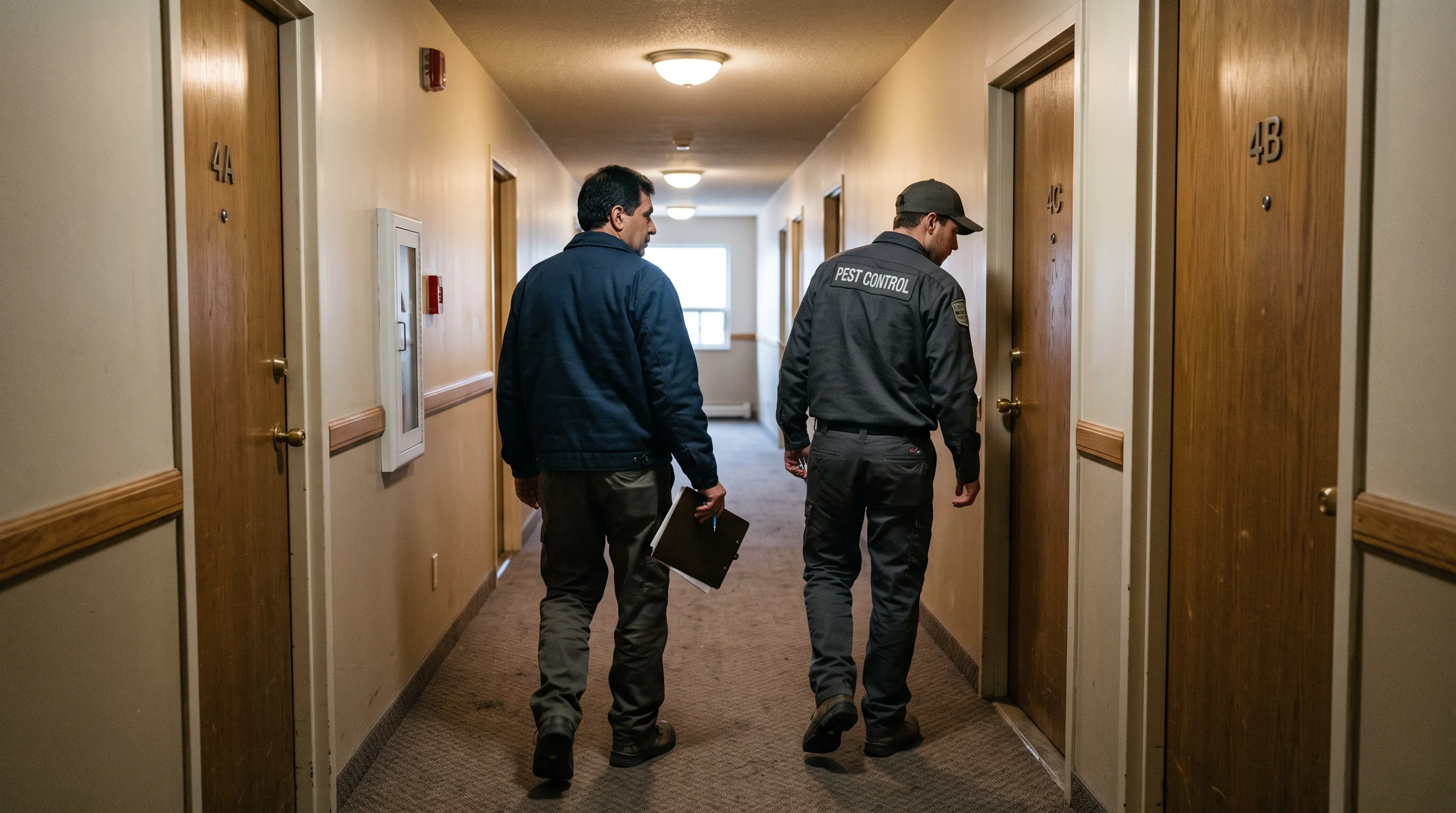
The landlord is responsible for bed bugs in an Ontario rental. Section 20(1) of the Residential Tenancies Act, 2006 (RTA) makes the landlord responsible for keeping the residential complex, including every rental unit, "in a good state of repair and fit for habitation" and for complying with health, safety, housing and maintenance standards. Section 20(2) adds that this duty applies even if the tenant knew about the problem before signing.
The standards themselves name pests. Section 46 of O. Reg. 517/06, the provincial maintenance standards, says:
- a residential complex shall be kept reasonably free of rodents, vermin and insects;
- the methods used for exterminating rodents and insects shall be in accordance with applicable municipal or provincial law; and
- openings and holes in a building with rental units shall be screened or sealed to keep pests out.
Under section 224 of the RTA, these provincial standards apply where a municipality has no property standards by-law (and in some prescribed cases where it does). Most large cities have their own by-law. Toronto's Chapter 629, for example, says every property "shall at all times be kept free of pests" and lists bedbugs by name. Either way, section 20 makes the applicable standard part of the landlord's duty. Our guide to maintenance standards in Ontario explains how the two layers fit together.
Section 4 of the RTA voids any lease term that is inconsistent with the Act, so a clause saying the tenant handles "all pest control" does not move the landlord's section 20 duty onto the tenant.
Who pays for bed bug treatment in Ontario?
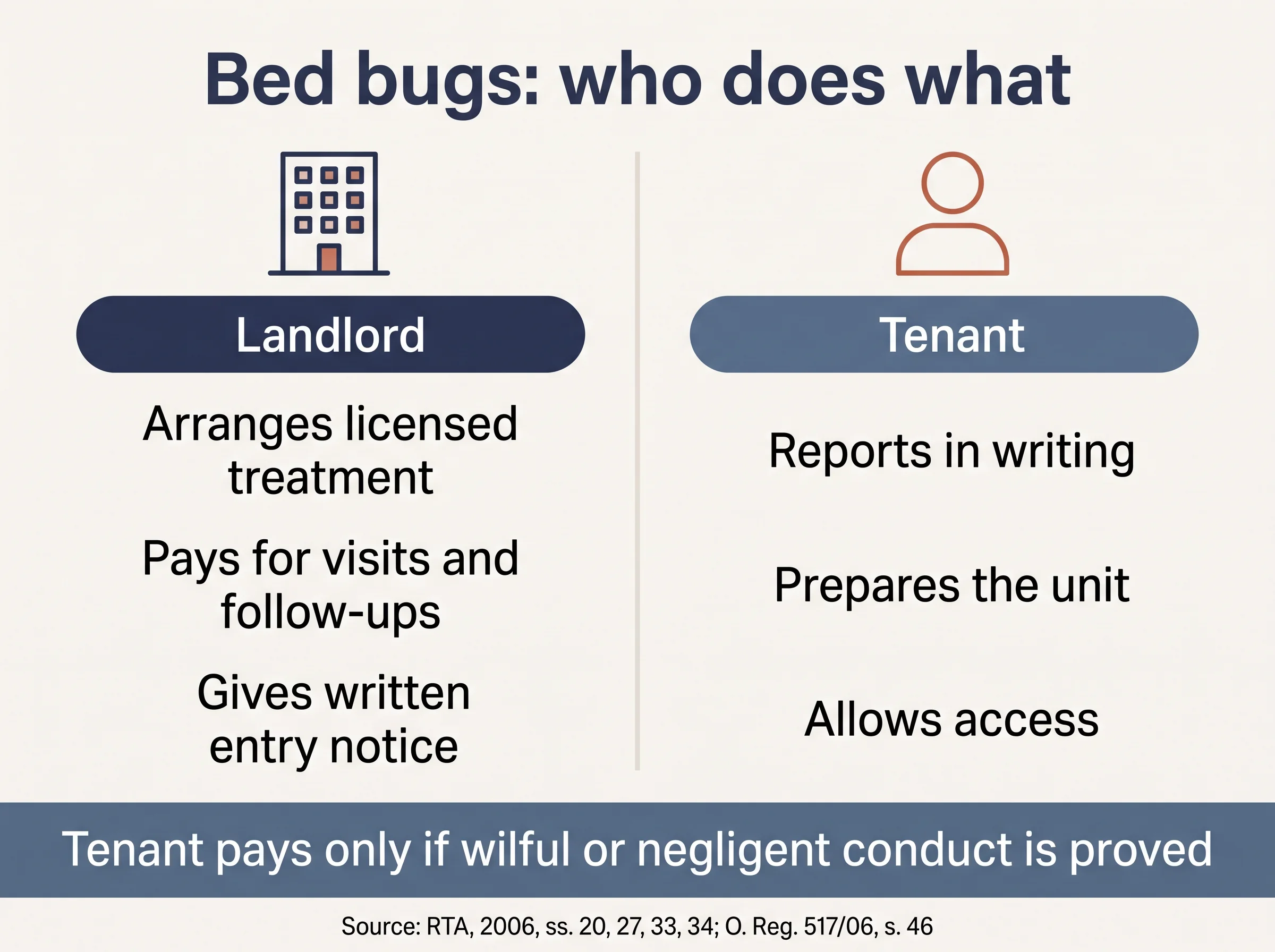
In Ontario, the landlord pays for bed bug treatment by default: arranging and paying for professional treatment is how the landlord meets the RTA section 20 duty. Bed bugs are also the pest where the bill grows quickly, for three reasons:
- Follow-up visits. Treatment usually takes more than one visit, and each visit is part of the same job.
- Neighbouring units. In a multi-unit building, the units beside, above and below an infested unit may need inspection or treatment too. Toronto's apartment building by-law requires owners to take adequate measures to prevent pests spreading into other parts of the property.
- Common areas. Hallways, laundry rooms and storage areas are the landlord's to keep clean and pest-free.
| Landlord (Ontario) | Tenant (Ontario) |
|---|---|
| Keep the complex reasonably free of insects (RTA s.20(1); O. Reg. 517/06 s.46) | Report promptly and in writing |
| Arrange and pay for licensed treatment, including follow-ups | Keep the unit ordinarily clean (RTA s.33) |
| Give 24 hours' written notice for each entry (RTA s.27) | Prepare the unit and allow access |
| Can recover costs only with proof of wilful or negligent conduct (RTA ss.34 and 89) | Pays only for undue damage they, an occupant or a guest caused |
When can a landlord charge the tenant?
Only in narrow situations, and the landlord carries the burden of proof. Section 34 of the RTA makes a tenant responsible for repairing "undue damage" caused by the wilful or negligent conduct of the tenant, another occupant or a guest. Section 89 lets the landlord apply to the Landlord and Tenant Board (LTB) for the reasonable cost of repairing or replacing damaged property in that situation, using the L2 application (Part 3, Reason 4). Separately, section 88.1 lets a landlord claim reasonable out-of-pocket expenses caused by a tenant's conduct that substantially interferes with the landlord's lawful rights (L2, Part 3, Reason 5), which is the route most often discussed when a tenant's refusal wastes a scheduled treatment.
Bed bugs travel on luggage, used furniture and visitors, and a tenant can bring them in without doing anything wrong. Being the first unit where they were noticed does not prove negligence. A landlord who wants to recover treatment costs needs evidence, and the LTB decides each case on its facts. The conservative course is to treat first and argue about cost later, if at all.
What must an Ontario tenant do about bed bugs?
An Ontario tenant must report bed bugs promptly, keep the unit ordinarily clean (RTA s.33), prepare the unit as the provider instructs, and allow access on proper notice:
- Report it promptly, in writing. A dated message with photos starts the record. Health Canada's bed bug guidance tells tenants to "tell your landlord right away."
- Keep the unit reasonably clean. Section 33 of the RTA makes the tenant responsible for ordinary cleanliness of the rental unit.
- Prepare the unit. The pest control provider's preparation sheet is the practical guide: laundering bedding and clothing, bagging items, clearing floor space and moving furniture away from walls. Toronto's Chapter 629 requires every occupant to co-operate with the landlord in complying with the chapter.
- Allow access. A landlord may enter on 24 hours' written notice to do work in the unit (RTA s.27(1)). See our guide on the notice to give before a pest treatment.
Preparation instructions must be reasonable. Under Ontario's Human Rights Code, a housing provider must accommodate a disability-related need to the point of undue hardship, so a tenant who cannot bag belongings or move furniture because of a disability can ask for help or more time. The Ontario Human Rights Commission's rental housing policy sets out how that duty works.
How does bed bug treatment usually run in an Ontario rental?
In an Ontario rental, bed bug treatment usually runs as an inspection, a preparation sheet with a written entry notice, a first treatment and one or more follow-ups, each with its own notice. The provider sets the method, but the shape is similar in most buildings:
- Inspection of the reported unit, then of neighbouring units where the provider recommends it.
- Preparation sheet to the tenants, with the written entry notice for each visit.
- First treatment. Health Canada notes that heat treatments "should be left to the professionals."
- Follow-up visit(s), each with its own notice unless the tenant consents at the time of entry.
- Records: the provider's report, the notices and the invoices, kept with the tenancy file.
Health Canada's practical advice for the household side includes washing bedding and infested clothes in hot water and drying them on the highest setting, putting small non-washable items in a hot dryer for 30 minutes or more, and storing clean items in sealed bags or bins. It also says treatment only works when physical control methods and preventive measures are used together, which is why the tenant's preparation matters as much as the landlord's booking.
Choosing a licensed pest control provider in Ontario: what does the law require?
Ontario law requires bed bug extermination in a tenanted unit to be done by a licensed exterminator working for a licensed operator, under the Pesticides Act. Section 46(2) of O. Reg. 517/06 requires extermination methods to follow municipal and provincial law. In Ontario that means the Pesticides Act: a person needs a licence to perform an extermination, and a business needs an operator licence to run an extermination business. A landlord cannot rely on the homeowner exemption for a tenanted unit: O. Reg. 63/09, s.54(2), says the exemption for using Class D (domestic) products on premises you own applies to a rental unit only if the person who occupies it does the treatment. Our guide to hiring a licensed exterminator in Ontario explains what to ask for before you book.
What can an Ontario tenant do if the landlord does not treat bed bugs?
An Ontario tenant whose landlord does not treat bed bugs can make a written request, call the municipality's property standards office, and file a T6 with the LTB within one year (RTA s.29(2)):
- Written request. Describe the problem, attach photos and keep a copy. Under section 30(2), the LTB considers whether the tenant told the landlord before applying.
- Municipal property standards. Where a city by-law requires pest-free premises, its enforcement officers can inspect and issue orders. In Toronto, contact 311. The City of Toronto's bed bug page notes that bed bugs are "not considered a health hazard," so the property standards route, not public health, is usually the one that applies.
- A T6 application. A tenant can file a T6, Tenant Application about Maintenance, within one year of the conduct (RTA s.29(2)). Section 30(1) lets the LTB order the work done, order a rent abatement, and order the landlord to pay the reasonable cost of repairing or replacing a tenant's property that was damaged, destroyed or disposed of because of the landlord's breach, such as a mattress thrown out.
Two things not to do. Withholding rent is not a remedy under the Act. And for N4 non-payment applications filed on or after September 21, 2026, a tenant can raise maintenance issues at the hearing only after giving the landlord advance written notice and paying half of the arrears claimed, plus any other prescribed amounts (RTA s.82, as amended by Bill 60); see our explainer on Ontario's 50% arrears rule.
How can Tenon10 help with bed bug reports?
Tenants can submit maintenance requests in Tenon10, so a bed bug report arrives in writing with a date on it. On plans that include scheduled maintenance, landlords can book a pest control visit for a unit; Tenon10 checks the 24-hour and 8 a.m. to 8 p.m. rules and emails tenants a Notice of Entry. Email counts as service only where the tenant has agreed in writing to receive documents by email, so keep posting or handing the notice where they have not.
Frequently asked questions
Are bed bugs the landlord's responsibility in Ontario?
Yes, as a rule. RTA section 20 and the applicable maintenance standard (O. Reg. 517/06 s.46, or the municipal by-law) make keeping an Ontario rental reasonably free of insects part of the landlord's duty.
Can my Ontario landlord charge me for bed bug treatment?
Only with proof that you, an occupant or a guest caused it wilfully or negligently (RTA ss.34 and 89), or for out-of-pocket costs your conduct caused, such as a wasted visit after a refusal (s.88.1). The LTB decides each case on its facts.
Is a "tenant pays for pest control" lease clause valid in Ontario?
No. RTA section 4 voids lease terms that are inconsistent with the Act, and the Ontario landlord's maintenance duty comes from section 20.
Do I have to throw out my furniture because of bed bugs?
Not automatically, so follow the provider's instructions. If belongings are lost because the Ontario landlord failed to deal with the problem, the LTB can order compensation on a T6 (RTA s.30(1)).
Can I break my Ontario lease because of bed bugs?
Not on your own. The LTB can terminate a tenancy as a remedy on a T6 (RTA s.30(1), paragraph 1), but a tenant cannot end a fixed term early just by leaving.
Which Ontario pest control guides should you read next?
- Pest Control in an Ontario Rental: Who's Responsible, and What to Document
- Pest control notice to tenants in Ontario: 24 hours, written notice and prep sheets
- Tenant refuses entry for pest control: what a landlord can do
- Cockroaches in an Ontario apartment building
- Tenant communication templates for Ontario landlords
Keep every pest report and visit in one place
Tenant maintenance requests, scheduled pest control visits and Notice of Entry records for your Ontario units, in Tenon10.
Built for Canadian landlords and property managers.