Renting out your principal residence in Canada is a change in use: CRA treats the home as sold and immediately reacquired at fair market value on the day it becomes a rental (Income Tax Act, s.45(1); CRA Folio S1-F3-C2, ¶2.48). You can elect under subsection 45(2) to defer that deemed sale, and the home can then stay your principal residence for up to four years, as long as you claim no capital cost allowance.
Many first-time landlords become landlords by accident: a job move, a new partner, a bigger house. The tax result of that first lease depends on a few choices made in the year you move out. This guide explains them using the CRA's own guidance, the Principal Residence folio S1-F3-C2 and Guide T4036, Rental Income.
Renting Out Your Home, 45(2): Landlord Checklist
A one-page checklist for Canadians turning their home into a rental: record the value at the change, decide on the 45(2) election, avoid the CCA trap and report the sale correctly.
Get Free PDF →What happens for tax when you start renting out your home in Canada?
When your whole home changes from personal use to a rental in Canada, you are deemed to have disposed of the land and building at fair market value and to have reacquired them at the same amount (Folio S1-F3-C2, ¶2.48). Any gain up to that date may be eliminated or reduced by the principal residence exemption, and the fair market value becomes your new starting cost as a landlord.
Two consequences follow. First, the deemed disposition is a reportable event: since 2016, a disposition of a principal residence must be reported, and for an individual the designation is made on Schedule 3 and, for 2017 and later, on Form T2091(IND) (Folio ¶2.15). Second, the fair market value at the change matters later, both for the capital gain when you eventually sell and for capital cost allowance (CCA) on the building. Guide T4036 explains how to set the building's capital cost when personal property becomes rental property: if fair market value is below your original cost, you use fair market value; if it is higher, a calculation in the guide applies.
| Your choice | What happens at the change | Principal residence status | CCA on the building |
|---|---|---|---|
| No election | Deemed disposition at fair market value; gain may be sheltered by the exemption | Can be designated for years you ordinarily inhabited it | Available |
| Subsection 45(2) election | No deemed disposition | Can be designated for up to 4 years while the election is in force, if you are resident in Canada | Must not be claimed, or the election is rescinded |
What does the subsection 45(2) election do?
The subsection 45(2) election lets a Canadian taxpayer treat the home as not having changed use, so no deemed disposition occurs when it becomes a rental (Folio S1-F3-C2, ¶2.48). While the election is in force, the property can be designated as your principal residence for up to four tax years even though you do not ordinarily inhabit it, provided you are resident in Canada during those years (¶2.50).
The trade-off is CCA. No CCA should be claimed on the property for the years the election covers, and if CCA is claimed, the election is considered rescinded on the first day of the year in which it is claimed (¶2.48, ¶2.51). Rescinding triggers the deemed disposition then, at that day's fair market value.
You still report the rental income and expenses every year on Form T776. The election does not shelter rent; it only defers the deemed sale and preserves principal residence years. Our walkthrough of the T776 form covers the annual reporting.
How do you make the 45(2) election?
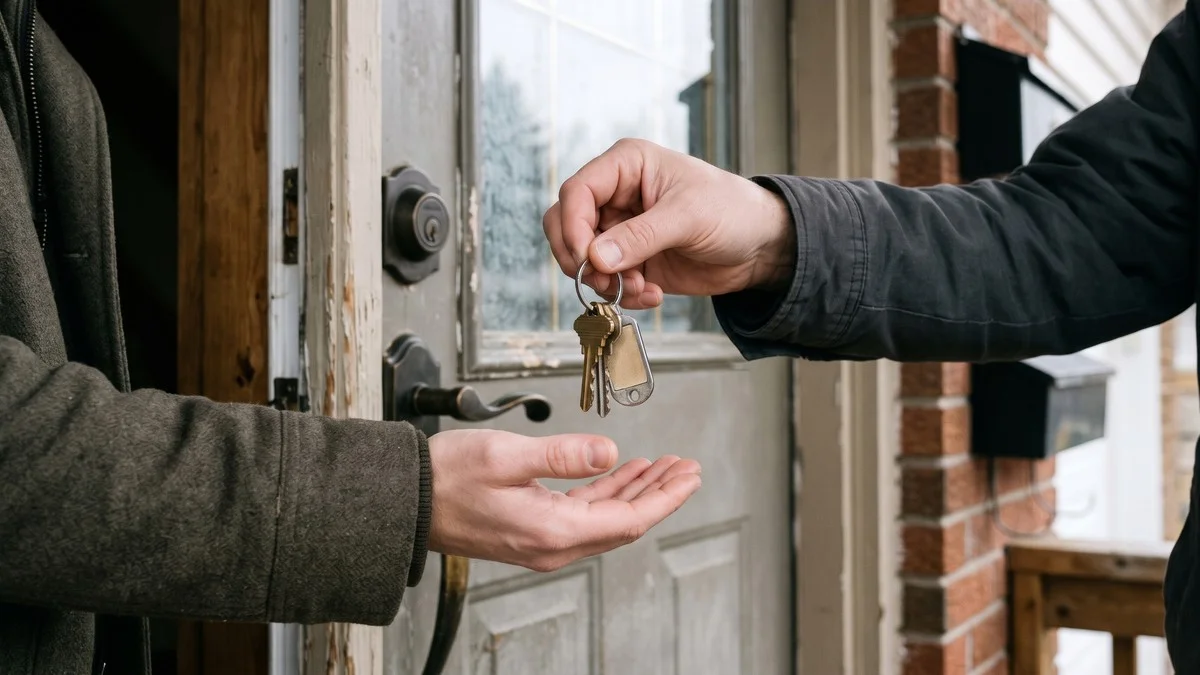
You make the 45(2) election by a letter, signed by you, filed with your income tax return for the year the use changed; the CRA folio notes that e-filers should follow the CRA's guidance on filing elections (Folio S1-F3-C2, ¶2.48).
- Record the date the home became a rental and get evidence of its fair market value at that date, such as an appraisal or comparable sales.
- Write the election letter stating that you elect under subsection 45(2) of the Income Tax Act for the property, with its address and the date of the change, and sign it.
- File it with your return for that year, following the CRA's instructions for elections if you file electronically.
- Report the rental on Form T776 without claiming CCA on the property.
- Keep the file. You will need the date and value again when you sell or move back.
Missed it? The CRA may accept a late-filed 45(2) election in certain circumstances, one of which is that no CCA has been claimed on the property since the change in use (Folio ¶2.49, referring to IC07-1).
What about renting a basement suite or a room in your home?
Renting part of your home in Canada is a change in use of that part only, but the CRA does not apply the deemed disposition where three conditions are all met: the income-producing use is ancillary to the main use as your residence, there is no structural change to the property, and no CCA is claimed (Folio S1-F3-C2, ¶2.57-2.59). Renting out a room is one of the CRA's own examples (¶2.60).
A substantial, structural change, such as converting part of the house into a separate rental unit, is a deemed disposition of that part (¶2.58). Since March 19, 2019, a 45(2) election can also be made for a partial change to income-producing use (¶2.60.1). If you later claim CCA on the rented part, the CRA applies the deemed disposition from the date the rental use began (¶2.60).
Guide T4036 adds an expense point: you cannot claim expenses for renting part of your property if you have no reasonable expectation of making a profit. Renting a room to a family member at a token rent is usually a cost-sharing arrangement rather than a rental business.
What happens when you move back in?
When a rental changes back to your principal residence, the change is again a deemed disposition at fair market value unless you make a subsection 45(3) election, which defers the gain (Folio S1-F3-C2, ¶2.54). The 45(3) election is filed with the return for the year you finally dispose of the property, or earlier if the CRA formally demands it (¶2.54).
The 45(3) election is not available if CCA was claimed on the property after 1984 by you, your spouse or common-law partner, or a trust under which you are a beneficiary (¶2.55). It can cover up to four tax years before the change back (¶2.56), and since March 19, 2019 it also works for a partial change back (¶2.60.2). You still report the net rental income for the period the home was rented.
How do you report the sale years later?
When you eventually sell, you report the disposition on Schedule 3 and designate the principal residence years on Form T2091(IND) (Folio S1-F3-C2, ¶2.15). The CRA's T4036 notes that the principal residence exemption applies only if you report the disposition and the designation on your return. A late designation may be accepted by the Minister under subsection 220(3.2) (¶2.15.1).
If you are deciding between renting and selling, our analysis of renting out a Toronto condo or selling it walks through the numbers, and CCA for landlords explains when claiming depreciation helps and when it costs you. More guides are in the Canadian Landlord Resource Center.
Frequently asked questions
Do I pay tax when I start renting out my home?
There is a deemed disposition at fair market value (ITA s.45(1)), but any gain may be eliminated or reduced by the principal residence exemption for the years it was your principal residence. A 45(2) election defers the deemed disposition altogether.
How long can a rented home stay my principal residence?
With a 45(2) election in force, up to four tax years, provided you are resident in Canada (Folio S1-F3-C2, ¶2.50). Section 54.1 can extend this in certain work-relocation situations (¶2.52).
Can I claim CCA if I make the 45(2) election?
No. Claiming CCA on the property rescinds the election from the first day of the year you claim it (Folio ¶2.48).
Is renting out a room a change in use?
Not for the deemed-disposition rule if the rental is ancillary to your residential use, there is no structural change and you claim no CCA (Folio ¶2.59-2.60).
What if I forgot to file the election?
The CRA may accept a late 45(2) election in certain circumstances, including that no CCA was claimed since the change in use (Folio ¶2.49).
Renting Out Your Home, 45(2): Landlord Checklist
A one-page checklist for Canadians turning their home into a rental: record the value at the change, decide on the 45(2) election, avoid the CCA trap and report the sale correctly.
Get Free PDF →Becoming a landlord?
Start with the right lease and notices. Browse free landlord forms and calculators.
Free • No signup required