You signed a one-year lease, and now life has changed: a job in another city, a relationship ending, a home you can finally buy. You need to leave months before the term runs out, and you have heard you could owe "the rest of the lease."
In British Columbia that is the starting point of a landlord's claim, not the final bill. What you actually owe depends on how quickly the unit is re-rented, what your lease says, and whether you use one of the lawful ways to end a fixed term early.
This guide explains when you can leave a fixed-term tenancy early without owing anything, what a landlord can claim when you break the lease, and how to keep that amount as low as possible.
BC Breaking a Lease Checklist for Tenants
A renter checklist for leaving a BC fixed-term lease early: the lawful routes, what a landlord can claim, and the evidence that keeps the amount down.
Get Free PDF →The rule: a fixed term binds both sides
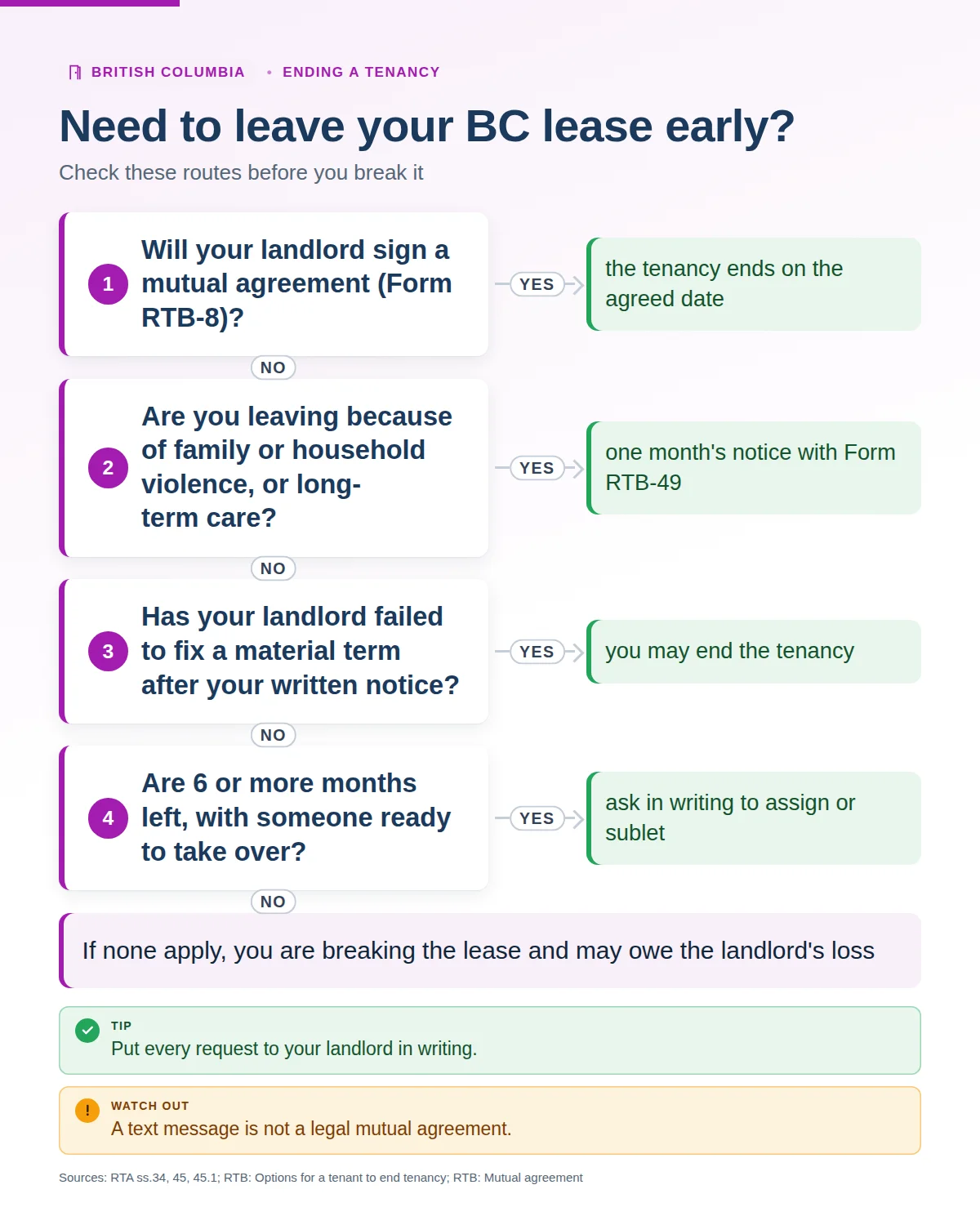
A fixed-term tenancy is a contract for a set period. Under section 45(2) of the Residential Tenancy Act (RTA), your ordinary notice cannot take effect earlier than the end date in your agreement. The RTB's tenant options page says a fixed term cannot end before that date unless:
- you and your landlord agree in writing, using a Mutual Agreement to End a Tenancy (Form RTB-8),
- special circumstances apply, such as fleeing family or household violence or being assessed for long-term care,
- an arbitrator orders it, or
- you break the lease, which may leave you owing your landlord money.
Ways to leave early without breaking the lease
| Route | What it needs |
|---|---|
| Mutual agreement | Your landlord's agreement in writing, usually on Form RTB-8. Neither of you can be forced to sign. |
| Family violence or long-term care (s.45.1) | One month's written notice, plus the Ending Fixed-Term Tenancy Confirmation Statement (Form RTB-49) signed by an authorized professional. |
| Landlord's breach of a material term (s.45(3)) | Written notice to your landlord of the problem, and the landlord not fixing it within a reasonable time. |
| Assignment or sublet (s.34) | Your landlord's written consent. If 6 months or more remain in the term, the landlord must not unreasonably withhold it and cannot charge you for considering it. |
What a landlord can claim if you break the lease
Section 7 of the RTA says a party who does not comply with the Act or the tenancy agreement must compensate the other for the resulting loss. Policy Guideline 3 explains how that works for a tenant who leaves early:
- The landlord can claim unpaid rent to the date you left, plus the rent they would have received for the rest of the term.
- Compensation is meant to put the landlord where they would have been if you had stayed. It can include the difference between your rent and a lower rent the landlord gets from a new tenant for the rest of your term.
- If the landlord re-rents for more than you paid, the extra is set off against what you owe, but you do not get any surplus back.
The RTB's breaking-a-lease page gives the outer limit: a tenant on a one-year lease who leaves after two months could face a claim for 10 months' rent. That is the ceiling, before the landlord's duty to limit the loss.
The landlord must try to re-rent
Section 7(2) requires the person claiming to do whatever is reasonable to minimize the loss. Policy Guideline 5 says the landlord must try to re-rent at a reasonable rent and as soon as possible. Its example: a tenant gives notice on September 30 and leaves October 31, so the landlord should try to rent the unit for November. A landlord who waits until spring for higher demand may have the lost-rent claim reduced or denied. Guideline 3 adds that asking a greatly increased rent, or putting the property up for sale, generally does not count as a reasonable effort. The landlord has to prove the steps they took.
Worked example
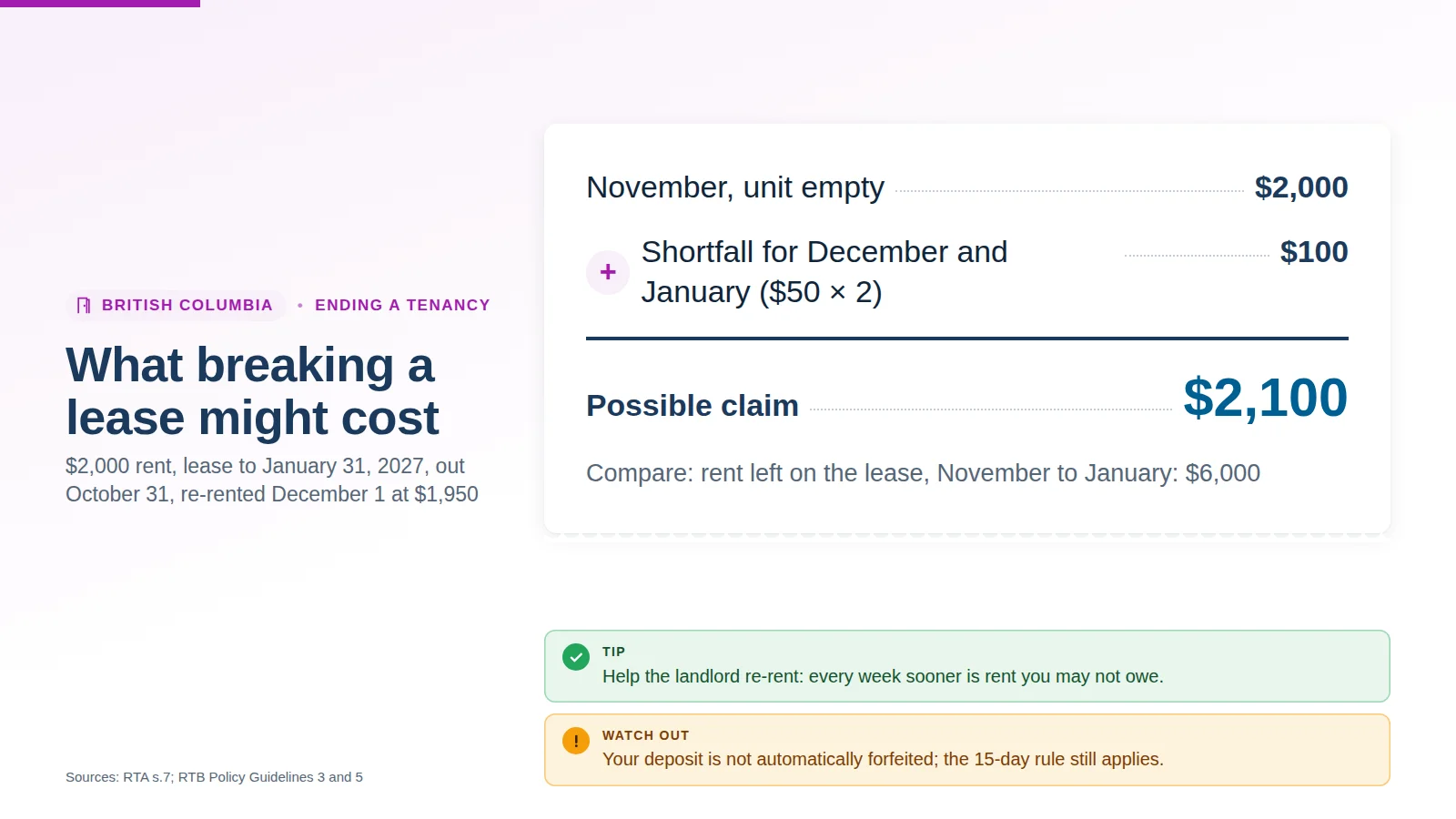
Your lease runs from February 1, 2026 to January 31, 2027 at $2,000 a month. Your landlord receives your written notice on September 30, 2026, and you leave on October 31. The landlord advertises right away and finds a new tenant from December 1 at $1,950.
| Item | Amount |
|---|---|
| November rent lost while the unit sat empty | $2,000 |
| Shortfall for December and January ($50 × 2) | $100 |
| Possible claim for lost rent | $2,100 |
That is far less than the $6,000 left on the lease for November to January. If the landlord had not advertised until the spring, an arbitrator could cut the claim. Only an RTB arbitrator decides the final amount.
Liquidated damages clauses
Some leases name a fixed sum payable if you break the lease. Policy Guideline 4 says the sum must be a genuine pre-estimate of the landlord's loss when the lease was signed. If it is extravagant compared to the greatest possible loss, it is a penalty and cannot be enforced, although it still caps what the landlord can claim for the losses it covers. If the clause is valid, you pay the stated sum even if the landlord's actual loss turns out to be small.
Common mistakes

- Just leaving. Moving out without written notice makes it harder to show when the landlord could start re-renting. Give a signed, dated notice of your move-out date anyway.
- Agreeing by text. The RTB says a text message is not a legal way to end a tenancy by mutual agreement.
- Signing a deposit deduction you do not agree with. Your written agreement is what lets a landlord keep part of the deposit without an RTB order.
- Subletting without consent. Section 34 requires the landlord's written consent.
- Assuming you owe nothing because a new tenant moved in. You may still owe for any empty period and any rent shortfall.
What to do next
- Read your lease for a liquidated damages clause and the end date.
- Check the lawful routes first: section 45.1, a material breach, or a request to assign or sublet.
- Ask your landlord for a mutual agreement on Form RTB-8. The RTB says tenants can help find a replacement by advertising, allowing regular viewings and cooperating.
- Give written notice of your move-out date, ideally received a full month ahead and on the day before rent is due.
- Keep evidence: copies of your notice, messages, and screenshots of the landlord's rental ads with dates and asking rent.
- Do the move-out inspection and give your forwarding address in writing.
- If your landlord files a claim, respond with your evidence at the RTB hearing.
How Tenon10 helps
Tenon10 generates a BC tenant's notice to end tenancy, so your move-out date is in writing, signed and dated, with the unit's address. The Mutual Agreement to End a Tenancy (RTB-8) is an RTB form, and Tenon10 links to it.
If your landlord uses Tenon10, the lease, notices and payment records are kept together, which helps both sides if the amount owed goes to a hearing.
Frequently asked questions
Do I owe the rent for the whole remaining term?
Not automatically. That is the maximum a landlord can claim. The landlord must try to re-rent, and you owe only the loss they could not reasonably avoid, unless a valid liquidated damages clause applies.
Can my landlord keep my deposit because I broke the lease?
Not on their own. They must return it or apply to the RTB within 15 days after the later of the tenancy ending and receiving your forwarding address in writing, unless you agree in writing.
How long does my landlord have to make a claim?
Where the Act sets no other deadline, section 60 says an application must be made within 2 years after the tenancy ends.
Is leaving because of family violence breaking the lease?
No. Section 45.1 lets you end a fixed term with one month's notice and a confirmation statement on Form RTB-49. The RTB describes it as ending early with no financial penalty.
BC Breaking a Lease Checklist for Tenants
A renter checklist for leaving a BC fixed-term lease early: the lawful routes, what a landlord can claim, and the evidence that keeps the amount down.
Get Free PDF →Put your move-out in writing
Create a BC tenant's notice to end tenancy in Tenon10, signed, dated and complete.
Built for Canadian landlords and property managers.
Related BC guides
- Fixed-Term vs Month-to-Month in BC: What Happens When the Term Ends
- Getting Your Deposit Back in BC: A Tenant's Step-by-Step Guide
- What You Can and Can't Add to a BC Tenancy Agreement
Sources: Residential Tenancy Act; RTB: Breaking a lease as a tenant; RTB: Options for a tenant to end tenancy; RTB Policy Guideline 3; RTB Policy Guideline 4; RTB Policy Guideline 5; RTB: Special circumstances to end a tenancy. This article is a summary of British Columbia rules as of October 2026, not legal advice. Check the Residential Tenancy Branch for your situation.