In Saskatchewan, a tenant who gets a notice to vacate after complaining about health, safety or housing standards can ask the Office of Residential Tenancies (ORT) hearing officer for relief when the landlord applies for possession. Section 70(11) of The Residential Tenancies Act, 2006 lets the hearing officer grant relief where the notice was retaliatory.
This FAQ explains what counts as retaliatory eviction in Saskatchewan, how to raise it and what the hearing officer can order. For the wider picture, see Saskatchewan tenant rights: a complete guide and the Saskatchewan Tenant Resource Center.
Saskatchewan Retaliatory Notice: Tenant Checklist
A one-page checklist for Saskatchewan tenants who received a notice after a health, safety or housing complaint, or after asserting their rights.
Get Free PDF →When is a Saskatchewan eviction notice retaliatory?
Under s.70(11), a hearing officer may grant a tenant relief in a landlord's application for possession if it appears that:
- A complaint triggered it. The notice was given because of the tenant's good faith complaint to the director, a provincial or federal government agency or a municipality alleging a breach of a law on health or safety standards, including housing standards (s.70(11)(a)).
- Asserting rights triggered it. The notice was given because the tenant tried to secure or enforce their rights under the Act (s.70(11)(b)).
- The landlord broke the deal. The landlord contravened the tenancy agreement or a standard condition (s.70(11)(c)).
- A rent increase set up the arrears. A notice for unpaid rent under s.57 relates to amounts from a rent increase made so the landlord could end the tenancy, and relief is just and equitable (s.70(11)(d)).
How does a tenant raise retaliation?

A Saskatchewan tenant raises retaliation by asking for an order of relief in the landlord's application for possession (s.70(11)). The request is made at the ORT hearing, so first make sure any notice that can be disputed is disputed in time.
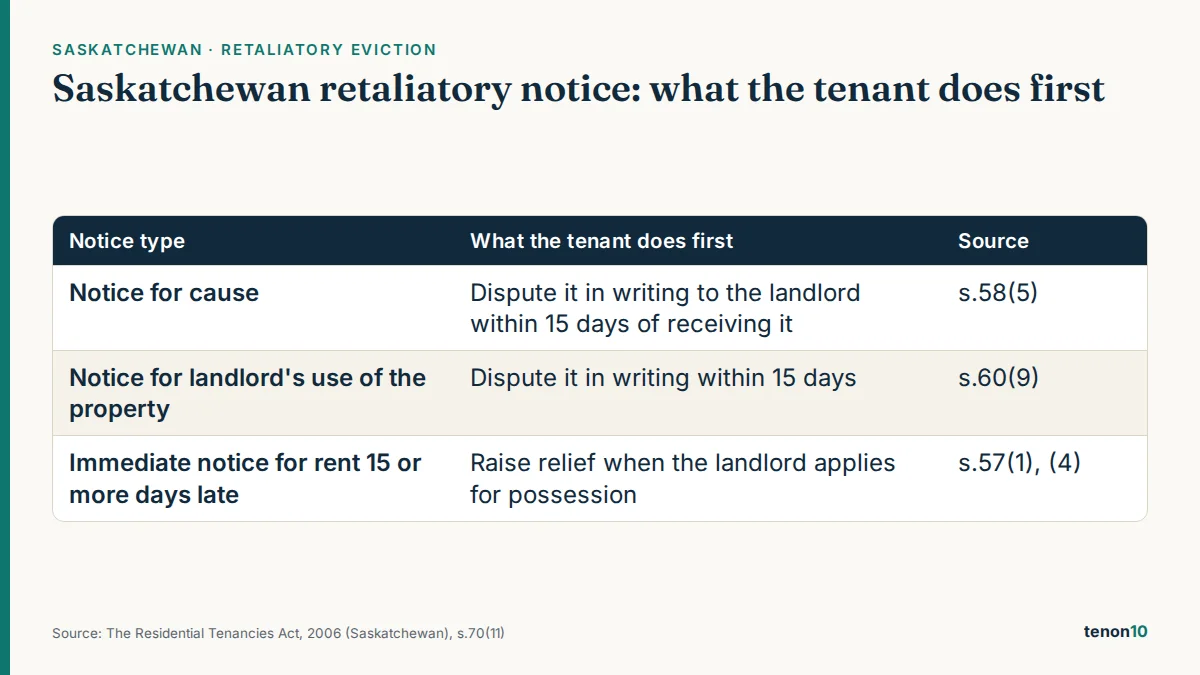
| Notice type | What the tenant does first | Source |
|---|---|---|
| Notice for cause | Dispute it in writing to the landlord within 15 days of receiving it | s.58(5) |
| Notice for landlord's use of the property | Dispute it in writing within 15 days | s.60(9) |
| Immediate notice for rent 15 or more days late | Raise relief when the landlord applies for possession | s.57(1), (4) |
A tenant who does not dispute a s.58 or s.60 notice within 15 days is deemed to accept that the tenancy ends on the notice's effective date, unless the landlord applied to the ORT before the 15 days ran out (s.58(6)-(7), s.60(10)-(11)). Once a tenant disputes, the landlord must apply and carries the burden of proving the right to end the tenancy (s.67(1)-(2)). The steps are in how to dispute a notice to vacate within 15 days.
What relief can the hearing officer order?

The hearing officer can order relief on rent or reasonable compensation, and an order restraining the landlord's breach of the agreement or a standard condition (s.70(12)). The terms and conditions are set with regard to the conduct of both parties and the other circumstances (s.70(12)).
Frequently asked questions
Does a complaint stop the landlord from ever ending my tenancy?
No. Section 70(11) lets a hearing officer grant relief when a notice was given because of the complaint. A landlord with a valid, separate reason can still apply, and the hearing officer weighs the evidence.
Which complaints count?
A good faith complaint to the director of residential tenancies, any agency of the Government of Saskatchewan or Canada, or a municipality, alleging a breach of a law dealing with health or safety standards, including housing standards (s.70(11)(a)). A complaint to a municipality's bylaw office about housing standards is one example.
The landlord raised my rent and then served a notice for unpaid rent. Is that covered?
It can be. If the unpaid amounts result from an increase the landlord made to be able to end the tenancy, and relief is just and equitable, s.70(11)(d) applies. A notice for unpaid rent also has no effect if the unpaid amount is one the Act lets the tenant deduct (s.57(3)). If you received an immediate notice, read what tenants can do now.
Can I complain about repairs instead of waiting for a notice?
Yes. A tenant can apply to the ORT on any residential tenancy dispute, such as a landlord's failure to repair (s.70(1)). The landlord's notice options are listed in every landlord notice, ground and deadline.
Saskatchewan Retaliatory Notice: Tenant Checklist
A one-page checklist for Saskatchewan tenants who received a notice after a health, safety or housing complaint, or after asserting their rights.
Get Free PDF →Key takeaways
- Relief under s.70(11) covers notices given because of a health or safety complaint or because the tenant asserted their rights.
- Dispute a cause or landlord's-use notice in writing within 15 days (s.58(5), s.60(9)).
- The hearing officer can grant relief on rent or compensation and restrain the landlord's breach (s.70(12)).
Put your dispute in writing
Free tenant forms and letters for notices, repairs and records.
Free • No signup required