

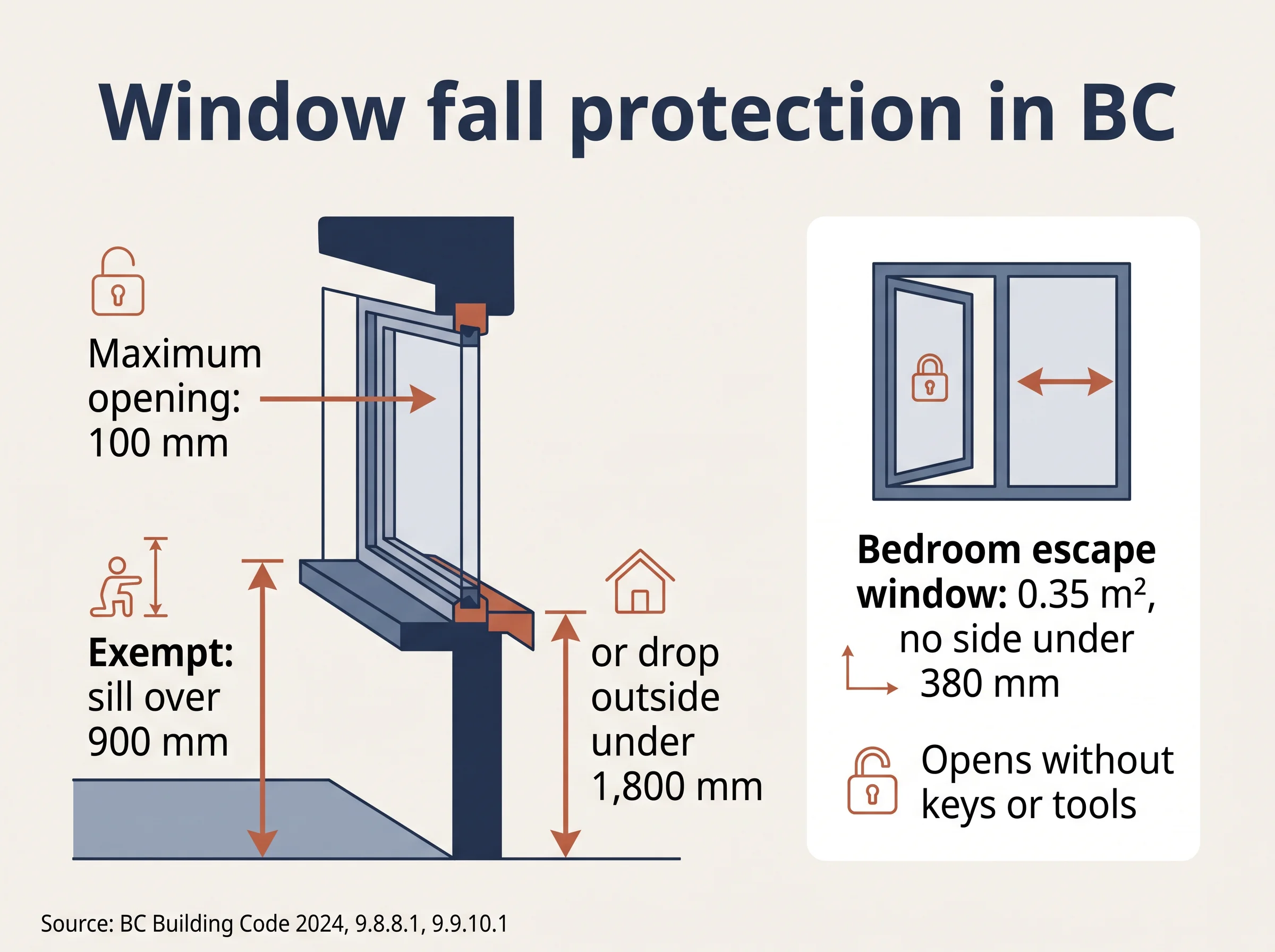
Window safety in BC rentals starts with the BC Building Code 2024: for new work, Article 9.8.8.1 requires openable windows in residential buildings to have a guard or a device limiting the opening to 100 mm, with exceptions for high sills and short drops, while bedroom escape windows must still open fully from the inside (Article 9.9.10.1).
When the weather warms up, BC Children's Hospital reminds parents that young children fall from open windows; its emergency department treated 19 of them in a single year. In a rental, two questions follow: does the landlord have to install window limiters or guards, and can a tenant add their own? The answers sit across three sources: the BC Building Code, which sets the standard for construction and alterations; the Residential Tenancy Act, which sets the landlord's repair duty; and the Residential Tenancy Branch (RTB) guidance on changes to a rental unit. This guide sets out what each one says and where the rules are unclear.
Do BC landlords have to install window limiters in rentals?
For new work, yes: the BC Building Code 2024 requires fall protection on openable windows in residential buildings unless an exception applies. For an existing BC rental that is not being altered, the Residential Tenancy Act does not name window limiters, and whether an older building must be upgraded is not spelled out.
The conservative approach for BC landlords: keep any safety device that is there in working order, bring windows up to the current code when you replace them, and respond quickly to a family's request. Bedroom windows that serve as the room's emergency exit must still open fully from the inside without keys, tools or special knowledge, unless the suite is sprinklered.
Why does window fall prevention matter in BC?
BC Children's Hospital reported that 19 children were treated in its emergency department after falling from windows in 2022, and that the average age of these children is between three and six (BC Children's, August 2023). The hospital's advice is that windows should not open more than 10 centimetres (four inches), that window opening control devices also need a safety release in case of fire, that furniture and anything climbable should be moved away from windows, and that "screens keep bugs out, not children in".
What does the BC Building Code 2024 say about window limiters?
The BC Building Code 2024 requires openable windows in residential buildings to be protected by a guard or by a mechanism, released only with tools or special knowledge, that keeps any clear opening to 100 mm or less (Division B, Article 9.8.8.1). The province publishes the BC Building Code 2024 as a downloadable PDF; together with the BC Plumbing Code it regulates new construction, building alterations and repairs, and demolitions. The relevant Part 9 rules compare as follows:
| Situation (BC Building Code 2024) | Requirement | Provision |
|---|---|---|
| Openable window in a building of residential occupancy | A guard, or a mechanism released only with tools or special knowledge that limits any clear opening to 100 mm, measured vertically or horizontally | Art. 9.8.8.1(4) |
| Bottom edge of the openable part more than 900 mm above the finished floor, or less than 1,800 mm above the floor or ground on the other side | That protection is not required | Art. 9.8.8.1(5) |
| Door in a residential building where the floor on one side is more than 600 mm above the surface on the other (such as a "Juliet" opening) | A similar 100 mm rule | Art. 9.8.8.1(3) |
| Rotary crank operator | Cannot meet the 100 mm requirement or act as a guard, even with the handle removed | Note A-9.8.8.1.(4) |
| Bedroom window or door required for escape, in a suite that is not sprinklered | Opens from the inside without keys, tools or special knowledge, and without removing sashes or hardware; unobstructed opening of at least 0.35 m² with no dimension under 380 mm; stays open in an emergency without extra support | Art. 9.9.10.1 |
The code's explanatory Note A-9.8.8.1.(4) says the aim is to minimize the likelihood of small children falling significant heights from open windows, and that the requirement applies to openable windows in dwelling units, generally on the second floor or higher. It points to ASTM F2090 for window opening control devices, and gives examples such as a fixed-stop lever, a fixed-length cable and a fixed-position stop block.
Does the BC Building Code apply to an existing rental?
Only partly. The BC Building Code is written primarily for new construction, and its application to existing buildings (Division A, 1.1.1.2) says that when a building is altered, renovated or repaired, the level of life safety and building performance must not be decreased below what already exists. We did not find a provincial rule that requires BC landlords to retrofit window limiters in an older building that is not being altered.
The province also notes that BC Codes do not apply in the City of Vancouver, which has its own building bylaw, so Vancouver owners should check the city's rules.
What the Residential Tenancy Act does require (see our guide to repairs and maintenance in BC) is in section 32(1): the landlord must keep the property in a state of repair that complies with the health, safety and housing standards required by law and makes it suitable for occupation. The conservative reading for landlords:
- Any limiter, stop or guard already installed is part of the property and should be kept working. A broken stop is a repair.
- When windows are replaced, the new installation should meet the current code, including fall protection and bedroom egress.
- A tenant who reports a window that swings wide open at floor level, above a significant drop, should get a prompt written response.
Can a BC tenant install window stops in a rental?
A BC tenant should get the landlord's written consent first. The RTB's Policy Guideline 1 says any change to the rental unit not explicitly consented to by the landlord must be returned to its original condition, and if it is not, the landlord may restore it and claim the cost.
So a tenant should ask in writing before screwing hardware into frames, and a landlord should say yes in writing, ideally specifying the product and agreeing it can stay at move-out. Adhesive or clamp-on stops that leave no damage are less likely to cause a dispute, but the safest path is still written consent.
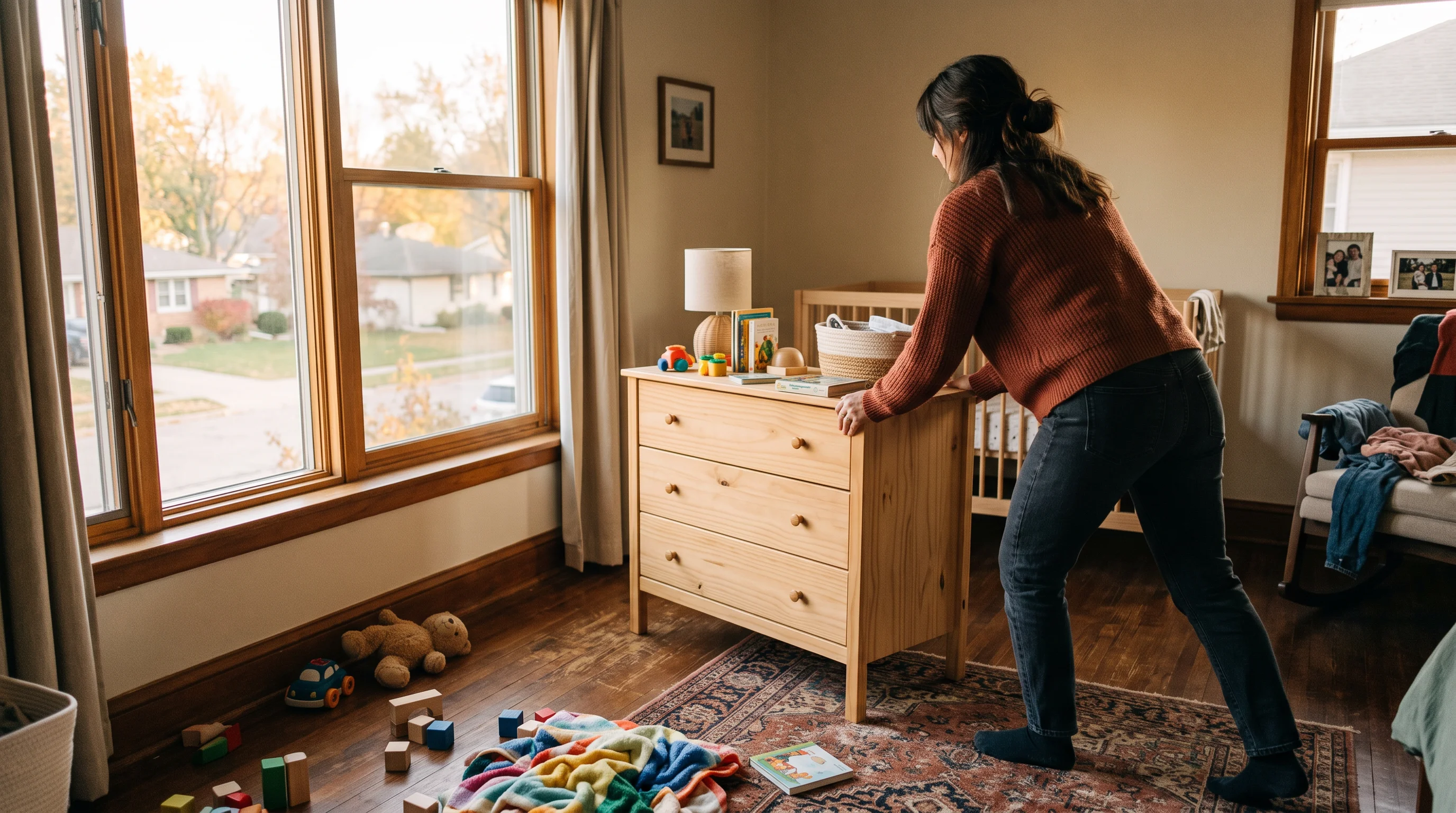
A landlord entering to install stops still needs the tenant's consent or proper written notice; see tenant rights in BC. Both sides should keep in mind the bedroom egress rule above: a stop that cannot be released quickly by an adult in a fire creates a different danger.
What about balconies and sliding doors in BC rentals?
Sliding patio doors and balconies in BC rentals raise the same fall risk, and the code's guard rules in Article 9.8.8 cover balconies and raised surfaces. In a strata building, balcony railings are usually the strata corporation's to repair under the Standard Bylaws.
BC Children's asks families to keep children safe near windows and on balconies, and to move anything that can be climbed on away from windows. A railing that is loose or damaged is a repair to report in writing right away.
Who handles window safety devices in a BC strata building?
In most BC strata buildings, windows on the building exterior are repaired and maintained by the strata corporation under section 8 of the Standard Bylaws, and owners need written approval to alter them under section 5. An owner-landlord who wants to add limiters to exterior windows should check the strata's bylaws and ask the strata in writing first.
Our guide to renting out a strata unit in BC covers how strata rules bind tenants.
How do you choose a licensed window contractor for safety work in BC?
Safety work is mostly about the details of the hardware and the opening. Ask the installer to put in writing:
- Which windows get fall protection, and whether it is a guard or a window opening control device.
- The product's standard, such as certification to ASTM F2090 for opening control devices, and how an adult releases it in an emergency.
- How bedroom escape openings will still meet the 0.35 square metre and 380 mm minimums after installation.
- Whether a permit is needed for the job in your municipality.
- Proof of a valid business licence and liability insurance.
Frequently asked questions
How far can a rental window open under the BC Building Code?
Where the BC Building Code 2024 requires fall protection, a window opening control device must keep any clear opening to 100 mm or less (Article 9.8.8.1). BC Children's Hospital gives similar advice to families: windows should not open more than 10 centimetres, or four inches.
Can a window limiter go on a bedroom window in a BC rental?
Not on the bedroom's required escape window without checking first. In Building Code Appeal Board decision 1940, the Board found that a 100 mm opening control device could satisfy the window-fall rule but not the egress rule, so the window required for egress could not be fitted with that restrictor. Confirm the approach with the local building official.
Do window screens stop children from falling in BC?
No. BC Children's Hospital warns that "screens keep bugs out, not children in". It recommends window opening control devices with a safety release in case of fire, and moving furniture and anything climbable away from windows.
Do the BC Building Code window rules apply in Vancouver?
No. The province notes that BC Codes do not apply in the City of Vancouver, which has its own building bylaw. Vancouver rental owners should check the city's rules before installing or replacing windows.
Can a BC landlord charge a tenant for window stops the tenant installed?
Possibly, if the tenant installed them without consent. RTB Policy Guideline 1 says a change the landlord did not explicitly consent to must be returned to its original condition, and if it is not, the landlord may restore it and claim the cost. Written consent before installation avoids the dispute.
Make safety checks part of the routine
Tenon10 lets you schedule maintenance visits, track repair requests from tenants and keep your own vendor list, so a broken window stop gets logged and fixed instead of forgotten.
Built for Canadian landlords and property managers.


