Does the Residential Tenancy Act apply? In BC, it applies to almost every home rented out for money, including a basement suite, a room in a house the owner does not live in, and a deal the paperwork calls a "licence to occupy". It does not apply only where section 4 of the Act excludes the accommodation, such as a home shared with the owner's kitchen or bathroom.
Is a "licence to occupy" outside the BC Residential Tenancy Act?
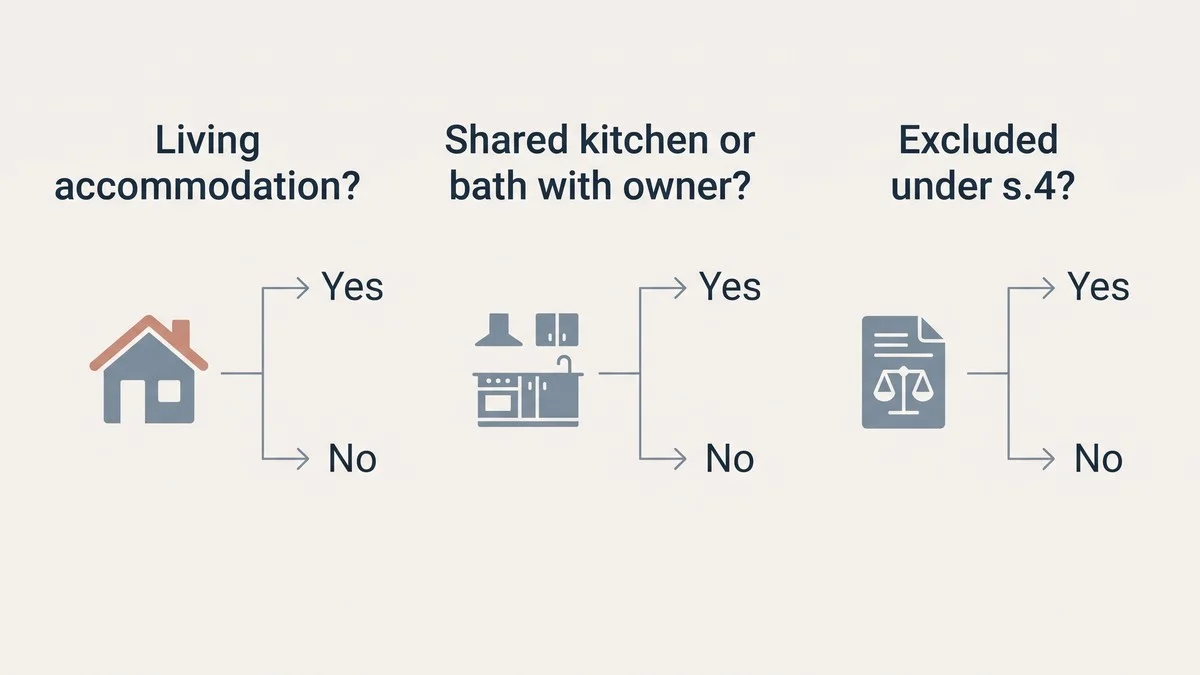
No, not for a rental unit. The Residential Tenancy Act defines a tenancy agreement as an agreement, written or oral, express or implied, about possession of a rental unit, and says it "includes a licence to occupy a rental unit". RTB Policy Guideline 9 notes the contrast: the Manufactured Home Park Tenancy Act does not include licences, which is why the licence question matters mainly for RV and campground sites.
Labels do not decide it either. Section 5 says landlords and tenants cannot contract out of the Act, and any attempt has no effect. A signed clause saying "this is not a tenancy" does not remove the tenant's protections.
The factors that point to a tenancy

Guideline 9 says that, unless the circumstances suggest otherwise, a tenancy is presumed where the occupant gets exclusive possession of the unit or site for a term, subject to the landlord's right of access, and pays a fixed amount of rent. A licence, by contrast, is permission to use the space that can be revoked at any time. An arbitrator looks at what the parties intended and all the circumstances; no single factor decides it.
The guideline's list, written mainly for RV parks and campgrounds, shows the kind of facts that weigh against a tenancy:
- the owner keeps control of parts of the site and can enter without notice;
- rent is charged daily or weekly, with GST, rather than monthly;
- the parties agreed the occupier can be removed without a reason or leave without notice;
- the arrangement has not been in place for long;
- the owner pays utilities such as electricity and wi-fi; and
- there are restricted visiting hours.
Other factors include whether a security deposit was paid, and whether the occupancy was given out of a family or personal relationship and generosity rather than as a business arrangement. Guideline 9 also says a landlord's failure to comply with local bylaws does not invalidate a tenancy agreement: it is the actual use and the nature of the agreement that decide.
What does section 4 of the BC Residential Tenancy Act exclude?
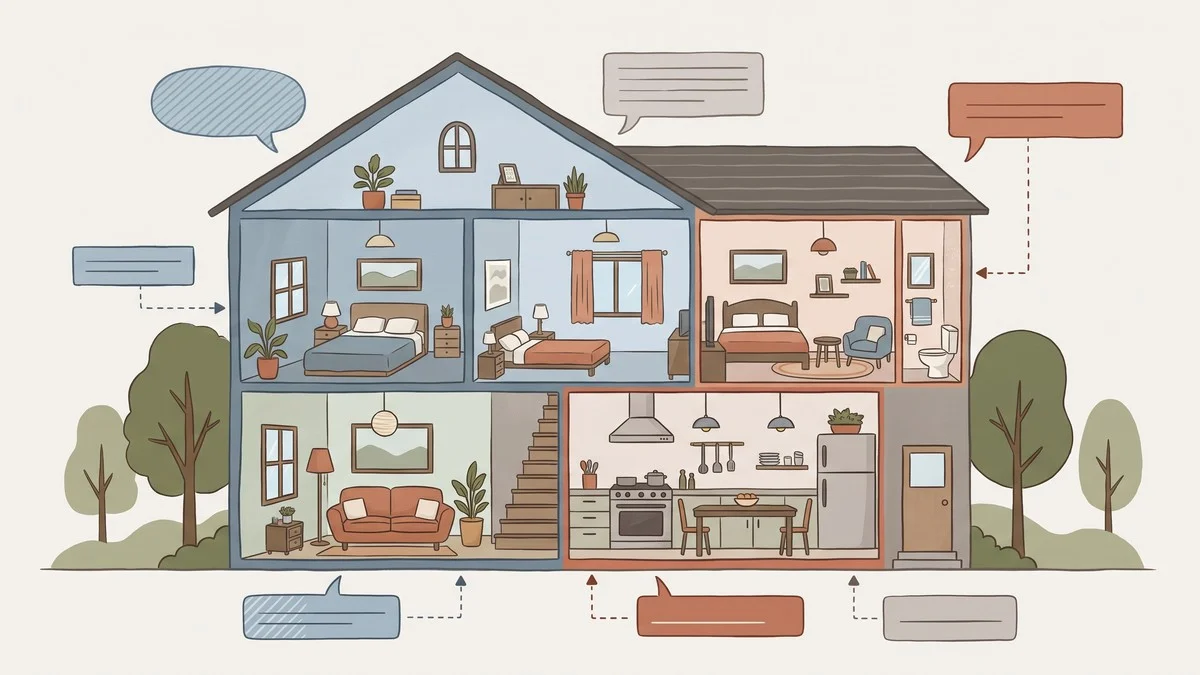
Section 4 lists the accommodation the Act does not apply to. The main exclusions are:
| Excluded (RTA s.4) | Typical example |
|---|---|
| Sharing a bathroom or kitchen with the owner (4(c)) | A room in the owner's own home with a shared kitchen |
| Vacation or travel accommodation (4(e)) | A nightly short-term rental |
| Housing co-op unit rented to a member (4(a)) | A non-profit co-op home |
| Student or staff housing owned or operated by an educational institution (4(b)) | A university residence |
| Living space in premises primarily used for business, under one agreement (4(d)) | A shop with a flat above, leased together |
| Emergency shelter or transitional housing (4(f)) | A funded, temporary program bed |
| Care facilities, hospitals and treatment housing (4(g)), and correctional institutions (4(h)) | A licensed community care home |
| A tenancy agreement with a term longer than 20 years (4(i)) | A very long fixed lease |
| Manufactured home sites under the MHPTA (4(j)) | A pad in a manufactured home park |
The shared-facilities exclusion is the one landlords meet most often; it is covered in shared accommodation in BC. Sharing with other tenants, rather than the owner, does not trigger it; see co-tenants, roommates and occupants.
Exclusions that are narrower than they sound
RTB Policy Guideline 46 says that where the wording of an exclusion is ambiguous, a narrow reading best protects tenants. Several exclusions have specific tests:
- Transitional housing must meet all three parts of the Regulation's definition: provided on a temporary basis, by a person or organization funded by a local government or the BC or federal government to provide it, together with programs to help residents live independently. Having residents sign a "transitional housing agreement" does not settle it.
- Emergency shelter covers temporary overnight shelter, or in extreme cases shelter until an emergency is over.
- Treatment housing under section 4(g)(vi) generally means residency depends on actively receiving the provider's rehabilitative or therapeutic services and is time-limited.
- Assisted living: section 1.3 of the Residential Tenancy Regulation excludes a unit in an assisted living residence occupied by a resident under the Community Care and Assisted Living Act.
- Housing co-ops: the exclusion is for a unit rented to a member. RTB Policy Guideline 14 notes that if a non-member rents from a member, the RTA may apply.
How does the RTB decide if a unit is commercial or residential?
By its predominant purpose. Policy Guideline 14 says neither tenancy act applies to a commercial tenancy, and an arbitrator looks at factors such as the floor area used for business compared with living space, employees and clients on the premises, and visible signs of the business. Using part of a home for work does not by itself make it commercial; the question is what the premises are predominantly used for. Guideline 14 adds that renting a unit and re-renting it to others usually stays under the RTA or MHPTA.
Guideline 14 also cites Gardiner v. 857 Beatty Street Project, 2008 BCCA 82, where the Court of Appeal looked at the predominant and legally authorized use, focusing on zoning, development permits, lease terms and municipal policy, rather than on how the occupant subjectively saw the space. A live-work unit permitted mainly for business can therefore fall outside the Act even if someone lives there.
A quick way to check your own rental
- Is someone paying money or value for the right to possess living space? If not, there is likely no tenancy.
- Do they have exclusive possession of a unit for a term, at a fixed rent? That points to a tenancy, whatever the paperwork is called.
- Do they share a kitchen or bathroom with the owner, not just with other tenants? If so, section 4(c) excludes it.
- Is it vacation or travel accommodation, a co-op member's unit, institution-owned student or staff housing, a shelter, or a care, treatment or correctional facility? Check the specific test above.
- Is the space part of premises used mainly for business and rented under one agreement? Apply the predominant-purpose test.
- If none of the exclusions clearly applies, treat the Act as applying.
Frequently asked questions
Who has to prove the Act does or does not apply?
RTB Policy Guideline 46 says the person claiming the Act applies must first show an agreement to possess the space for rent; the person relying on an exclusion must then prove it, on a balance of probabilities.
Is a room rented in a house where the owner does not live covered?
Yes, unless another exclusion applies. The section 4(c) exclusion needs the tenant to share a bathroom or kitchen with the owner, not just with other tenants.
Are Airbnb-style stays covered by the RTA?
No. Section 4(e) excludes accommodation occupied as vacation or travel accommodation. Separate provincial and city rules apply; see BC's short-term rental principal residence rules.
Does supportive housing fall under the RTA?
Yes. Guideline 46 says the Act applies to supportive housing that meets section 4.2, except the sections on quiet enjoyment, landlord entry and guests. Transitional housing that meets the regulation's definition is excluded.
Can a 17- or 18-year-old sign a BC tenancy agreement?
Yes. Section 3 says a person under 19 may enter into a tenancy agreement, and the agreement and the Act are enforceable by and against them.
What if the RTB finds it has no jurisdiction?
It declines to decide the dispute. A commercial tenancy, for example, is governed by contract law instead (Guideline 14).
Covered by the Act? Use the agreement it requires
Fill in BC's Residential Tenancy Agreement (RTB-1) online.
Free • No signup required