To evict a tenant immediately in Saskatchewan, a landlord cannot change the locks; the only fast lawful route is an application to the Office of Residential Tenancies (ORT) under s.68 of The Residential Tenancies Act, 2006. It lets a hearing officer end the tenancy earlier than a one-month notice for cause would, and no notice to end the tenancy is needed first (s.68(1), (3)). The ORT calls it a possession application for eviction in serious circumstances. For the ordinary routes, see how eviction works in Saskatchewan.
What must the landlord prove?
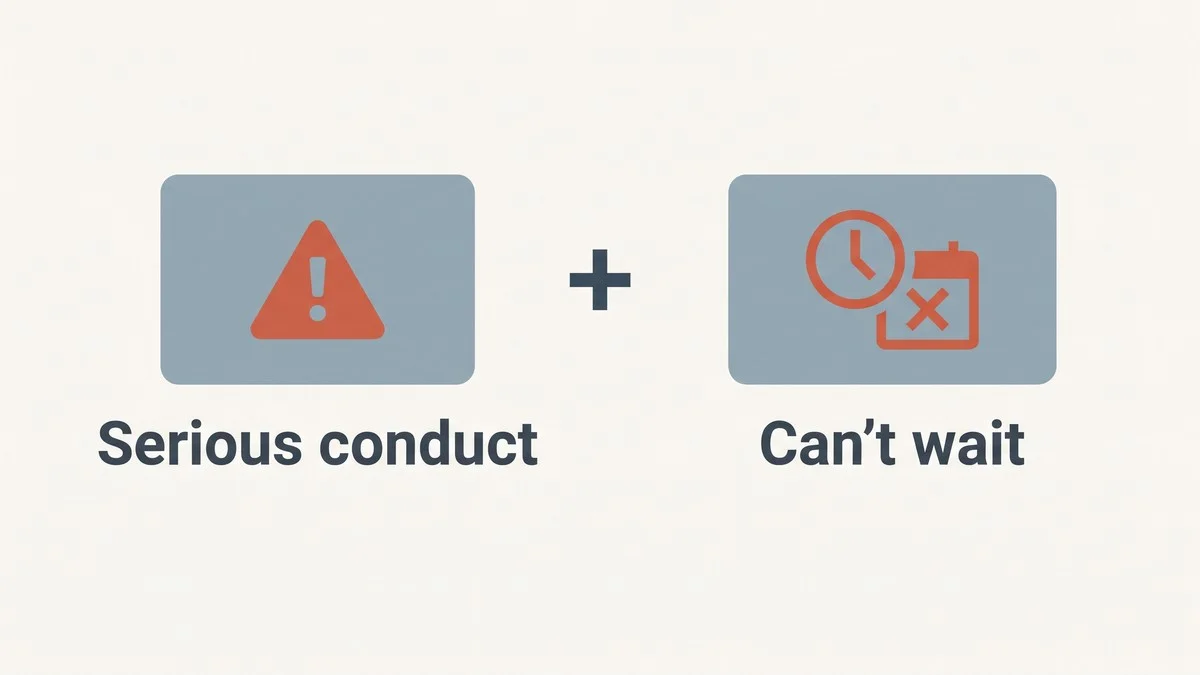
Two things (s.68(2)). First, that the tenant, or someone the tenant let onto the property, did at least one of these:
- significantly interfered with or unreasonably disturbed another occupant, the landlord or neighbours;
- seriously jeopardized someone's health, safety or lawful right;
- put the landlord's property at significant risk;
- engaged in noxious, offensive or illegal activity causing, or likely to cause, damage or harm to others' safety or quiet enjoyment;
- caused extraordinary damage to the property.
Second, that it would be unreasonable to wait for a s.58 notice to take effect. Saskatchewan's guidance says significant evidence is required.
Serious circumstances or a one-month notice for cause?

The conduct grounds in s.68(2)(a) are the same ones that support a notice for cause under s.58(1)(d) to (f). What differs is speed and the second test.
| Serious circumstances (s.68) | Notice for cause (s.58) | |
|---|---|---|
| Notice to the tenant first | None (s.68(3)) | Written notice ending the tenancy at least one month after it is received, on the day before a rent day (s.58(3)) |
| Chance to fix the problem | Not required by s.68 | A reasonable period to remedy anything that can be remedied (s.58(2)) |
| Tenant's response | Answers at the hearing | May dispute in writing within 15 days of receiving the notice (s.58(5)) |
| Extra test | Unreasonable to wait for a s.58 notice (s.68(2)(b)) | None beyond the ground |
The s.58 route also covers grounds that s.68 does not, such as repeated late rent or an unapproved sublet. If waiting a month is merely inconvenient rather than unreasonable, the notice for cause is the route the Act expects.
How does the application work?

Apply through the ORT portal with the $50 filing fee or a fee waiver application. No prior notice to vacate or Certificate of Service is needed (ORT Rules of Procedure, Part 2). Possession applications are urgent, and the hearing notice must be served on the tenant at least two days before the hearing (Parts 3 and 4).
Step by step
- Assemble the evidence described below, and a copy of the written tenancy agreement if there is one.
- File the Landlord Application for Possession online and pay the fee. The fee is non-refundable (s.70(2.01)).
- Serve the hearing notice on the tenant at least two days before the hearing. A current tenant can be served personally, or by posting it on the unit's door and sending a copy by ordinary mail or electronically.
- Prove service. Complete the Certificate of Service in the portal and a manual one uploaded as evidence, and upload the full hearing notice as served. Service by text or email needs proof of prior communication at that address.
- Attend the hearing, normally by phone. If the tenant was given notice and does not attend, the hearing officer may proceed and decide as if they were present (s.73(4)).
- Enforce the order. If possession is granted, the hearing officer may order a writ of possession directed to the sheriff at the nearest judicial centre (s.70(13)).
Evidence that carries a serious-circumstances hearing
The formal rules of evidence do not apply at the ORT. A hearing officer may admit any testimony, record or thing they consider credible, trustworthy and relevant (s.75). In practice that means:
- dated photos or video of the damage or conduct, with repair quotes or invoices;
- written statements from the tenants, neighbours or staff affected, and those people available to speak at the hearing;
- police file numbers. The ORT can be asked in writing to subpoena a police file, though it cannot subpoena RCMP files, and it can be asked to summon a witness who will not come voluntarily; both are at the hearing officer's approval;
- a short timeline showing why the next month matters, which is what the second test turns on.
Uploading evidence is not service. Each party must also send its evidence to the other well before the hearing, and evidence not disclosed in advance may not be considered (ORT Rules of Procedure, Part 4).
What if the ORT says no?
The hearing officer may still end the tenancy as if a s.58 notice had been given, and make the orders that would follow from one (s.68(4)). If granted, an order is enforced through a writ and the sheriff (s.65); see how a writ of possession is enforced. A separate order under The Safer Communities and Neighbourhoods Act can also end a tenancy (s.67(5)).
What a landlord must not do while waiting
- Lock the tenant out. A landlord may regain possession only if the tenant has left or abandoned the unit, or with an order for possession and a writ directed to the sheriff (s.65). A hearing officer who finds an unjustified lockout may award punitive damages (s.66(4)).
- Take or hold the tenant's belongings without a court order or the abandonment process (s.12).
- Cut off a service or facility without the tenant's agreement or an ORT order (s.43(1)).
Breaking the Act is an offence, with fines of up to $500 for an individual and $1,000 for a corporation (s.79(2)).
What the tenant can do
A tenant served with a serious-circumstances hearing notice should upload their own evidence, serve it on the landlord, and attend. A tenant who did not receive notice of the hearing, or was not heard, can ask in writing for a re-hearing (s.73(5)), but for possession applications a re-hearing does not stop the landlord from enforcing the writ. An appeal to the Court of King's Bench is on a question of law or jurisdiction and must be made within 30 days after the order is signed and dated (s.72(1)). The certificate of payment of rent that s.72(1.3) requires is tied to possession orders after a notice for non-payment or repeated late payment. Tenants facing a notice can also read what to do after a notice to vacate.
Frequently asked questions
Does the tenant have to be the one who caused the problem?
No. Section 68(2)(a) covers the tenant or a person the tenant permitted on the property.
Does there need to be a criminal charge first?
Section 68 does not mention a charge or conviction. The hearing officer decides whether the evidence meets both tests.
Is the application fee refunded if I win?
The fee itself is non-refundable (s.70(2.01)); ask the hearing officer whether it can be awarded against the other party.
For timing across every route, read how long a Saskatchewan eviction takes.
More guides for landlords
Notices, hearings and compliance for Saskatchewan and across Canada.
Free • No signup required