In Saskatchewan, a lease clause that conflicts with The Residential Tenancies Act, 2006 does not count. Illegal lease clauses in Saskatchewan are unenforceable even if you signed them: a term inconsistent with the Act or regulations, an unconscionable term or an unclear term cannot be enforced (s.7(2)), and any agreement that the Act does not apply is void (s.6).
This guide lists the clauses that most often break the rules, with the section that overrides each one, and what a tenant can do about them. For your other rights, see Saskatchewan tenant rights: a complete guide and the Saskatchewan Tenant Resource Center.
Saskatchewan Lease Clause Check: Tenant Checklist
A one-page checklist for Saskatchewan tenants reviewing a lease: fees, deposits, entry, locks, repairs and services, with the section for each.
Get Free PDF →Why does an illegal clause not count in Saskatchewan?
Three rules work together:
- No contracting out. Every agreement, verbal or written, that the Act or any part of it does not apply, or that a benefit or remedy under it is not available, is void (s.6).
- Unenforceable terms. A provision is not enforceable if it is inconsistent with the Act or regulations, unconscionable, or not expressed in a way that clearly communicates the rights and obligations under it (s.7(2)).
- Standard conditions win. The standard conditions in the regulations are part of every tenancy agreement and cannot be changed or removed by amendment (s.22(1)). The standard conditions themselves state that a term contradicting or changing a right or obligation under the Act, regulations or standard conditions is void and cannot be enforced (Standard Conditions s.1(3)).
The rest of the lease still applies. Only the offending provision drops out.
Which lease clauses are illegal in Saskatchewan?

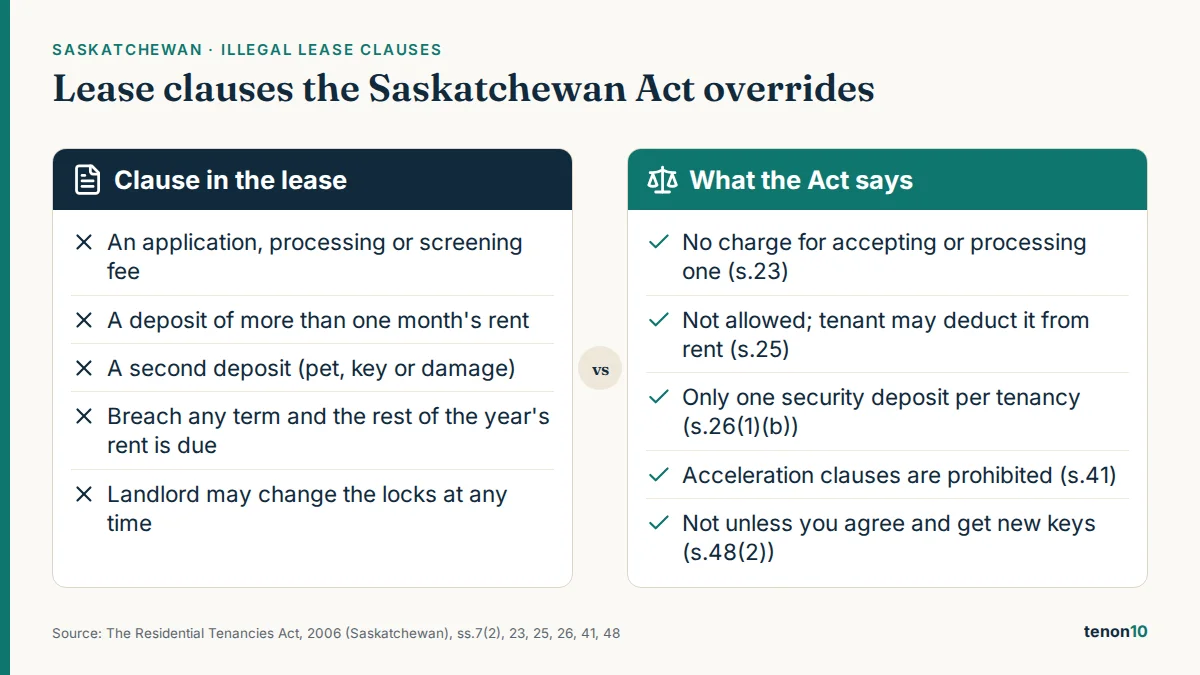
The table below sets out common clauses and the provision that overrides each.
| Clause in the lease | What the Act says | Section |
|---|---|---|
| An application, processing or screening fee | A landlord must not charge for accepting or processing an application, checking suitability or accepting a tenant | s.23 |
| A deposit of more than one month's rent | Not allowed; the tenant may deduct the overpayment from rent or otherwise recover it | s.25(1)-(2) |
| The full deposit up front | No more than 50% when the agreement is entered into; the rest within two months after the tenant takes possession | s.26(4) |
| A second deposit (pet, key or damage) on top of the security deposit | A landlord must not require or accept more than one security deposit for a tenancy | s.26(1)(b) |
| A deposit demanded partway through the tenancy | Only when the agreement is entered into, except where a Saskatchewan Assistance Act guarantee is withdrawn | s.26(1)(a), (2) |
| "The deposit is kept automatically at move-out" | A landlord must not include a provision that it automatically keeps all or part of the deposit | s.26(1)(c) |
| Prepaid future rent beyond the deposit | A landlord must not demand, receive or collect money to be used to pay rent that becomes due in the future | s.40 |
| "Breach any term and the rest of the year's rent is due" | Acceleration clauses are prohibited | s.41 |
| "Landlord may enter at any time" | Entry needs permission, 24 hours' to seven days' written notice with a reasonable purpose and a four-hour window between 8 a.m. and 8 p.m., or another listed ground | s.45(1)-(2) |
| "Landlord may change the locks at any time" | A landlord must not change the locks to your unit unless you agree and get new keys | s.48(2) |
| "Tenant accepts the unit as is and does all repairs" | The landlord must keep the property in a good state of repair even if the disrepair was known before the tenancy | s.49(1)(a) |
| "Tenant pays for normal wear and tear" | A tenant is not required to repair reasonable wear and tear | s.49(7) |
| "Landlord may hold your belongings for unpaid rent" | A landlord must not seize a tenant's personal property without a court order or an order under s.85 | s.12 |
| "No subletting or assignment, ever" | Assignment, and subletting under a fixed term, needs written consent, which must not be unreasonably withheld; the fee is capped at $20 | s.50(1)-(2); Regulations s.8 |
| "Free parking or laundry may be cut or charged at any time" | Terminating or restricting a service, or charging for one that was free, needs your agreement or an ORT order | s.43 |
What about house rules in Saskatchewan?

A landlord may set and enforce rules about the use, occupancy or maintenance of the unit and the property, and the use of services and facilities, but only if the rules are in writing, made known to the tenant and reasonable (s.22.1(1)-(2)). If you think a rule is unreasonable, you can apply to the Office of Residential Tenancies (ORT), and the hearing officer may make any just and equitable order (s.22.1(3)).
Rules can cover things like cannabis in the unit, which s.22.1(1)(a) names expressly. They cannot be used to change a standard condition or take away a right the Act gives you.
Can a landlord change the lease after I sign it?
Only with your agreement. Apart from standard conditions, which cannot be changed at all, a term may be added, removed or changed only if both the landlord and tenant agree (s.22(1)-(2)). The exceptions are a rent increase given with proper notice under s.54 and a change the ORT orders can be made without the other party's agreement (s.22(3)).
In a fixed term tenancy, the rent cannot be increased during the term unless the amount and timing of the increase were set out in the signed lease (s.53.1; Standard Conditions s.5(4)).
What else must a Saskatchewan lease include?
A written tenancy agreement must contain the standard conditions, the correct legal names of the landlord and tenant, the rental unit's address, the date it was entered into, the landlord's or agent's address for service and phone number, and an emergency contact number if different (s.19(1)). A fixed term tenancy of three months or longer must be in writing (s.20). The landlord must give the tenant a copy of the signed agreement within 20 days (Standard Conditions s.2(1)).
If a written agreement has no end date for a fixed term, the tenancy is deemed month-to-month (s.21).
What can a tenant do about an illegal clause?
- Identify the section. Use the table above and the Act to find the provision that overrides the clause.
- Raise it in writing. Tell the landlord which clause you will not follow and why, and keep a copy.
- Use the self-help the Act allows. An overpaid deposit can be deducted from rent (s.25(2)).
- Apply to the ORT. A tenant can apply for an order on any residential tenancy dispute (s.70(1)). A landlord or tenant who breaches the Act or the agreement must compensate the other for resulting loss, and the person claiming must take reasonable steps to keep the loss down (s.8).
Applications generally must be made within one year after the act or omission they are about (s.71.1). See ORT hearings, the $50 fee and what happens next for the process.
Frequently asked questions
I signed the lease. Doesn't that make the clause binding?
No. Signing does not make an inconsistent, unconscionable or unclear term enforceable (s.7(2)), and an agreement that the Act does not apply is void whether it is verbal or written (s.6).
Can my landlord charge a pet deposit in Saskatchewan?
Not as a second deposit. A landlord may require or accept only one security deposit per tenancy, capped at one month's rent (s.25(1), s.26(1)(b)).
Can my landlord make me pay the whole deposit on move-in day?
No. A landlord may require no more than 50% of the security deposit when the agreement is entered into, and the remainder within two months after you take possession (s.26(4)). Fees in a lease, such as late or NSF charges, are covered in late fees and NSF charges in Saskatchewan leases.
Does an illegal clause cancel my whole lease?
No. Section 7(2) makes the offending provision unenforceable. The rest of the agreement, and the standard conditions, continue to apply. If you want to leave early, see breaking a lease in Saskatchewan.
Can a lease say the landlord does not have to make repairs?
No. The duty to maintain the property in a good state of repair applies even where the disrepair was known before the tenancy (s.49(1)(a)), and a term changing a standard condition cannot be enforced (s.22(1); Standard Conditions s.1(3)).
Saskatchewan Lease Clause Check: Tenant Checklist
A one-page checklist for Saskatchewan tenants reviewing a lease: fees, deposits, entry, locks, repairs and services, with the section for each.
Get Free PDF →Key takeaways
- Terms inconsistent with the Act, unconscionable or unclear are unenforceable (s.7(2)); contracting out is void (s.6).
- Common illegal terms: application fees, a second deposit, automatic deposit forfeiture, acceleration clauses, entry at any time and lock changes without agreement.
- Keep paying rent and use the ORT to resolve the dispute (s.42(1), s.70(1)).
Put your lease concerns in writing
Free tenant forms and letters for notices, repairs and records.
Free • No signup required