If a Saskatchewan landlord ended your tenancy to move in, sell to a buyer who would move in, or renovate or demolish, and then did not follow through, you can apply to the Office of Residential Tenancies for compensation for your losses (The Residential Tenancies Act, 2006, s.62). Apply within one year (s.71.1).
If your landlord didn't move in after evicting you in Saskatchewan, they may owe you money. Section 62 is the Act's check on notices given under s.60, the "no-fault" notices that end a month-to-month tenancy because the landlord, a family member, a buyer or a renovation needs the unit. This guide shows when the claim applies, what to gather and how to apply. If you have just received such a notice, start with How to Dispute a Notice to Vacate in Saskatchewan Within 15 Days.
Saskatchewan s.62 Compensation: Tenant Checklist
A one-page checklist for Saskatchewan tenants claiming compensation when a no-fault notice was not followed through: evidence, losses, the $50 fee and the one-year limit.
Get Free PDF →When can you claim compensation in Saskatchewan?
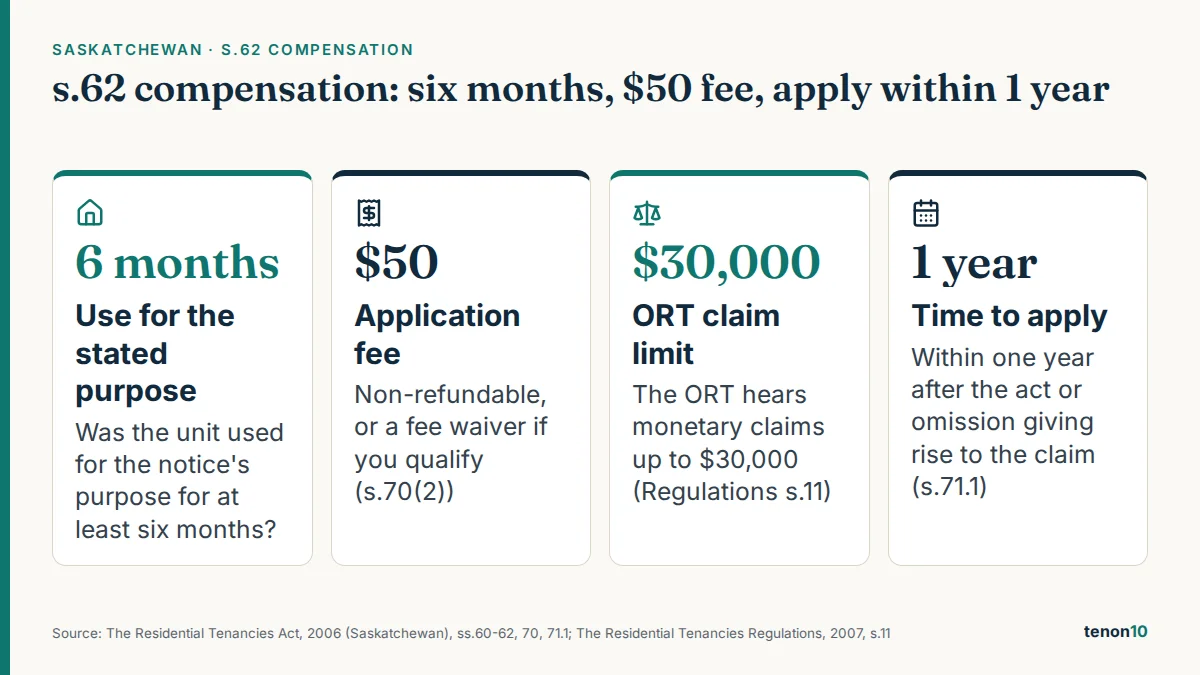
Two things must both be true under s.62:
- You received a notice under s.60. That covers the owner-occupy notice, the purchaser-occupy notice, the notice for specified uses (renovation, demolition, conversions) and the housing program notice.
- The stated purpose did not happen. Either steps were not taken to accomplish it within a reasonable period after the notice's effective date, or the unit was not used for that purpose for at least six months beginning within a reasonable period after the effective date.
The claim is against the landlord or, where the notice was given for a buyer under s.60(6), the purchaser, as applicable (s.62). A notice for cause, for unpaid rent or at the end of a fixed term is not a s.60 notice, so s.62 does not apply to it.
| Notice you received | Section | What should have happened |
|---|---|---|
| Owner or family to occupy | s.60(4)-(5) | The landlord, a close family member or friend moved in |
| Purchaser to occupy | s.60(6) | The buyer, or their close family member or friend, moved in |
| Specified uses | s.60(7) | The demolition, renovation or conversion went ahead |
What you'll need

- The notice you received, with its date and effective date.
- Evidence about the unit after you left: a rental listing, a new tenant's presence, photos showing no work under way, or anything else showing what the unit was used for.
- Records of your losses, with receipts.
- The $50 application fee, which is non-refundable, or a fee waiver under The Fee Waiver Act if you qualify (s.70(2)).
How to claim compensation, step by step
Step 1: Confirm the notice was under s.60
Read the notice's grounds. The ORT's names are the Notice to Vacate so Owner can Occupy (old Form 8b), so Purchaser can Occupy (8c), for Specified Uses (8d) and for Housing Program Purposes (8e). See the owner-occupy notice guide for what that notice requires.
Step 2: Watch what happens to the unit
Section 62 turns on what happened after the effective date. A unit re-rented to a new tenant soon after you left, or renovation that never started, is the kind of fact to record.
Step 3: Add up your losses
The Act allows compensation for "the tenant's losses" resulting from the notice and the failure to carry out its purpose. Keep receipts and records for each amount you claim; the hearing officer decides what is proven.
Step 4: Apply to the ORT
File through the ORT's online portal, pay the fee and serve the notice of hearing as the ORT directs (s.70(1)-(2)). The ORT hears monetary claims up to $30,000 (Regulations s.11). For how hearings run, see ORT hearings in Saskatchewan.
Step 5: Do not wait too long
Section 71.1 requires an application to be made within one year after the act or omission giving rise to the claim, unless the Act provides otherwise. Apply as soon as you have the evidence.
Troubleshooting
- The house was sold. If the notice was a purchaser-occupy notice, the claim may be against the purchaser. See Your Saskatchewan Landlord Sold the House.
- The landlord moved in for a few weeks, then re-rented. The test includes use for the stated purpose for at least six months (s.62(b)(ii)).
- The renovation was cosmetic. The specified-use notice requires work that needs the unit vacant and all permits in hand (s.60(7)); record what was actually done.
Frequently asked questions
How long must a Saskatchewan landlord live in the unit after evicting me?
The unit must be used for the stated purpose for at least six months, beginning within a reasonable period after the effective date (s.62(b)(ii)).
Is there a deadline to claim?
Generally one year after the act or omission giving rise to the claim (s.71.1).
How much does it cost to apply?
The ORT application fee is $50 and non-refundable. A waiver under The Fee Waiver Act may be available (s.70(2)).
Can I claim if I was evicted for unpaid rent?
Not under s.62. It applies only to notices given under s.60.
Saskatchewan s.62 Compensation: Tenant Checklist
A one-page checklist for Saskatchewan tenants claiming compensation when a no-fault notice was not followed through: evidence, losses, the $50 fee and the one-year limit.
Get Free PDF →Key takeaways
- Section 62 covers s.60 notices: owner, purchaser, specified uses and housing program.
- The claim arises if steps were not taken in a reasonable period, or the unit was not used for the purpose for six months.
- Apply to the ORT within one year (s.71.1); the fee is $50.
For more tenant guides across Canada, visit the Canadian Tenant Resource Center.
Looking for your next place?
Browse rentals on Tenon10 while you sort out your claim.
Keep your notice and receipts together