A landlord can lose a month's rent—not because the tenant stopped paying, but because the wrong lease form was used. If a tenant demands the Standard Lease in writing and doesn't get it, Ontario law lets them withhold up to one month's rent, and the landlord can lose the right to ask for it back (RTA s. 12.1(6)–(9)). That risk applies to every landlord who doesn't follow the rules around Ontario's mandatory Standard Lease.
Many Ontario landlords still use outdated templates, OREA Form 400 alone, or DIY Word documents—unaware that since April 30, 2018, the government-mandated Standard Lease is required for most residential tenancies. Using the wrong form or including illegal clauses can cost thousands in withheld rent, dismissed LTB applications, and unenforceable terms.
This guide covers everything landlords need to know about the Ontario Standard Lease in 2026: what's required and what's changed, how Bill 60 affects your lease strategy, which clauses are enforceable (and which will get thrown out), step-by-step completion instructions, and copy-paste additional terms that protect you at the LTB.
Ontario Standard Lease Compliance Checklist 2026
Don't risk losing thousands in withheld rent or dismissed LTB applications. This free checklist ensures your Ontario lease is legally compliant with Bill 60 changes—download now and protect your investment.
Get Free PDF →What Is the Ontario Standard Lease?
The Ontario Standard Lease is the government-mandated form every private residential landlord must use when renting out their property. Governed by the Residential Tenancies Act, 2006 (RTA), this standardized lease became mandatory on April 30, 2018, with an updated version required since March 1, 2021. The official form number is Form 047-2229.
The purpose of standardization is straightforward: prevent landlords from including illegal or unenforceable clauses that violate tenant rights under the RTA. Before the Standard Lease, landlords could (and often did) include terms that contradicted provincial law—terms tenants unknowingly signed but couldn't legally be held to.
Who Must Use the Standard Lease
The Standard Lease applies to all private residential tenancies in Ontario: apartments, condos, houses, basement units, and any other living space rented for residential purposes. This applies regardless of rent amount or lease length. Whether you're renting a $1,500 basement apartment or a $5,000 downtown condo, you need the Standard Lease.
Exemptions
A small number of housing types are exempt from the Standard Lease requirement (O. Reg. 9/18, s. 1): care homes, rentals of just a site for a mobile home or land lease home, most social and non-profit housing, rent-geared-to-income units with public funding, and certain supportive housing. Some arrangements sit outside the RTA altogether, so the Standard Lease never applies to them — for example, long-term care homes and member units of non-profit housing co-operatives (RTA s. 5). Commercial leases aren't residential tenancies at all. If your rental doesn't fall into these categories, you must use the Standard Lease.
The 17 Sections of the Form
The Standard Lease (Form 047-2229) has 17 numbered sections: 1 Parties to the Agreement, 2 Rental Unit, 3 Contact Information, 4 Term of Tenancy Agreement, 5 Rent, 6 Services and Utilities, 7 Rent Discounts, 8 Rent Deposit, 9 Key Deposit, 10 Smoking, 11 Tenant's Insurance, 12 Changes to the Rental Unit, 13 Maintenance and Repairs, 14 Assignment and Subletting, 15 Additional Terms, 16 Changes to this Agreement, and 17 Signatures. The form's printed wording can't be changed; your own terms go in section 15. Each section serves a specific legal purpose, and leaving any blank creates ambiguity that typically works against the landlord at the LTB.
2026 Updates: What's Changed and Why It Matters
If you're an Ontario landlord, 2026 brings significant changes to how you manage your rental properties. Bill 60 (the Fighting Delays, Building Faster Act, 2025), which passed third reading on November 24, 2025 and received Royal Assent on November 27, 2025 (S.O. 2025, c. 14), has fundamentally altered eviction timelines and LTB procedures. Understanding these changes is critical to your lease strategy.
2026 Rent Increase Guideline: 2.1%
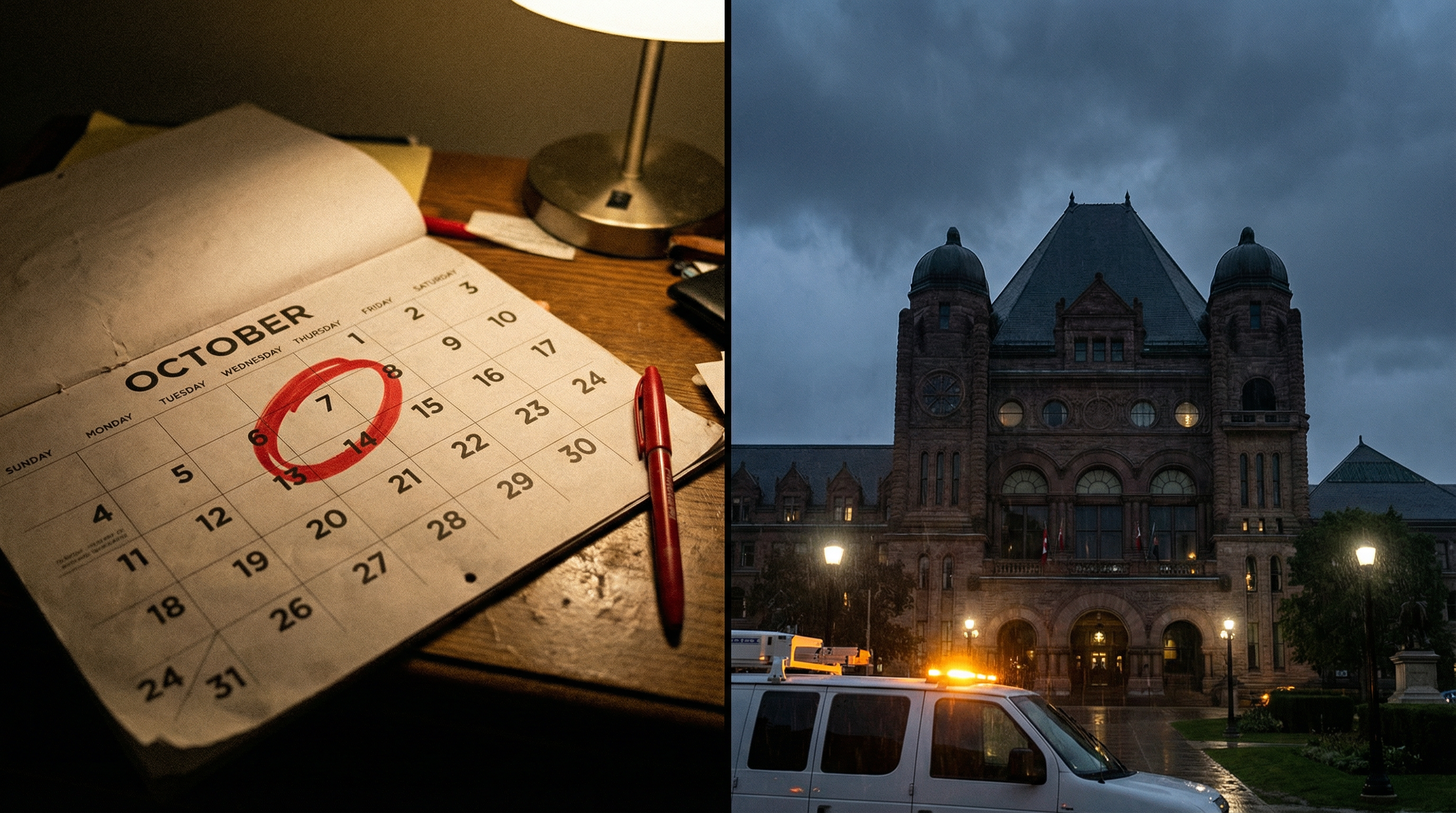
The 2026 rent increase guideline is 2.1%—the lowest cap in four years, down from 2.5% in 2025. It applies to most units. The main exception is a unit in a building (or an addition to a building) no part of which was occupied for residential purposes on or before November 15, 2018, along with certain newer basement and secondary units in houses (RTA s. 6.1). Those units are exempt from the guideline, so their landlords can increase rent by any amount with proper notice. An Above Guideline Increase (AGI) can go higher, with limits. The RTA allows three AGI grounds: an extraordinary increase in municipal taxes and charges, eligible capital expenditures, and security services (s. 126(1)). The 3% cap applies only to the part justified by capital expenditures and security costs: in 2026 that part can take a year's increase to at most 5.1% (2.1% + 3%), and any excess is phased in at no more than 3% a year over the following two years (s. 126(11)). The municipal-taxes part is not subject to that cap, and utility costs are not an AGI ground.
Bill 60: The Biggest Changes in 20 Years
Bill 60 represents the most significant changes to Ontario's rental landscape in two decades. The key provisions now in effect include:
N4 Notice Period Shortened: The termination date on N4 notices (non-payment of rent) has been reduced from 14 days to 7 days. This means landlords can file an L1 application at the LTB one week faster than before.
Review Requests Due in 15 Days: A request for the LTB to review its own order must now be submitted within 15 days of the order being issued, unless the Board extends the time (RTA s. 209(3), for orders made on or after July 1, 2026; LTB Rule 26.5). An appeal to the Divisional Court, which is limited to questions of law, is still due within 30 days of being given the order (s. 210(1)). Both landlords and tenants need to act faster if they want a review.
50% Arrears Rule: At the hearing of a landlord's eviction application for unpaid rent (an N4 followed by an L1), a tenant may raise any issue that could be the subject of their own application under the RTA — maintenance, harassment, an illegal charge or anything else — only if they give the landlord advance written notice and, unless the regulations provide otherwise, pay half of the rent arrears claimed in the application before the hearing (RTA s. 82, as amended by Bill 60, for applications filed on or after September 21, 2026). Under the LTB's Rules, the payment and a written description of each issue are due at least 7 days before the hearing or case management hearing (Rule 19.4).
Standardized Forms: The form itself is set by regulation: O. Reg. 9/18 prescribes the 2020/12 version for agreements entered into on or after March 1, 2021, and additional terms are allowed only if they are consistent with its mandatory terms.
How Bill 60 Affects Your Lease
Faster eviction timelines mean lease compliance is more critical than ever. Clear additional terms reduce disputes before they reach the LTB. Documentation requirements are stricter—your lease is evidence. Payment terms and late rent procedures should be crystal clear. The landlords who will navigate 2026 successfully are those with airtight leases that leave no room for interpretation.
Common Mistakes That Void Your Lease Terms
Understanding what makes a lease term invalid is just as important as knowing what to include. The most expensive mistakes landlords make aren't tenant problems—they're self-inflicted wounds from using the wrong forms or including unenforceable clauses.
Mistake #1: Using the Wrong Form
OREA Form 400 alone is NOT valid—it can only supplement the Standard Lease, not replace it. Generic templates downloaded from the internet likely contain illegal terms. Outdated lease versions from before March 2021 may cause problems at the LTB. Always use the official Ontario Standard Lease form (Form 047-2229, 2020 version).
Consider an example: a first-time landlord uses a generic lease template downloaded from the internet. The tenant demands the official Standard Lease in writing, and the landlord ignores the demand. Once 21 days have passed, the tenant withholds the next month's rent of $1,800. When 30 days go by after that withheld payment without the lease arriving, the landlord loses the right to ask for it back—all legal under the RTA.
Mistake #2: Including Illegal Clauses
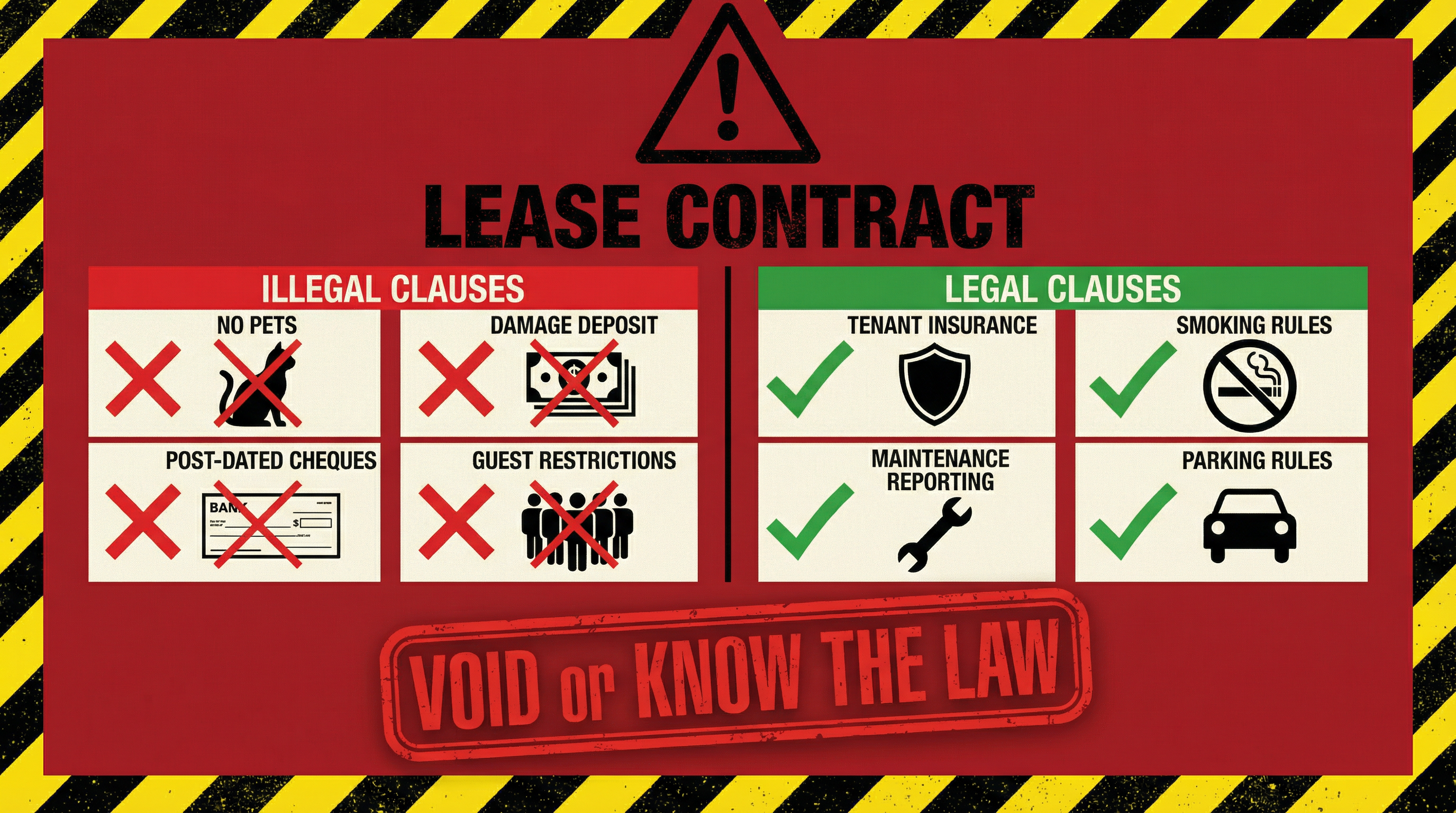
These clauses are void and unenforceable even if the tenant signs them:
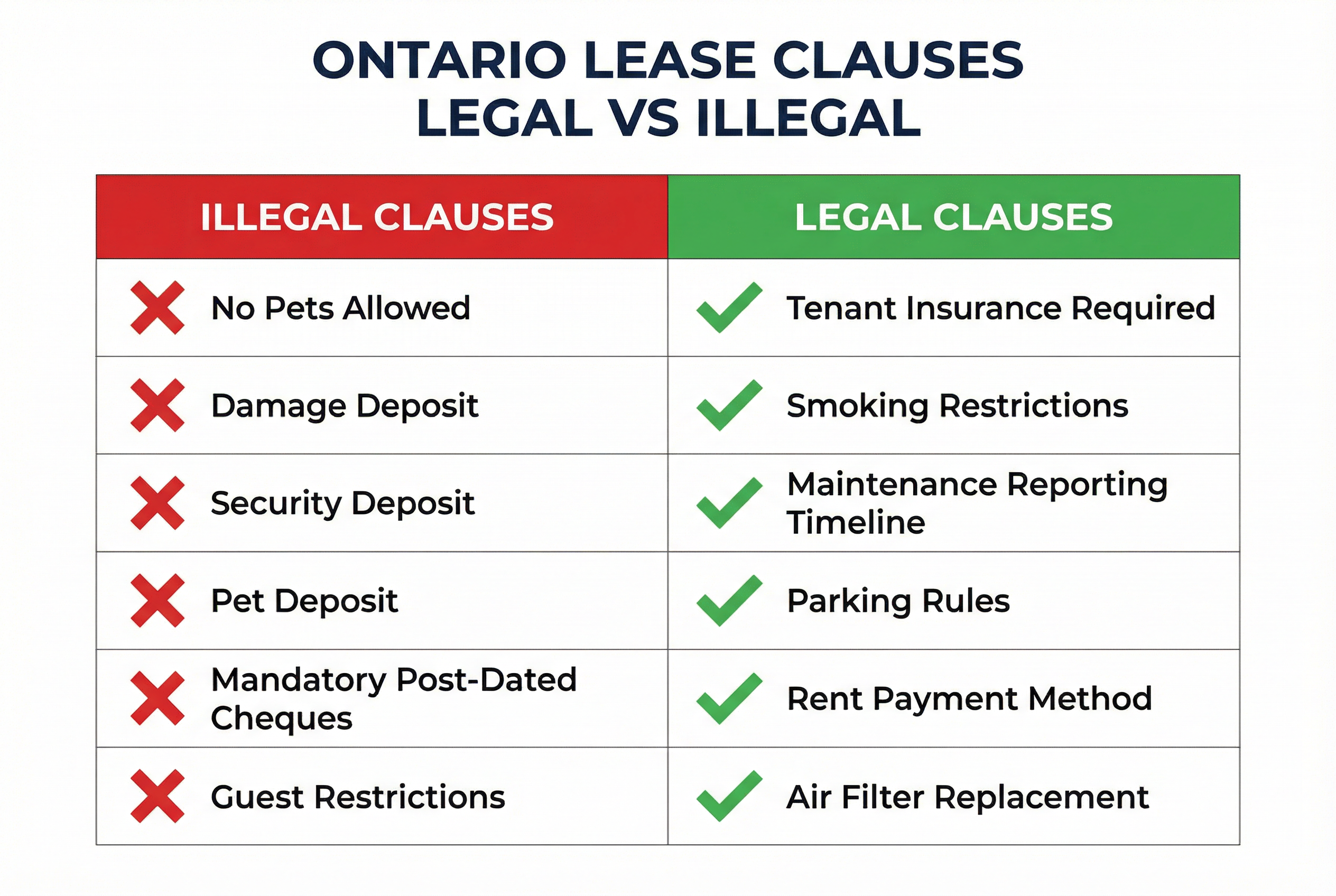
"No pets allowed" clauses are void under RTA section 14, so you cannot evict a tenant simply for having a pet. The Board can end a tenancy over an animal only if it is satisfied that the animal's behaviour has substantially interfered with the reasonable enjoyment of the landlord or other tenants, that the animal has caused the landlord or another tenant a serious allergic reaction, or that the species or breed is inherently dangerous (s. 76). In a condominium, a tenant must also comply with the condo's declaration, by-laws and rules, including any pet rules (Condominium Act, 1998, s. 119(1)).
Damage or security deposits are illegal. Only last month's rent (LMR) and a refundable key deposit are permitted. Any "damage deposit," "pet deposit," or "security deposit" gives the tenant grounds to file a T1 application for refund.
Mandatory post-dated cheques cannot be required. You can offer the option and accept if the tenant agrees, but you cannot demand them as a condition of tenancy.
Guest restrictions that limit who can visit or stay with the tenant violate tenant rights and are unenforceable.
Interest on late rent is not permitted under the RTA. You cannot charge interest on rent arrears.
Tenant-paid landlord repairs clauses that shift maintenance responsibility to the tenant are void. Landlords have a legal obligation to maintain the property.
The most common mistake is including terms that conflict with the RTA. A provision in a tenancy agreement that is inconsistent with the Act or its regulations is void, even if the tenant signed it (RTA s. 4(1)).
Example: The Pet Clause Trap
For example, a landlord who includes "No pets allowed" in the lease, and then gives an N5 because the tenant adopts a cat, is relying on a void clause (s. 14). Unless the landlord can prove one of the s. 76 grounds, the Board won't end the tenancy, and the landlord has spent time and the L2 filing fee ($186 through the Tribunals Ontario Portal, $201 by other methods) for nothing.
Mistake #3: Failing to Provide the Lease
If a tenant demands the Standard Lease in writing and you don't provide it within 21 days, the tenant can withhold rent that falls due after those 21 days, up to one month's rent in total (RTA s. 12.1(6)–(7)). You can require the withheld rent back only if you provide the lease no later than 30 days after the date of the first withheld payment; after that, the tenant keeps it (s. 12.1(9)). The tenant can also end a fixed-term or yearly tenancy early on at least 60 days' notice, with the termination date on the last day of a rental period (s. 47.0.1). Always provide the Standard Lease proactively—don't wait for a request.
Mistake #4: Incomplete Sections
Every section that asks for information must be filled out. Leaving sections blank creates ambiguity that the LTB may interpret against the landlord. Even if a section doesn't apply to your situation, write "N/A" rather than leaving it empty.
Penalty Ranges for Violations
The consequences of lease violations can be severe. Since July 1, 2026, an individual convicted of an offence under the Residential Tenancies Act faces a fine of up to $100,000, and a corporation up to $500,000 (RTA s. 238, as amended by Bill 97, the Helping Homebuyers, Protecting Tenants Act, 2023). Separately, the LTB can order a landlord to pay an administrative fine of up to the greater of $10,000 and the Small Claims Court limit.
Unsure if your current lease is compliant? Use Tenon10's free Lease Builder to generate a fully compliant Ontario Standard Lease in minutes. Try the Lease Builder →
How to Create a Bulletproof Ontario Lease
Now that you understand what NOT to do, here's exactly how to create a lease that protects you at the LTB and withstands legal scrutiny.
Step 1: Use the Official Form
Download the Standard Lease from Ontario.ca or use Tenon10's Lease Builder. The current required version is Form 047-2229 (2020 version, required since March 1, 2021). Never modify the pre-printed portions of the form—any alterations can invalidate terms or create grounds for dispute.
Step 2: Complete Every Section
Walk through each section carefully:
Section 4: Term of Tenancy — Specify whether the lease is fixed-term or month-to-month. Note that under the RTA, fixed-term leases automatically convert to month-to-month at their end unless properly terminated.
Section 5: Rent — Include the exact amount, due date, and payment method. Be specific: "Rent of $2,000 is due on the 1st of each month via e-transfer to [email protected]." Ambiguous payment terms create problems when you need to prove non-payment.
Section 8: Rent Deposit (Last Month's Rent) — You can only collect LMR, not a damage deposit. You must pay interest annually (2026 rate: 2.1%), and this deposit can only be applied to the last month of tenancy—not used as a damage offset.
Section 9: Key Deposit — The maximum you can charge is the actual replacement cost of keys. This deposit must be fully refundable when keys are returned.
Step 3: Add Legal Additional Terms (Section 15)
Section 15 is where smart landlords differentiate themselves. These additional terms ARE enforceable when properly written:
Tenant Insurance Requirement: "Tenant agrees to obtain and maintain tenant's liability insurance with coverage of at least $1,000,000 throughout the tenancy and to provide proof of coverage upon request." Record this in section 11 of the form (Tenant's Insurance). A landlord may require liability insurance only; contents insurance is the tenant's choice.
Smoking Restrictions: "Smoking of any substance, including cannabis, is prohibited inside the rental unit and within 9 metres of any entrance, window, or ventilation intake."
Maintenance Reporting: "Tenant agrees to report any maintenance issues, water leaks, or pest sightings to the landlord in writing within 48 hours of discovery."
Air Conditioning/HVAC: "Tenant is responsible for replacing HVAC filters every 90 days and ensuring vents remain unobstructed."
Parking Rules: "One designated parking space (#___) is included. Guest parking in visitor spots only. No vehicle repairs, storage of inoperable vehicles, or commercial vehicles."
Rent Payment Method: "Rent shall be paid by e-transfer to [email protected]. If a cheque is returned NSF, the tenant will pay the NSF charges from the landlord's bank plus a $20 administration charge."
Step 4: Get Signatures Before Move-In
Both the landlord and all tenants listed on the lease must sign before the tenant takes possession. Each tenant should receive a signed copy. Keep the original for your records in a secure, accessible location.
Step 5: Provide Copy Within 21 Days
After signing, provide the tenant with their copy within 21 days. Keep proof of delivery—email receipt, courier tracking, or a signed acknowledgment. This protects you if the tenant later claims they never received the lease.
What Happens If Things Go Wrong
Your lease isn't just paperwork—it's your primary evidence at the LTB. Understanding how your lease terms translate to legal disputes helps you structure them for maximum protection.
When Your Lease Becomes Evidence
Every LTB application references the lease. Clear terms equal a stronger case. Ambiguous terms give the adjudicator discretion—which often favors the tenant in borderline situations.
Common LTB Scenarios Where Lease Terms Matter
Non-Payment (L1 Application): Your lease proves the rent amount and due date. Clear payment terms support your N4 notice. Under Bill 60, you only have 7 days before you can file an L1—there's no time to clarify ambiguous lease terms.
Damage/Disturbance (N5/L2): Your additional terms define what's prohibited. Without clear smoking rules, it's harder to prove a violation. The winning combination at the LTB is photos plus clearly documented lease terms.
Rent Increases (N1): Your lease start date determines when you can increase rent. You must wait 12 months from move-in or the last increase. The 2026 guideline is 2.1% for rent-controlled units—your lease documentation proves whether your unit qualifies for rent control.
Example: Additional Terms That Hold Up
For example, a landlord who uses the Standard Lease with clear, lawful additional terms in section 15 — specific parking rules, a maintenance-reporting timeline and smoking rules — and records an agreed liability-insurance requirement in section 11 has written evidence of what was agreed if a dispute arises. Additional terms that are inconsistent with the form's mandatory terms or the RTA are void (O. Reg. 9/18, s. 4; RTA s. 4(1)).
Cost-Benefit Analysis
Consider the true cost of different lease approaches. A DIY Word document is free but carries high risk—it likely contains illegal clauses. A downloaded PDF is free but medium risk—it's missing custom protections. Paying for a legal review of each lease lowers the risk but adds a cost for every property. Tenon10's Lease Builder is free and low risk—it's built specifically for Ontario compliance.
Now consider the cost of getting it wrong: a tenant can withhold up to a full month's rent. An LTB application dismissed for invalid lease terms costs the filing fee plus months of lost rent. For a bad-faith eviction, the LTB can order an administrative fine of up to the greater of $10,000 and the Small Claims Court limit, on top of compensation to the tenant.
Ontario Standard Lease Compliance Checklist 2026
Don't risk losing thousands in withheld rent or dismissed LTB applications. This free checklist ensures your Ontario lease is legally compliant with Bill 60 changes—download now and protect your investment.
Get Free PDF →Practical Takeaways
Standard Lease Compliance Checklist
Before Signing:
Using official Ontario Standard Lease form (2020 version). All 17 sections reviewed and completed accurately. Names of all tenants listed. Full property address included. Rent amount and due date specified. Utilities responsibilities clearly defined. Lease term (start and end date) documented. Rent deposit amount recorded (LMR only). Key deposit amount recorded (replacement cost only). Smoking rules specified. Additional terms added in Section 15 only. No illegal clauses included.
After Signing:
Provide signed copy to tenant within 21 days. Keep proof of delivery. Store original lease securely. Note lease end date for renewal planning. Calculate rent increase date (12 months from start).
Quick Wins vs. Long-Term Strategies
Quick Wins (Do Today): Download the official Standard Lease form. Review your current lease for illegal clauses. Agree a tenant liability-insurance requirement in section 11.
Long-Term Strategies: Build a lease template library for different property types. Document all tenant communications in writing. Set calendar reminders for rent increase dates (90 days notice required).
Resource Links
Official Ontario Standard Lease: ontario.ca/page/guide-ontarios-standard-lease
Tenon10 Lease Builder: tenon10.com/forms/ca/on/standard-lease
LTB Forms: tribunalsontario.ca/ltb/forms/
Conclusion
The Ontario Standard Lease isn't just paperwork—it's your first line of defense as a landlord. With Bill 60 now in effect, the stakes are higher than ever. Faster eviction timelines (7 days vs. 14), stricter LTB procedures, and a 15-day deadline to ask the LTB to review an order mean your lease needs to be airtight from day one.
Use the official government form—no exceptions. Complete every section thoroughly. Add legal additional terms that protect you. Avoid the illegal clauses that get thrown out at the LTB. Provide the signed lease within 21 days.
Stop Using Outdated Templates That Put Your Investment at Risk
Tenon10's free Lease Builder generates a fully compliant Ontario Standard Lease in minutes—complete with legal additional terms and e-signature capability.
Free • No signup required • Updated for the Bill 60 changes in force 21 Sep 2026
Frequently Asked Questions
Can I use a "no pets" clause in my Ontario lease?
No. Under the Residential Tenancies Act, blanket pet bans are unenforceable in Ontario. Even if your tenant signs a lease with a "no pets" clause, the clause is void (s. 14), and you cannot evict them just for getting a pet. The Board can end a tenancy over an animal only if it has substantially interfered with others' reasonable enjoyment, caused the landlord or another tenant a serious allergic reaction, or is of an inherently dangerous species or breed (s. 76). In a condo, the tenant must also follow the corporation's declaration, by-laws and rules (Condominium Act, 1998, s. 119(1)). Instead of a pet ban, consider adding terms about pet damage responsibility and cleaning requirements.
What happens if I don't provide the Standard Lease within 21 days?
If a tenant demands the Standard Lease in writing and you don't provide it within 21 days, the tenant can withhold rent that falls due after those 21 days, up to one month's rent in total. If you still haven't provided it 30 days after the date of the first withheld payment, you can no longer require that rent back. The tenant can also end a fixed-term or yearly tenancy early on at least 60 days' notice, with the termination date on the last day of a rental period. Always provide the Standard Lease proactively—don't wait for a request.
Can I collect a damage deposit or security deposit in Ontario?
No. Ontario landlords can only collect two deposits: a rent deposit (last month's rent) and a refundable key deposit equal to the actual replacement cost of keys. Damage deposits, security deposits, pet deposits, and cleaning deposits are all illegal. If you've collected an illegal deposit, the tenant can apply to the LTB to recover it—plus potentially additional compensation.
Is my lease still valid if it contains illegal clauses?
Yes and no. Your lease remains valid, but any clause that violates the Residential Tenancies Act is automatically void and unenforceable—even if the tenant signed it. The legal portions of your lease still apply. However, relying on illegal clauses can backfire: the LTB may dismiss applications based on unenforceable terms, and an offence under the Act can bring a fine of up to $100,000 for an individual or $500,000 for a corporation (since July 1, 2026).
Do new buildings (post-November 2018) still need to use the Standard Lease?
Yes. This is a common misconception. Units in buildings (or additions) no part of which was occupied for residential purposes on or before November 15, 2018 are exempt from rent control (RTA s. 6.1) (meaning landlords can increase rent by any amount with proper notice), but they still must use the Ontario Standard Lease form. The Standard Lease requirement and rent control exemption are two separate rules. Every residential tenancy in Ontario—regardless of when the building was built—requires the Standard Lease.
Related Resources
New landlord? Start with our First-Time Landlord Checklist.
Need to send a rent increase? Learn about the N1 Notice for 2026.
Tenant not paying? Understand the New 7-Day N4 Process Under Bill 60.
Want to add legal protection? See our guide to 15 Additional Clauses Smart Landlords Include.