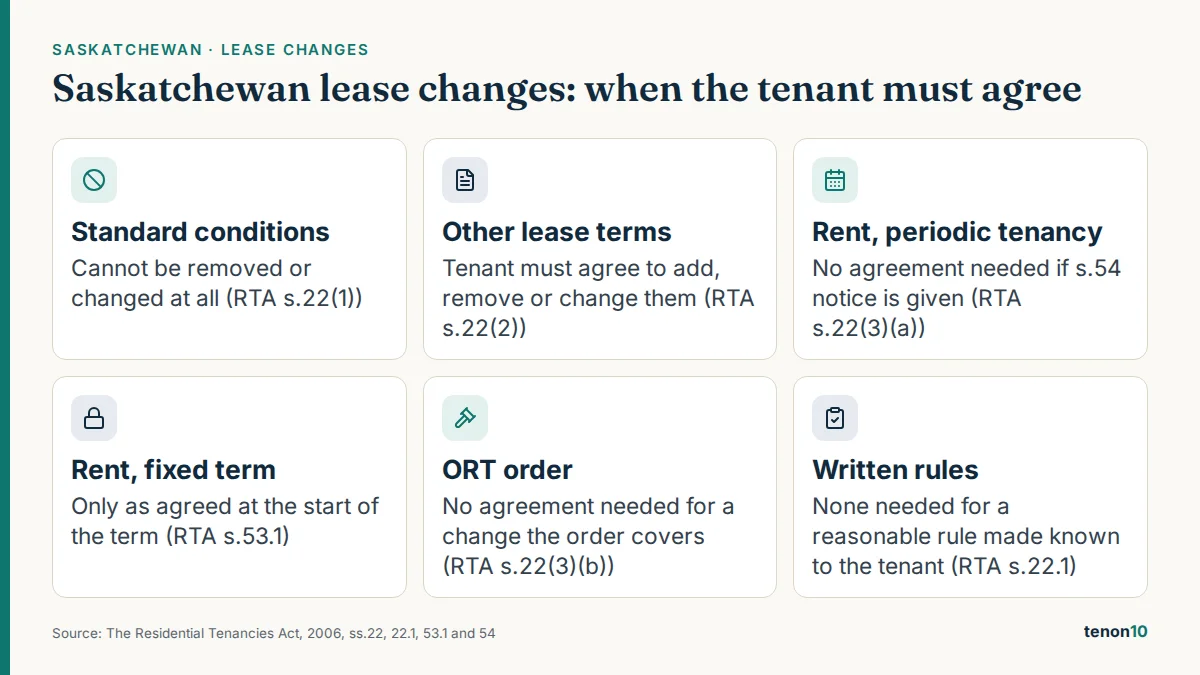
To change a lease in Saskatchewan, a landlord needs the tenant's agreement for any term other than a standard condition, and the standard conditions can never be changed or removed (Residential Tenancies Act, 2006, s.22). The exceptions are a rent increase with proper notice and an order from a hearing officer. Separately, a landlord may set written, reasonable rules (s.22.1).
Saskatchewan landlords often want to add a clause halfway through a tenancy: a new rule about storage, a change to who pays a utility, a different rent. The Residential Tenancies Act, 2006 (RTA) draws a clear line between amending the tenancy agreement, which needs both parties, and setting rules, which a landlord can do alone within limits. This guide explains both and how they are enforced. More topics are in the Saskatchewan landlord resource center.
Changing a Saskatchewan Lease: Landlord Checklist
A one-page checklist for Saskatchewan landlords changing a tenancy agreement, raising rent or setting rules under The Residential Tenancies Act, 2006.
Get Free PDF →Can a Saskatchewan landlord change the lease without the tenant's agreement?
No, not for most terms. In Saskatchewan, a tenancy agreement may be amended to add, remove or change a term other than a standard condition only if both the landlord and the tenant agree (RTA s.22(2)). A letter announcing a new lease term does not bind the tenant unless the tenant agrees to it.
Two changes do not need the tenant's agreement (s.22(3)):
- A rent increase when notice is served on the tenant in line with s.54.
- A change covered by an order under s.70 that says the other party's agreement is not required.
Which lease terms can never be changed in Saskatchewan?

The standard conditions can never be changed or removed in Saskatchewan, even if both parties sign (RTA s.22(1)). They are prescribed conditions that form part of every tenancy agreement (s.18), and a written agreement must contain them (s.19(1)(a)).
This means a signed amendment that strips out a standard condition does not work. The standard condition stays part of the agreement because s.18 puts it there.
How do rent increases fit in?

In Saskatchewan, rent is the main term a landlord can change without the tenant's agreement, and only by following Part V of the RTA; a landlord must not increase rent except in accordance with that Part (s.53). The rules differ for periodic and fixed-term tenancies.
- Periodic tenancy: written notice at least 12 months before the increase takes effect, and the effective date must be no earlier than the later of 18 months after the tenancy began and 12 months after the last increase (s.54(1)(a), (2)(a)). A landlord who is a member in good standing of a prescribed landlords' association uses 6 months' notice and the later of 12 months from the start and 6 months from the last increase (s.54(1)(b), (2)(b)).
- Fixed-term tenancy: no increase during the term unless the amount and the timing were agreed when the fixed-term tenancy was entered into (s.53.1(1)). The amount can be a dollar figure or a percentage (s.53.1(2)).
A rent increase notice that does not comply takes effect on the earliest date that does (s.54(4)). For worked dates, see Saskatchewan's 12-month notice and 18-month wait.
What rules can a Saskatchewan landlord set on their own?
A Saskatchewan landlord may set and enforce rules about the tenant's use, occupancy or maintenance of the rental unit or property, and about the tenant's use of services and facilities (RTA s.22.1(1)). The Act names rules prohibiting the possession, use, selling or distribution of cannabis, or growing cannabis plants in the unit, as examples (s.22.1(1)(a)).
Rules bind only if three conditions are met (s.22.1(2)):
- They are in writing.
- They are made known to the tenant.
- They are reasonable.
If a tenant applies to the Office of Residential Tenancies on the ground that a rule is not reasonable, a hearing officer may make any order that is just and equitable in the circumstances (s.22.1(3)).
| Change | Tenant must agree? | Source |
|---|---|---|
| Remove or change a standard condition | Not allowed at all | RTA s.22(1) |
| Add, remove or change another lease term | Yes | RTA s.22(2) |
| Rent increase, periodic tenancy | No, if s.54 notice is given | RTA s.22(3)(a), s.54 |
| Rent increase, fixed term | Only as agreed at the start of the term | RTA s.53.1 |
| Change covered by an ORT order | No | RTA s.22(3)(b) |
| Written, reasonable rule made known to tenant | No | RTA s.22.1 |
What can a landlord do if a tenant breaks the rules?
In Saskatchewan, a landlord may give notice to end a tenancy if the tenant, or a person the tenant permits on the property, has repeatedly violated rules set under s.22.1 (RTA s.58(1)(h.1)). One breach is not "repeatedly".
Before giving that notice, the landlord must give the tenant a reasonable period to remedy the problem if it can be remedied (s.58(2)). The notice must end the tenancy no earlier than one month after the tenant receives it, on the day before rent is due (s.58(3)). The tenant can dispute it in writing within 15 days of receiving it; a tenant who does not is deemed to accept the end date, unless the landlord has already applied under s.67 within that time (s.58(5)-(7)).
A breach of a material term of the agreement is a separate ground: the tenant must have breached it and failed to fix it within a reasonable time after the landlord's written notice (s.58(1)(h)). For the full process, see how eviction works in Saskatchewan.
How should a landlord make a change properly?
A Saskatchewan landlord should match the method to the change:
- Lease term: write the amendment, have both parties sign it and give the tenant a copy (s.22(2)).
- Rent: serve a written notice that meets s.54, or rely on an increase agreed in the fixed-term lease (s.53.1). Service rules are covered in how to serve a notice in Saskatchewan.
- Rule: write it down, give it to every tenant it affects and make sure it is reasonable (s.22.1(2)).
- Disagreement: apply to the Office of Residential Tenancies for an order (s.70). See ORT hearings in Saskatchewan.
Frequently asked questions
Can a Saskatchewan landlord raise rent during a fixed-term lease?
Only if the amount and timing of the increase were agreed when the fixed-term tenancy was entered into (RTA s.53.1(1)). Otherwise the rent stays as written for the term.
Do landlord rules need the tenant's signature?
No. A rule under s.22.1 binds if it is in writing, made known to the tenant and reasonable (s.22.1(2)). A lease amendment, by contrast, needs the tenant's agreement (s.22(2)).
Can a tenant challenge a rule they think is unfair?
Yes. The tenant can apply under s.70, and a hearing officer may make any just and equitable order if the rule is not reasonable (s.22.1(3)).
Can both parties agree to remove a standard condition?
No. A tenancy agreement must not be amended to change or remove a standard condition (s.22(1)), and the standard conditions are part of every tenancy agreement (s.18).
Can I end a tenancy for a single rule breach?
Not on the rules ground alone: s.58(1)(h.1) requires repeated violations, and s.58(2) requires a reasonable chance to remedy first where possible.
Changing a Saskatchewan Lease: Landlord Checklist
A one-page checklist for Saskatchewan landlords changing a tenancy agreement, raising rent or setting rules under The Residential Tenancies Act, 2006.
Get Free PDF →Key takeaways
- Standard conditions can never be changed or removed (RTA s.22(1)).
- Other lease terms change only with both parties' agreement (s.22(2)).
- Rent rises only under Part V: s.54 notice for periodic tenancies, s.53.1 for fixed terms.
- Landlord rules must be written, made known and reasonable (s.22.1(2)).
- Repeated rule violations can ground a notice to end, after a chance to remedy (s.58).
For every rule in one place, see the Saskatchewan landlord guide.
Put every change in writing
Free landlord and tenant forms for notices, amendments and records.
Free • No signup required