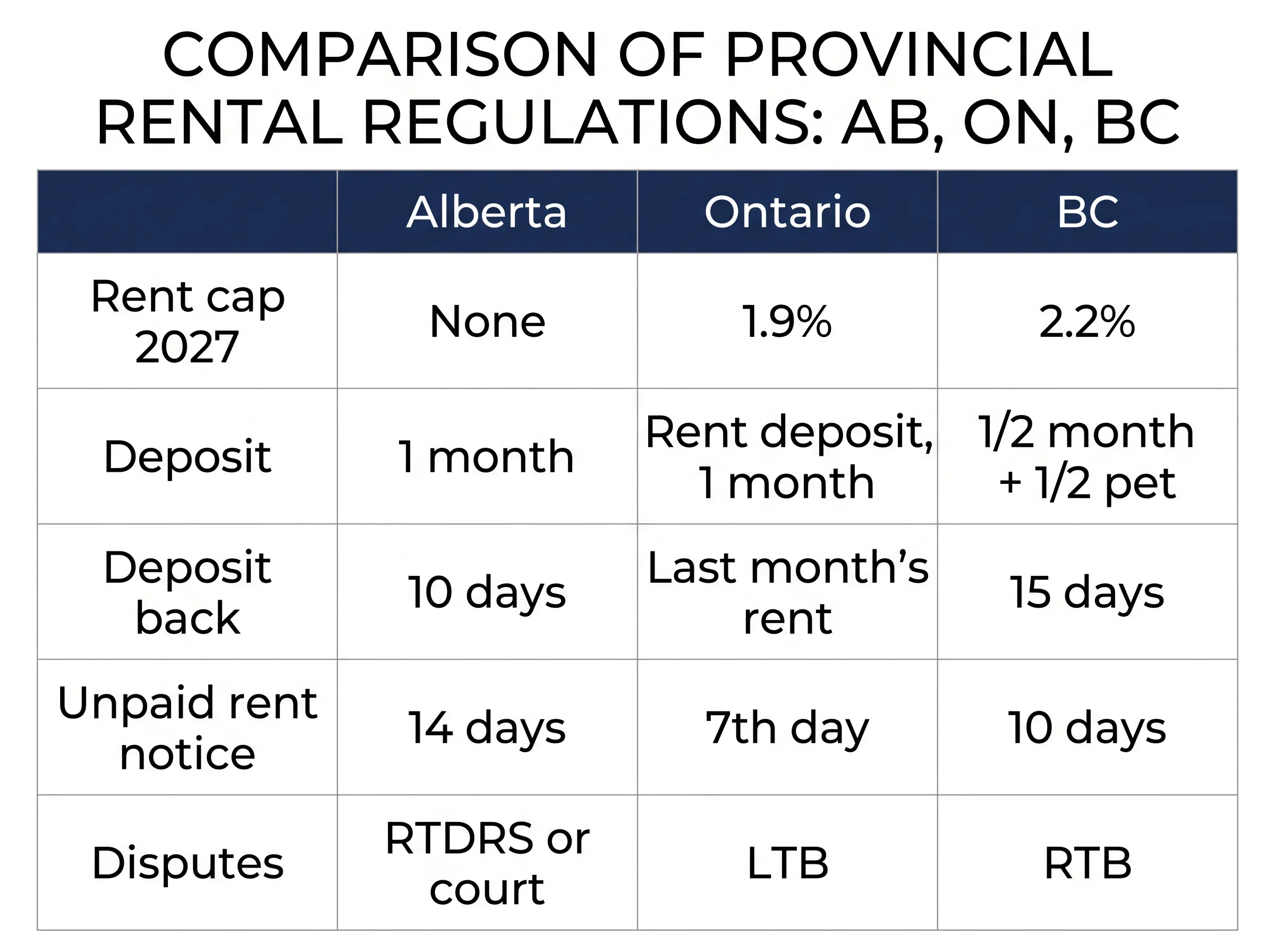
Alberta vs Ontario tenancy law differs most on rent: Alberta sets no limit on the amount, while Ontario's 2027 guideline is 1.9% and BC's 2027 limit is 2.2%. Alberta also allows a one-month deposit, gives a 10-day deposit return, uses a 14-day arrears notice and lets you choose the RTDRS or the courts.
At a glance: three provinces, three rulebooks
- Rent increases in 2027: Alberta no cap; Ontario 1.9% guideline; BC 2.2% limit.
- Deposits: Alberta up to one month's rent; Ontario a rent deposit only; BC half a month plus half a month for a pet.
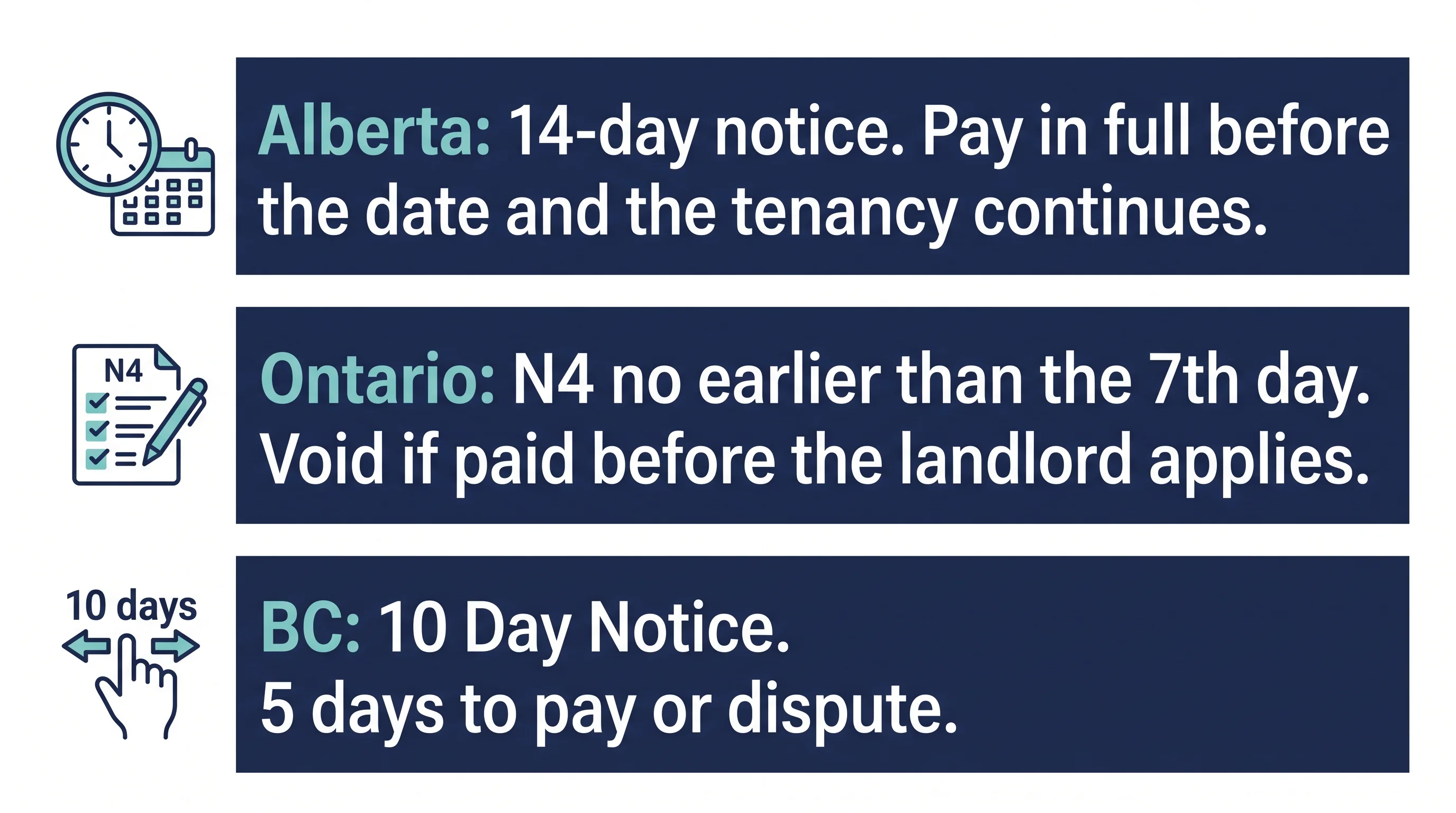
- Unpaid rent notice: Alberta 14 days; Ontario not earlier than the 7th day; BC 10 days, with 5 days to pay or dispute.
- Disputes: Alberta RTDRS or court; Ontario the Landlord and Tenant Board (LTB); BC the Residential Tenancy Branch (RTB).
This comparison is for landlords, managers and investors who own or are buying in more than one of these provinces, and for renters moving between them. Each cell names the section of the province's own Act so you can check it. Every figure was checked against the statutes and government pages on October 24, 2026.
Three-Province Landlord Rules Checklist
Alberta, Ontario and BC side by side for owners and managers with units in more than one province (rules as of October 24, 2026).
Get Free PDF →How do Alberta, Ontario and BC tenancy rules compare?
Alberta's Residential Tenancies Act (RTA) controls the timing and paperwork of a tenancy but not the price, while Ontario's Residential Tenancies Act, 2006 and BC's Residential Tenancy Act also cap the yearly increase. The table puts the rules people ask about most side by side.
| Rule | Alberta | Ontario | British Columbia |
|---|---|---|---|
| Limit on a rent increase | None | Guideline: 1.9% for 2027 (2.1% for 2026) | 2.2% for 2027 (2.3% for 2026) |
| Notice of increase, monthly tenancy | 3 tenancy months in writing (s.14(1)) | At least 90 days in writing (s.116(1)) | At least 3 months, approved form (s.42(2)-(3)) |
| How often | 365 days since the start or last increase (AR 211/2004 s.3) | 12 months (s.119(1)) | 12 months (s.42(1)) |
| During a fixed term of a year or more | No increase (AR s.3(3)) | Within the guideline rules | Within the limit |
| Deposit limit | One month's rent (s.43(1)) | Rent deposit only, up to one month (ss.105-106) | 1/2 month security plus 1/2 month pet damage (s.19) |
| Deposit back | Within 10 days of move-out (s.46(2)) | Applied to the last month's rent (s.106(10)) | Within 15 days, or double (s.38(1), (6)) |
| Inspection reports | Required at move-in and move-out (s.19) | Not required by the Act | Required at start and end (ss.23, 35) |
| Unpaid rent notice | 14 days; ineffective if paid before the date (s.29) | Not earlier than the 7th day; void if paid before the landlord applies (s.59) | 10 days; 5 days to pay or dispute (s.46) |
| Tenant's notice, monthly tenancy | On or before the first day of a tenancy month, to end on its last day (s.8(1)(a)) | At least 60 days, ending on the last day of a period (s.44(2)) | At least one month, ending the day before rent is due (s.45(1)) |
| Compensation for landlord's own use | None | One month's rent, with an exception for some notices of 120 days or more (s.48.1) | One month's rent (s.51(1)) |
| Where disputes go | RTDRS or court, your choice (ss.54.2-54.3) | Landlord and Tenant Board | Residential Tenancy Branch |
Alberta: No cap, strict timing, and a choice of tribunal or court. Read the Alberta landlord guide
How do rent increases differ between Alberta, Ontario and BC?
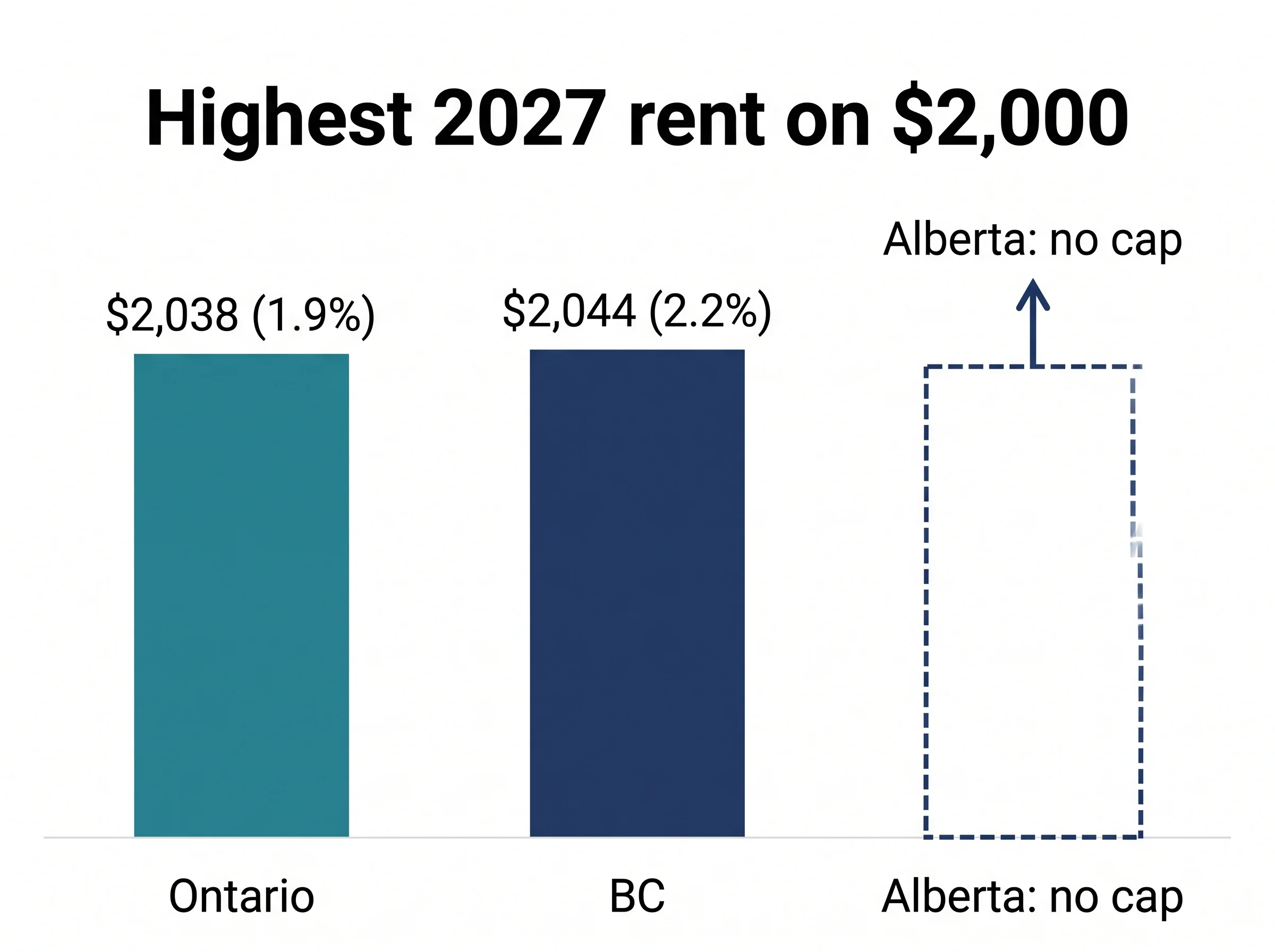
An Alberta landlord can set any new rent after 365 days with the right notice, while Ontario and BC landlords are held to a yearly percentage. On a $2,000 monthly rent, the 2027 ceiling is $2,038 in Ontario and $2,044 in BC; Alberta has no ceiling.
The process rules differ in ways that trip up multi-province owners:
- Alberta counts tenancy months, not days. A notice that does not meet section 14 is void (s.14(6)), and a tenant who paid the higher rent can recover it (s.14(7)). Alberta publishes no rent increase form. During a fixed term of one year or more, rent cannot go up at all (AR 211/2004 s.3(3)).
- Ontario needs at least 90 days' written notice (s.116(1)) and 12 months between increases (s.119(1)). Units first occupied for residential purposes after November 15, 2018 are exempt from the guideline, according to ontario.ca. Our Ontario 2027 N1 guide covers the details.
- BC needs at least 3 months' notice on the approved form (s.42(2)-(3)), and a notice that gives too little time or comes too soon after the last increase takes effect on the earliest date that complies (s.42(4)). See the BC 2027 rent increase limit.
Ontario: A 1.9% guideline for 2027, 90 days' notice and LTB forms for every step. Read the Ontario N1 guide
How do security deposits differ?
Alberta allows the largest single deposit, up to one month's rent, but it must sit in an interest-bearing trust account at an Alberta institution within 2 banking days (s.44(1)) and come back within 10 days after the tenant leaves (s.46(2)). The landlord cannot raise it when rent goes up (s.43(2)).
Ontario lets a landlord collect only a rent deposit (s.105(1)), capped at one rent period or one month, whichever is less (s.106(2)), with interest paid each year at the guideline rate (s.106(6)), and it is used for the last month's rent (s.106(10)). BC caps the security deposit and the pet damage deposit at half a month's rent each (s.19(1)) and a landlord who misses the 15-day deadline must pay back double (s.38(6)). The BC half-month cap guide works through the numbers.
Damage deductions follow the inspections. In Alberta, no deduction may be made for damage unless the move-in and move-out inspection reports were done (s.46(6)), and none for normal wear and tear (s.46(5)).
British Columbia: A 2.2% limit for 2027, half-month deposits and a 15-day return with a double penalty. Read the BC deposit guide
What happens when rent is unpaid in each province?
All three provinces let a landlord end a tenancy for unpaid rent with a short notice that the tenant can cancel by paying, but the clocks differ. Alberta's notice must give at least 14 days and becomes ineffective if the tenant pays all rent due before the termination date (s.29(1), (4)).
- Alberta: the notice must show the rent due now and later rent separately (s.29(2)(c)). If the tenant neither pays nor leaves, the landlord applies to the RTDRS or the court.
- Ontario: since September 21, 2026, the N4 termination date can be not earlier than the 7th day after the notice is given (s.59(1)), and the notice is void if the tenant pays the arrears before the landlord applies to the LTB (s.59(3)).
- BC: the 10 Day Notice takes effect not earlier than 10 days after receipt, and the tenant has 5 days to pay, which cancels it, or to dispute it (s.46(1), (4)). See what happens after a BC 10 Day Notice.
Which province is easiest for landlords, and which for tenants?
Alberta gives landlords the most freedom on price and the widest choice of forum, while Ontario and BC give tenants the strongest protection on rent and on ending a tenancy for the landlord's own use. Neither is simpler: Alberta's lack of a cap comes with strict timing rules, and a void notice costs the increase.
Fees are another difference. Alberta sets no cap on late fees but a fee must be in the lease and can be challenged if unreasonable. Ontario prohibits charges beyond lawful rent except those its regulation allows, such as an administration charge of up to $20 for an NSF cheque (RTA s.134; O. Reg. 516/06 s.17). BC allows an administration fee of up to $25 for late rent or a returned cheque (Residential Tenancy Regulation s.7(1)(d)).
For a portfolio across provinces, keep one rule card per province and label every unit with its province, so a notice is never written to the wrong Act.
Frequently asked questions
Does Alberta have rent control like Ontario?
No. Alberta sets no limit on the amount of a residential rent increase. It limits how often rent can rise (once every 365 days) and how much notice is needed, and bars increases during a fixed term of one year or more.
Which province allows the biggest security deposit?
Alberta, at up to one month's rent for any deposit. Ontario permits only a rent deposit of up to one month, and BC caps the security deposit and the pet damage deposit at half a month's rent each.
Is the Alberta RTDRS the same as Ontario's LTB?
No. The RTDRS is an alternative to court in Alberta, and the applicant chooses one or the other. In Ontario most tenancy disputes go to the Landlord and Tenant Board, and in BC to the Residential Tenancy Branch.
Do Alberta tenants get compensation if the landlord moves in?
No. Alberta's RTA has no compensation for a landlord's-use notice. Ontario generally requires one month's rent (s.48.1) and BC requires one month's rent (s.51(1)).
Are inspection reports required in all three provinces?
They are required in Alberta (s.19) and BC (ss.23, 35), and a landlord who skips them limits what can be claimed from the deposit. Ontario's Act does not require them, though many landlords do one.
Three-Province Landlord Rules Checklist
Alberta, Ontario and BC side by side for owners and managers with units in more than one province (rules as of October 24, 2026).
Get Free PDF →Renting in more than one province?
Tenon10 creates Alberta leases and the BC tenancy agreement, fills the Ontario N-forms, runs move-in and move-out inspection reports and tracks deposit return dates.
Free • No signup required