In BC, a landlord can charge more rent when an additional occupant moves in only if the written tenancy agreement says the rent varies with the number of occupants and sets out the amount by which it varies (Residential Tenancy Act s.13(2)(f)(iv)). That change is not a "rent increase" under Part 3 of the Act, so the 12-month, 3-month notice and annual-limit rules do not apply to it (s.40).
An additional occupant clause is one of the few ways BC rent can change mid-year. It works only if it was written correctly at the start, and it cannot be used for children. This how-to shows landlords how to set the clause up and apply it. For more landlord guides, see the BC Landlord Resource Center.
BC Additional Occupant Rent: Landlord Checklist
A one-page checklist for BC landlords: the written occupant term, the minor rule, applying and reversing the amount, and guests versus occupants.
Get Free PDF →What you'll need
- The written tenancy agreement, with the rent amount and any term that the rent varies with the number of occupants.
- The dollar amount the rent changes per additional occupant, as written in the agreement.
- The new occupant's date of birth, to check the rule on minors.
- A written record of the date the occupant started (and later stopped) living in the unit.
When can a BC landlord charge more rent for an additional occupant?

In BC, a landlord can charge more for an additional occupant only when the tenancy agreement includes a term that the rent varies with the number of occupants and states the amount, and the occupant is not a minor who triggers the section 22.1 restriction. If the agreement has no such term, the landlord cannot increase the rent because a new occupant begins to live with the tenant (RTB Policy Guideline 37, section F).
Section 40 of the Act takes an increase that is for additional occupants and authorized by that term out of the meaning of "rent increase" in Part 3. That is why it does not need the 3 months' notice under section 42 or the RTB-7 Notice of Rent Increase, and why it does not count against the annual limit. For the regular annual increase, see the 2027 BC rent increase limit.
Steps: setting up and applying the clause
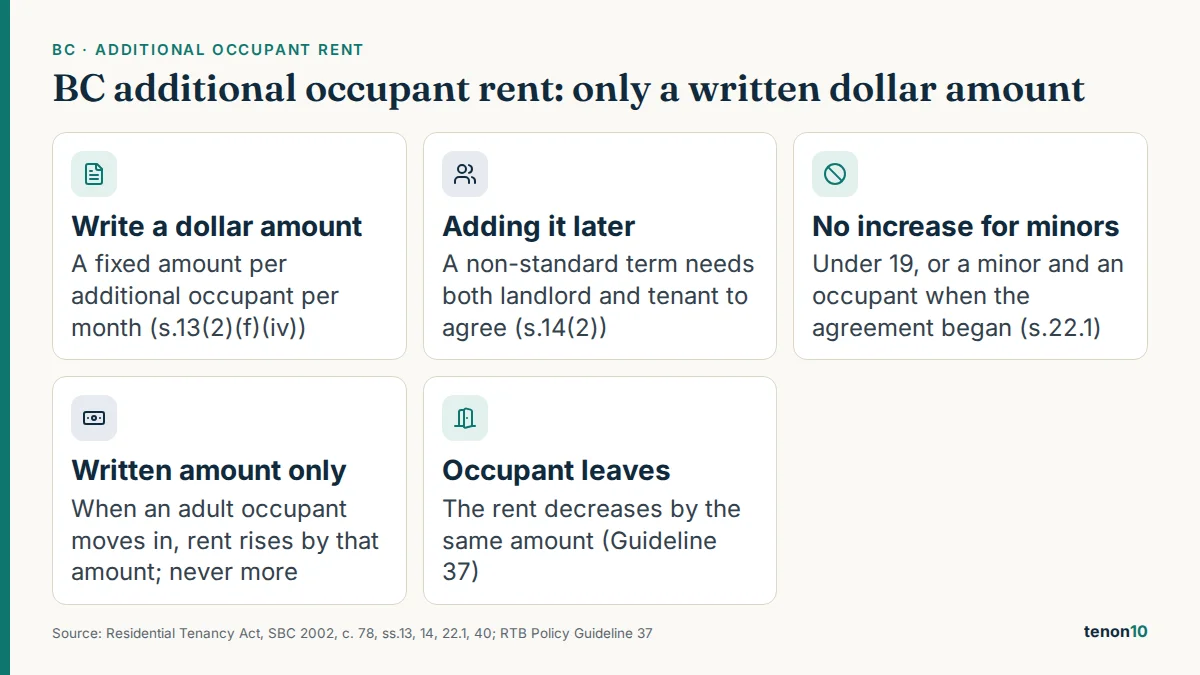
- Write the term at the start. Section 13(2)(f)(iv) requires the agreement to set out "the amount of rent payable for a specified period, and, if the rent varies with the number of occupants, the amount by which it varies." State a fixed dollar amount per additional occupant per month.
- Keep the amount fair. Guideline 37 notes that a term will not be enforceable if the amount is unconscionable because it is grossly unfair to the tenant.
- Adding the clause later needs the tenant's agreement. A non-standard term can be added to an existing agreement only if both the landlord and tenant agree (s.14(2)). See what you can and can't add to a BC tenancy agreement.
- Check the occupant's age. Under section 22.1, you cannot increase the rent because of an occupant who is a minor, or one who was a minor and an occupant when the agreement was entered into. In BC, a minor is under 19.
- Apply the written amount only. When an adult occupant moves in, the rent goes up by the amount in the agreement; it cannot be more.
- Put it in writing. Give the tenant a dated note naming the occupant, the start date and the new rent, so the ledger and the agreement match.
- Lower the rent when they leave. If the occupant stops living in the unit, the rent decreases by the same amount (Guideline 37).
How the minor rule works
Guideline 37 gives examples. A 17-year-old who is an occupant when the tenancy begins can never trigger an increase, even after turning 19 or moving away and returning. A friend who moves in at 18 cannot trigger an increase at first, but the additional occupant amount can apply once they turn 19. A partner who moves in later can trigger the increase, but that partner's baby cannot until the child turns 19 and still lives there. An increase applied before May 16, 2024 for an occupant who is or was a minor stays in effect.
Occupants, guests and co-tenants are different
- Guests. Under standard term 9 in the Residential Tenancy Regulation schedule, a landlord must not require or accept any extra charge for daytime visits or overnight guests. See guests in a BC rental.
- Occupants. A person the tenant lets move in is an occupant with no rights or obligations under the agreement unless it is amended to add them as a tenant (Guideline 13). Where the agreement does not say no additional occupants are allowed, the tenant may have occupants move in. See co-tenants, roommates and occupants.
- Too many people. If the number of occupants is unreasonable, the landlord may give a One Month Notice for cause (s.47(1)(c)).
Troubleshooting
- The agreement has no occupant term. You cannot raise the rent because someone moved in. Any change has to follow the regular rules for rent increases in Part 3.
- An extra amount was collected that the Act did not allow. Under section 43(5), if a landlord collects a rent increase that does not comply with Part 3, the tenant may deduct it from rent or otherwise recover it.
Frequently asked questions
Does an additional occupant increase need 3 months' notice in BC?
No. An increase for additional occupants that the agreement authorizes is not a "rent increase" under Part 3 (s.40), so the notice and timing rules in section 42 do not apply (Guideline 37).
Can a BC landlord charge more for a tenant's new baby?
No. Section 22.1 bars an increase based on an occupant who is a minor.
BC Additional Occupant Rent: Landlord Checklist
A one-page checklist for BC landlords: the written occupant term, the minor rule, applying and reversing the amount, and guests versus occupants.
Get Free PDF →Key takeaways
- The extra rent must be a dollar amount written in the tenancy agreement (s.13(2)(f)(iv)).
- It is not a Part 3 rent increase, so the 12-month and 3-month rules do not apply (s.40).
- No increase for an occupant who is a minor, or was a minor and an occupant at the start (s.22.1).
- The rent goes back down by the same amount when the occupant leaves.
Set up your BC tenancy paperwork right
Free landlord and tenant forms with plain-language instructions.
Free • No signup required