In BC, your landlord cannot stop you having guests under reasonable circumstances, cannot restrict your guests, and cannot charge you for daytime visits or overnight stays. Those rules are standard terms of every BC tenancy agreement. A landlord can set reasonable rules for guests in common areas, and a guest who moves in becomes an occupant, which the agreement may treat differently.
At a glance
- Guests are allowed: the landlord must not stop you having guests under reasonable circumstances (Regulation, Schedule term 9(1)).
- No guest fees: no charge for daytime visits or overnight guests (term 9(2); Regulation s.5(1)).
- Common areas: the landlord may set reasonable restrictions on guests' use of them (term 9(2.1)).
- You are responsible: for damage your guests cause (RTA s.32(3)) and for serious disturbance they cause (s.47(1)(d)).
- Moving in is different: a person who lives with you is an occupant, and extra rent applies only if your agreement says so (s.13(2)(f)(iv)).
Can a BC landlord limit my guests?
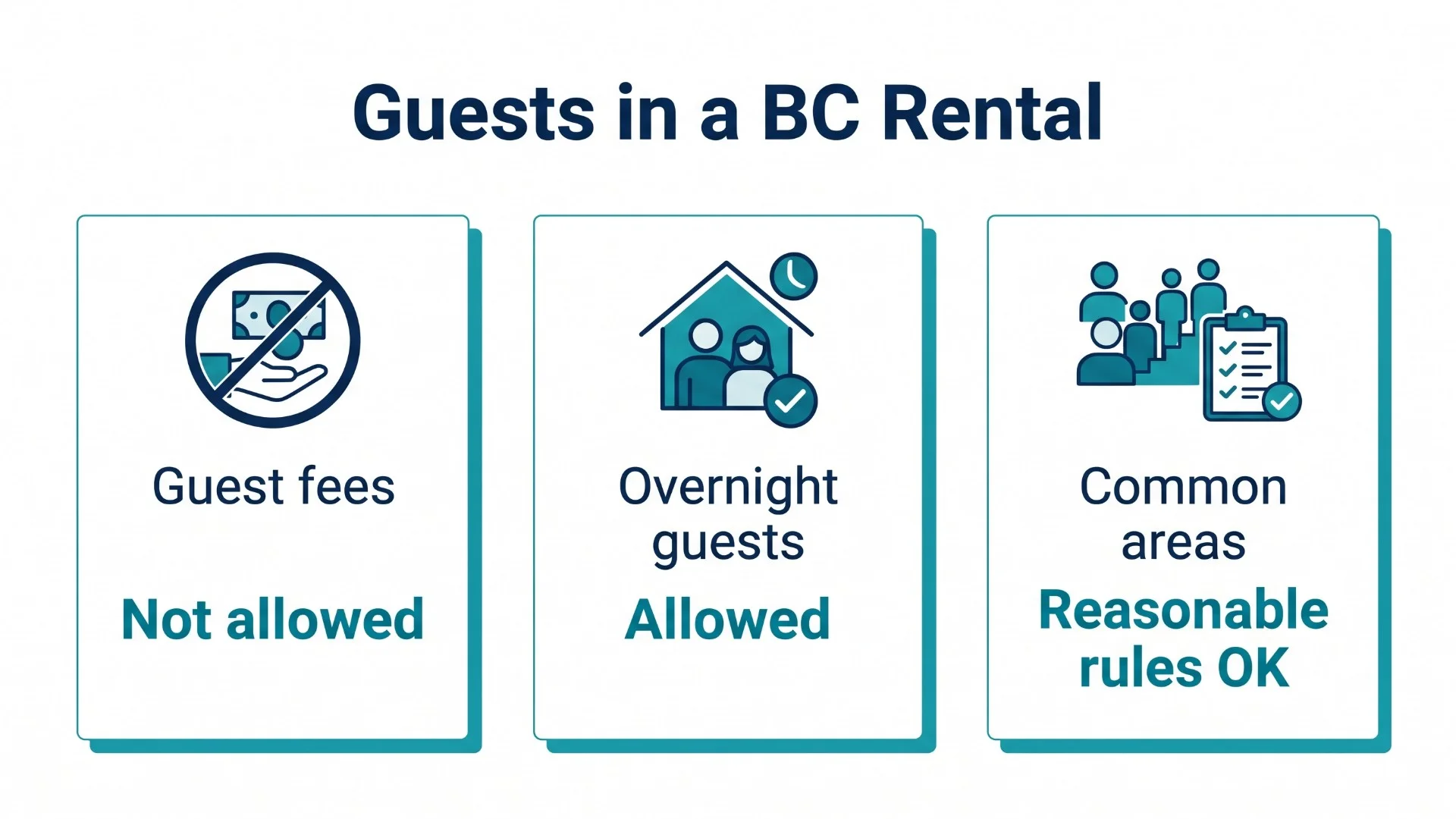
No, not inside your unit. Term 9 of the standard terms in the Schedule to the Residential Tenancy Regulation says the landlord must not stop the tenant from having guests under reasonable circumstances in the rental unit, and must not impose restrictions on guests. Section 13 of the Regulation requires those standard terms to be included in every tenancy agreement, and section 5 of the Residential Tenancy Act means a clause that tries to override them has no effect.
The Act backs this up. Section 30(1) says a landlord must not unreasonably restrict access to the residential property by the tenant or by a person the tenant permits there. A clause such as "no overnight guests", "guests limited to three nights a month" or "guests must be approved by the landlord" is a restriction on guests and is not enforceable; see illegal clauses in a BC lease.
Can my landlord charge a guest fee?
No. Section 5(1) of the Regulation says a landlord must not charge a guest fee, whether or not the guest stays overnight, and term 9(2) of the standard terms says the landlord must not require or accept any extra charge for daytime visits or overnight accommodation of guests. Charging a guest fee is also an offence: section 32 of the Regulation sets a fine of up to $5,000 for contravening section 5(1).
What rules can a landlord set for guests?
Reasonable rules for common areas. Term 9(2.1) lets the landlord impose reasonable restrictions on guests' use of common areas of the residential property, subject to section 27 of the Act on terminating or restricting services or facilities. A rule that guests must be accompanied by a tenant in a gym or pool, for example, is aimed at a common area; a rule about who may sleep in your unit is not. Whether a particular rule is reasonable is for the RTB to decide if it is disputed.
| Landlord rule | Allowed? | Source |
|---|---|---|
| "No overnight guests" | No | Schedule term 9(2) |
| $20 a night for a guest | No | Regulation s.5(1) |
| Guests must be accompanied in the gym | Yes, if reasonable | Schedule term 9(2.1) |
| Extra rent when a partner moves in, under a clause in the agreement | Yes, if the agreement sets the amount | RTA s.13(2)(f)(iv), s.40 |
When does a guest become an occupant?
When they move in. RTB Policy Guideline 13 says that if a tenant allows a person to move into the rental unit, the new person is an occupant with no rights or obligations under the tenancy agreement unless the landlord and tenant agree to add them as a tenant. The guideline adds that where the agreement has no clause saying additional occupants are not allowed, it is implied that the tenant may have additional occupants.
The Act does not set a number of nights. The practical question is whether the person is living there, for example receiving mail, keeping their belongings, or staying most nights over a long period, rather than visiting. Our guide to co-tenants, roommates and occupants in BC explains how each is treated.
Can my rent go up because someone moves in?
Only if your tenancy agreement says so. Section 13(2)(f)(iv) of the Act requires the agreement to state the rent and, if the rent varies with the number of occupants, the amount by which it varies. Section 40 says an increase under such a term is not a "rent increase" under the annual limit. Section 22.1 adds that the rent cannot go up for an occupant who is a minor, or who was a minor occupant when the agreement was made and has since grown up.
A visitor, however long the visit, is not an additional occupant. And a landlord who thinks the number of people living in a unit is unreasonable can discuss it with the tenant and may serve a notice to end the tenancy (term 9(3); RTA s.47(1)(c)), which the tenant can dispute.
Am I responsible for what my guests do?
Yes. Section 32(3) of the Act says a tenant must repair damage to the unit or common areas caused by the actions or neglect of the tenant or a person the tenant permits on the property. Section 47(1)(d) lets a landlord give a One Month Notice for cause if a person the tenant permits on the property significantly interferes with or unreasonably disturbs others, seriously jeopardizes their health or safety, or puts the landlord's property at significant risk. Your guests' conduct is, for these purposes, yours.
Can a guest sublet or take over my unit?
No. A guest or occupant is not a party to the tenancy. Handing your unit to someone else while you are away is a sublet or assignment and needs the landlord's written consent under section 34; see subletting and assigning in BC.
Frequently asked questions
Can my landlord ban my partner from staying over?
No. Schedule term 9 says the landlord must not stop you having guests under reasonable circumstances or impose restrictions on them, and must not charge for overnight guests.
How long can a guest stay in a BC rental?
The law sets no number of nights. A person becomes an occupant when they are living there rather than visiting, and the tenancy agreement may then set extra rent for an additional occupant.
Can a landlord evict me because of my guests?
Not for having guests. A notice for cause can follow if a guest causes serious disturbance, a safety risk or damage (RTA s.47(1)(d)), and you can dispute any notice within the time it states.
Does my landlord have to be told about guests?
Neither the Act nor the Regulation requires you to tell the landlord about visitors. If someone is moving in, check your agreement's terms on occupants first.
Guests are part of having a home. In BC the law keeps the landlord out of who visits you and when, while holding you responsible for how your guests behave.
Check what your agreement really says
Free forms and plain-language guides for BC renters.
Free • No signup required