A BC rental application can ask for photo ID, your rental history, references and proof of income, and, with your consent, a credit check. Under British Columbia's privacy and human rights laws, a landlord can't copy your ID, require your banking details before the tenancy starts, charge an application fee, or refuse you because of a protected ground such as family status or source of income.
The rules come from three places: the Personal Information Protection Act (PIPA), which every BC landlord must follow; the Human Rights Code; and the Residential Tenancy Act (RTA). The Office of the Information and Privacy Commissioner for BC (OIPC) has published guidance for landlords, and this article walks through it question by question.
At a glance
- No application fee. A landlord can't charge to accept or process an application (RTA s.15).
- ID is viewed, not copied (OIPC guidance; RTB).
- Credit checks need your consent, and should come near the end of selection (OIPC).
- Your SIN should be optional; name and date of birth usually do the job (OIPC).
- No banking details before the tenancy (OIPC), and no refusal on a Human Rights Code ground (s.10).
BC Rental Application Checklist
What to bring, what to share and what to refuse when you apply to rent in BC.
Get Free PDF →What can a BC landlord ask on a rental application?
Information that a reasonable person would consider appropriate for deciding whether to rent to you. In BC, the RTB says landlords can request verifiable income and employment, references (preferably a previous landlord) and photo ID to confirm your name, and may want a credit check with your written approval. The OIPC adds rental history, such as where you rented, for how long, and whether you were ever evicted.
| Information | Can they ask? | Conditions (OIPC guidance unless noted) |
|---|---|---|
| Government photo ID | Yes | View it and hand it back; don't copy or keep it |
| Rental history and evictions | Yes | Where, how long, and why you left |
| Landlord references | Yes | Only with your consent; limited to tenancy suitability |
| Income or employment | Yes | May be reasonable, especially if references are thin |
| Credit check | Yes, with consent | Towards the end, on the few applicants being considered |
| Social insurance number | Optional only | Name and date of birth are often enough |
| Date of birth or age | Limited | To confirm ID for a credit check, 55+ housing, or that you're 19 or older |
| Criminal record check | Rarely | In most situations it won't be necessary |
| Bank account or card numbers | No, not before the tenancy | OIPC; the RTB says landlords can't unreasonably ask for them |
| Your social media | No | Not a "publicly available source" under PIPA |
What can't a BC landlord ask or do?
A BC landlord can't require more personal information than is needed to provide the tenancy. PIPA s.7(2) says an organization must not, as a condition of supplying a service, require consent to collecting information beyond what is necessary, and the OIPC applies that to tenancies. The RTA separately bans application and processing fees (s.15).
The OIPC's limits, in plain terms
- Copies of ID: a landlord should view your ID and return it, not copy or keep it. The RTB says the same.
- Banking information: a landlord can't require it before the tenancy is established. Once you're selected, rent can be collected in many ways.
- Criminal record checks: only with clear reasons a reasonable person would find appropriate; the OIPC's example is a unit in the same building as a daycare.
- Social media: not a permitted public source, and viewing your profile collects far more than a landlord needs.
- Automated screening services: the OIPC tells landlords to use significant caution, and the service needs your consent too.
A landlord can, without your consent, look at BC's online court registry and published Residential Tenancy Branch decisions, which are prescribed public sources (PIPA s.12(1)(e)). They may still only use them for purposes a reasonable person would consider appropriate (s.11).
Which Human Rights Code grounds protect BC renters?
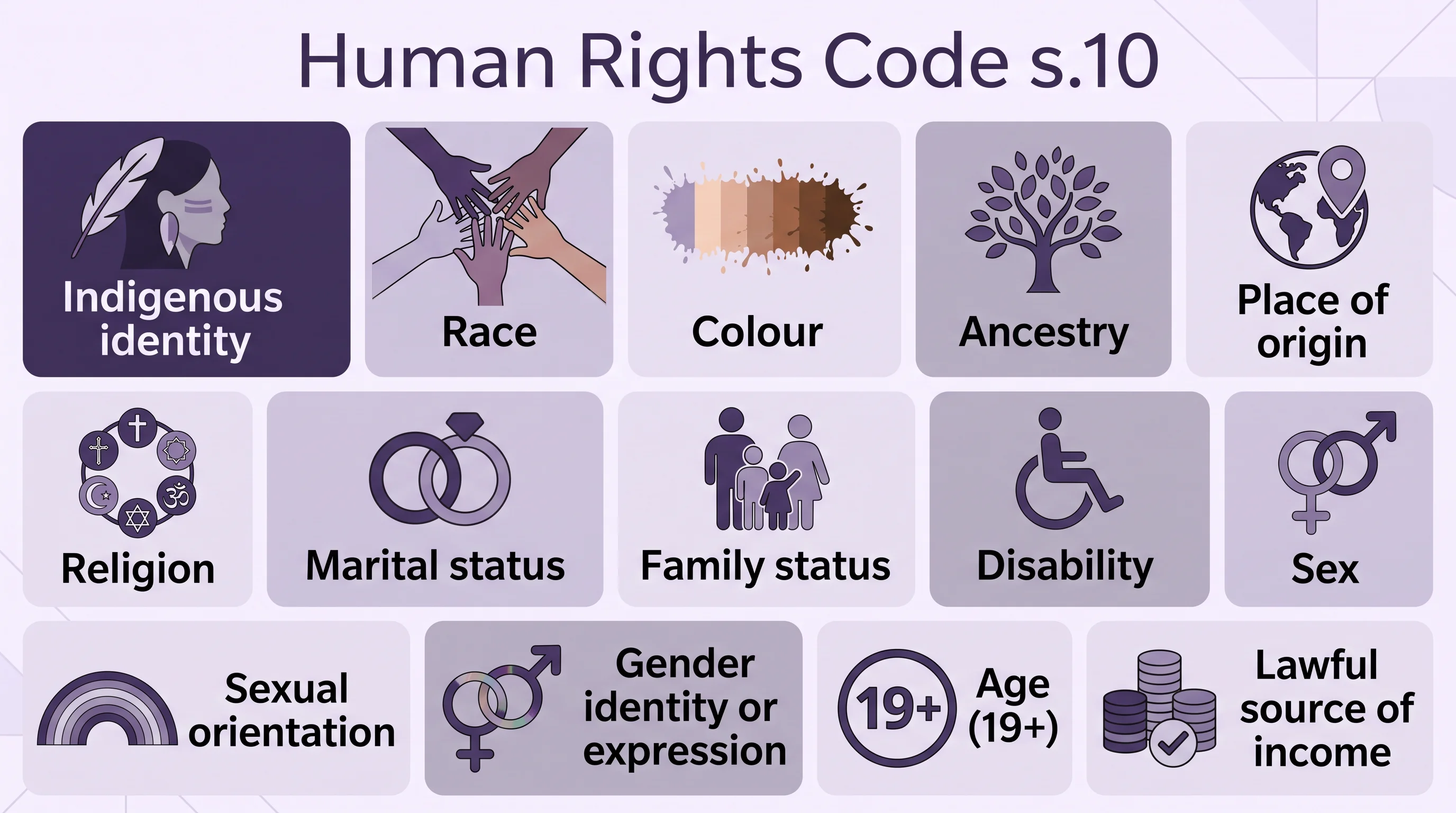
In BC, Human Rights Code s.10(1) says a person must not deny you a tenancy, or discriminate in its terms, because of your Indigenous identity, race, colour, ancestry, place of origin, religion, marital status, family status, physical or mental disability, sex, sexual orientation, gender identity or expression, age, or lawful source of income. Under the Code, "age" means 19 or older (s.1).
Section 7 also bars ads and statements that indicate an intention to discriminate. In practice, this means a landlord shouldn't ask whether you plan to have children, where you were born, your religion, or whether your income comes from a disability benefit rather than a job. The OIPC says using information protected by the Code is usually not a reasonable purpose under PIPA either.
The exceptions are narrow
Section 10(2) sets out when the tenancy protections don't apply:
- You would share sleeping, bathroom or cooking facilities with the person offering the space. (The RTA may not apply either; see Shared Accommodation in BC: When the RTA Doesn't Apply.)
- For age and family status, a building where every unit is reserved for someone 55 or older (or a household with at least one person 55 or older), or a prescribed class of premises.
- For disability, a unit and building designed for people with disabilities, meeting prescribed standards, and offered only to people with a disability.
What can you do if a landlord asks for too much?
Ask why they need it and offer a reasonable alternative, such as making your SIN optional and giving your name and date of birth for the credit check. If you believe a landlord is asking for inappropriate information or misusing it, the RTB says you can contact the OIPC; discrimination complaints go to the BC Human Rights Tribunal.
The OIPC also notes that you can withdraw consent, and the landlord must tell you the likely consequences, which may include not renting to you. If an application fee was charged, that is a breach of the RTA that the Residential Tenancy Branch handles. Our guide to tenant rights in BC covers your other protections once the tenancy starts.
Frequently asked questions
Can a BC landlord charge an application fee?
No. RTA s.15 bans charging for accepting or processing an application, investigating suitability, or accepting someone as a tenant.
Can a landlord photocopy my driver's licence?
The OIPC says a landlord should view your government photo ID and return it, not copy or keep it. The RTB's list-and-show page says landlords cannot make a copy of any identification.
Do I have to give my SIN for a credit check?
The OIPC says your full name and date of birth are often enough to identify you to a credit bureau, and landlords should avoid asking all applicants for a SIN or make it optional.
Can a landlord refuse me because I receive income assistance?
No. "Lawful source of income" is a protected ground for tenancy under Human Rights Code s.10(1). A landlord may still check, in a non-discriminatory way, that you can pay the rent.
Can a landlord refuse to rent to families with children?
Not because of family status, unless an exception in s.10(2) applies, such as a building where every unit is reserved for people 55 or older.
BC Rental Application Checklist
What to bring, what to share and what to refuse when you apply to rent in BC.
Get Free PDF →Conclusion
A BC landlord is entitled to check that you'll pay rent and look after the unit, and you're entitled to keep everything else private. Offer ID to view, references and income proof; consent to a credit check when you're a finalist; and push back on fees, ID copies, banking details and questions about who you are rather than how you rent.
Know what you're signing next
Once you're approved, the BC tenancy agreement sets out the rent, deposit and terms. See the agreement Tenon10 creates for BC tenancies.
Free BC form • Built for Canadian renters and landlords