You read your lease again and one clause stops you. It says the landlord can come in whenever they like, or charges $50 a month for your cat, or says you lose your whole deposit if you leave early. You think it breaks the rules. Now what?
In British Columbia, signing a lease does not make an illegal clause binding. But knowing a clause is unenforceable is only half of it. How you deal with it matters too. Handled badly, a bad clause can turn into a rent dispute or a notice to end your tenancy.
This guide is the tenant's action plan: how to confirm the clause really fails, what to say to your landlord, how to get money back, and when to take it to the Residential Tenancy Branch (RTB).
BC Lease Clause Checklist for Renters
Get Free PDF →First: is the clause really unenforceable?
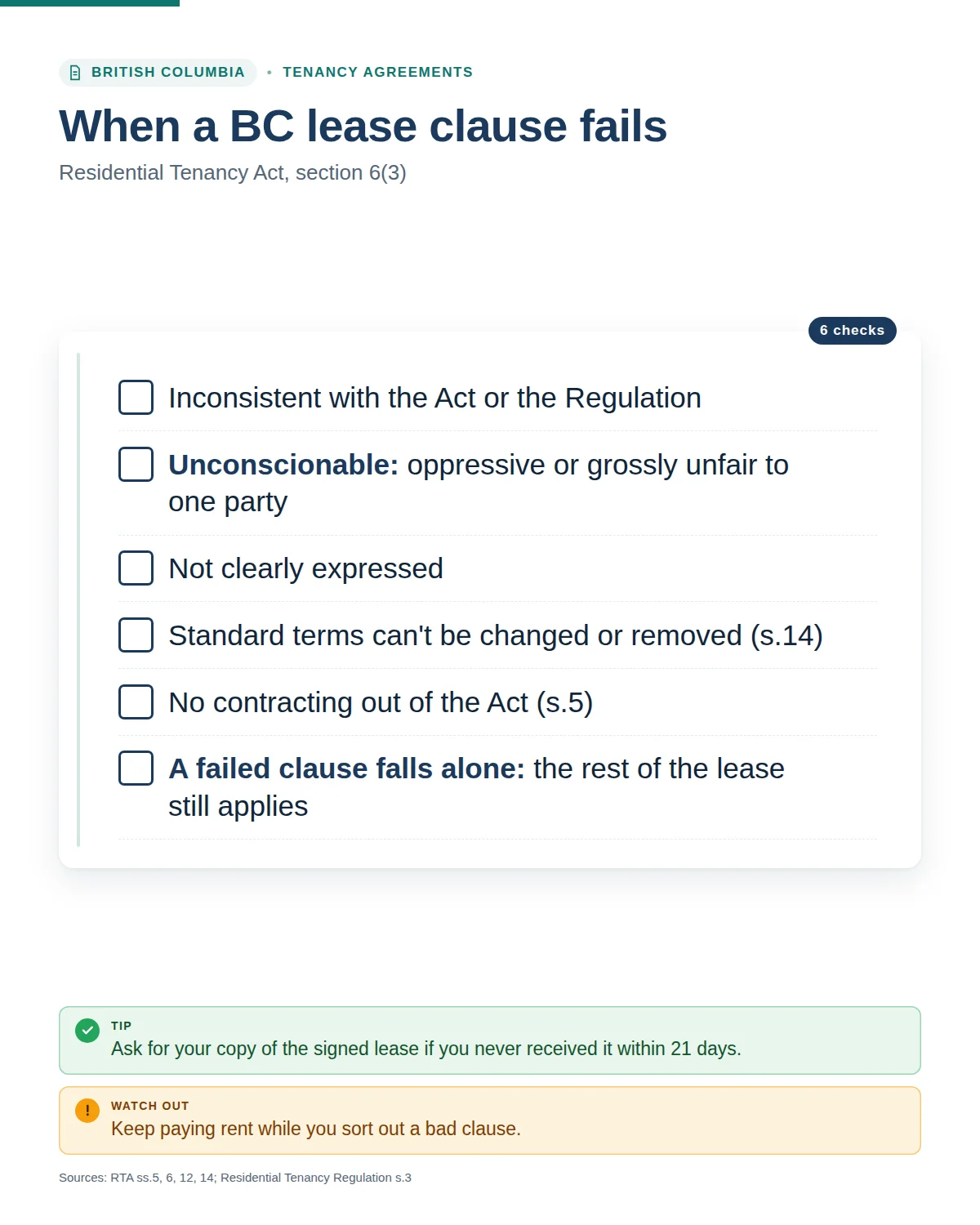
Section 5 of the Residential Tenancy Act (RTA) says landlords and tenants can't contract out of the Act, and any attempt to do so has no effect. Section 6(3) says a lease term is not enforceable if it:
- is inconsistent with the Act or the regulations,
- is unconscionable, meaning oppressive or grossly unfair to one party under the Residential Tenancy Regulation, or
- is not written clearly enough to tell you your rights and obligations.
The standard terms in every BC tenancy can't be changed or removed (RTA s.14). The RTB's tenancy agreements page puts it plainly: every tenant has rights protected by law, no matter what is in the tenancy agreement.
The clauses tenants most often bring up are deposits over half a month's rent, a monthly pet fee, entry without notice, guest fees or bans, and a deposit the landlord "keeps automatically". For the full list of what a landlord can and can't add, with the rule behind each, see What You Can and Can't Add to a BC Tenancy Agreement.
Not every rule you dislike is illegal. The RTB gives smoking restrictions, late rent fees and tenant insurance requirements as examples of normal additional terms, and section 18 lets a lease restrict pets. If a term is clear, fair and consistent with the Act, it binds you.
What to do, step by step
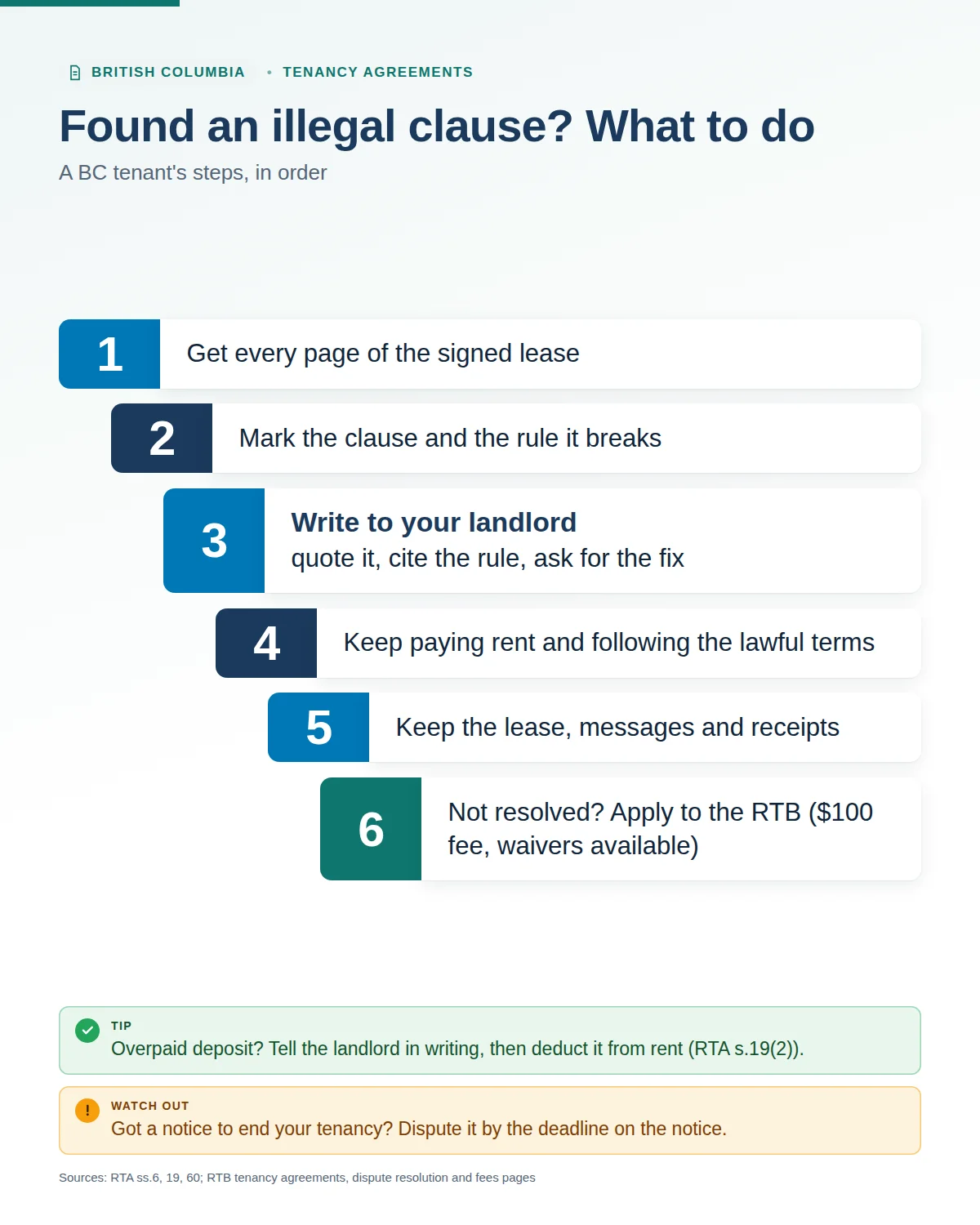
- Get the whole agreement. Your landlord must give you a copy within 21 days of entering into it (RTA s.13(3)). If you never got one, ask in writing. Make sure you have every page, including any addendum.
- Mark the clause and the rule it breaks. Write down the section of the Act or Regulation, or the standard term, that the clause conflicts with.
- Raise it with your landlord in writing. The RTB suggests contacting the landlord first, because they may not know the clause is against the law. Quote the clause, cite the rule, and say what you are asking for: the clause removed, a fee refunded, or both.
- Keep paying rent and keep following the lawful terms. The RTB says tenants must keep paying rent even while going through dispute resolution.
- Keep records. Save the lease, your messages, receipts for any fees, and proof of every rent payment. They are your evidence if it goes further.
- Apply for dispute resolution if it isn't resolved. The RTB says a tenant who can't solve an illegal or unfair term with the landlord can seek dispute resolution. The filing fee is $100, and a fee waiver is available in some circumstances, such as low household income.
A message you can adapt
Keep it short and calm. Something like:
"Hi [landlord], clause 14 of our tenancy agreement charges a $50 monthly pet fee. The Residential Tenancy Branch says a pet damage deposit is the only pet charge a landlord can collect. Please confirm in writing that the fee no longer applies, and refund the $300 I have paid since May. Thanks, [name], [unit]."
Send it in a way you can prove later, such as email, and keep a copy.
Getting money back
If the clause has already cost you money, how you recover it depends on what you paid.
- Deposit over the cap. A security deposit and a pet damage deposit are each capped at half of one month's rent. If you paid more, section 19(2) lets you deduct the overpayment from rent or recover it another way. The RTB's own example: rent of $1,500 with a $900 deposit, against a $750 limit, so the tenant told the landlord in writing and withheld the $150 difference from the next month's rent.
- Fees the rules don't allow. A monthly pet fee, a guest fee or a rental application fee (RTA s.15) has no lawful basis. There is no deduction rule for these, so ask for a refund in writing first. If the landlord refuses, you can apply to the RTB for the money.
- Deadlines. Where the Act sets no other time limit, an application must be made within 2 years after the tenancy ends (RTA s.60). Don't let a refund claim drift.
If your landlord tries to enforce the clause
They enter without proper notice
Outside an emergency or your permission, entry needs written notice at least 24 hours and not more than 30 days ahead, with a reasonable purpose and a time between 8 a.m. and 9 p.m. (RTA s.29), whatever the lease says. Keep a log of each entry. If it keeps happening, the RTB can make an order suspending or setting conditions on the landlord's right to enter (RTA s.70).
They serve a notice to end your tenancy
A clause that breaks the Act can't be enforced (RTA s.6(3)), but a notice still has a deadline. Dispute the notice before the deadline printed on it and let an arbitrator decide. Missing the deadline is a far bigger risk than the clause itself.
They call the clause "material"
Some leases label every term material. RTB Policy Guideline 8 says the label is not decisive; an arbitrator looks at how important the term really is. But a genuine material term matters: a landlord can end a tenancy if you breach one and don't correct it within a reasonable time after written notice (RTA s.47(1)(h)). If you get that kind of warning, answer it in writing.
Mistakes that make things worse
- Treating the whole lease as void. Only the bad term fails.
- Withholding rent to make a point. The narrow deductions the Act allows don't extend to clauses you object to.
- Settling it with a quick text. The RTB-1 says changes must be in writing and initialled by both landlord and tenant. A text saying "sure, fine" may not count. Ask for a proper written change.
- Ignoring a notice because the lease is unfair. Deal with the notice and its deadline first.
- Waiting until move-out. Raise the clause when you notice it, while the records are fresh.
How Tenon10 helps
Tenon10 generates a BC tenancy agreement with every detail the Act requires and the standard terms copied word for word from the current Regulation. A landlord who uses it starts from the Regulation's own wording rather than a home-made lease, so clauses like these are less likely to appear in the first place.
Lease, notice and payment records are kept together for each tenancy, so if a clause is disputed, both sides have a clear record of what was agreed and what was paid.
Frequently asked questions
Can I just ignore an illegal clause?
You don't have to follow a term the Act makes unenforceable, but tell your landlord in writing why, so the disagreement is on record. Keep paying rent and following the lawful terms.
Can my landlord evict me for refusing to follow it?
A term inconsistent with the Act is not enforceable. If you receive a notice to end your tenancy, dispute it before the deadline on the notice and the arbitrator will decide.
I paid a monthly pet fee for a year. Can I get it back?
The RTB says a pet damage deposit is the only pet charge allowed. Ask for a refund in writing first, and apply for dispute resolution if the landlord refuses. Claims generally must be made within 2 years after the tenancy ends.
Do I need a lawyer to apply to the RTB?
No. Tenants apply to the RTB directly. The filing fee is $100, with fee waivers available in some circumstances.
BC Lease Clause Checklist for Renters
Get Free PDF →Leases that start from the current standard terms
Tenon10 generates a BC tenancy agreement with the standard terms word for word from the current Regulation and keeps it with the notices and payment records for the tenancy.
Built for Canadian landlords and property managers.
Related BC guides
- What You Can and Can't Add to a BC Tenancy Agreement
- The Half-Month Cap: How Much Deposit a BC Landlord Can Collect
- How to File a Dispute Resolution Application with the BC RTB
- Five Days to Pay or Dispute: What Happens After a BC 10 Day Notice
Sources: Residential Tenancy Act; Residential Tenancy Regulation; RTB: Tenancy agreements; Residential Tenancy Agreement (RTB-1); RTB: Tenancy deposits and fees; RTB Policy Guideline 8; RTB: Tenancy dispute resolution. This article is a summary of British Columbia rules as of October 2026, not legal advice. Check the Residential Tenancy Branch for your situation.