A rental scam in BC usually follows one pattern: a great unit at a low rent, a "landlord" who can't meet you, and a request for money before you have seen the place or signed anything. The RCMP in BC lists these warning signs, and BC's Residential Tenancy Act (RTA) gives you a quick test: a real landlord can't charge an application fee or take a deposit before a tenancy agreement exists.
This guide is for renters searching in British Columbia. It covers how fake listings work, the red flags to check, the BC rules that expose a scam, and where to report one.
At a glance
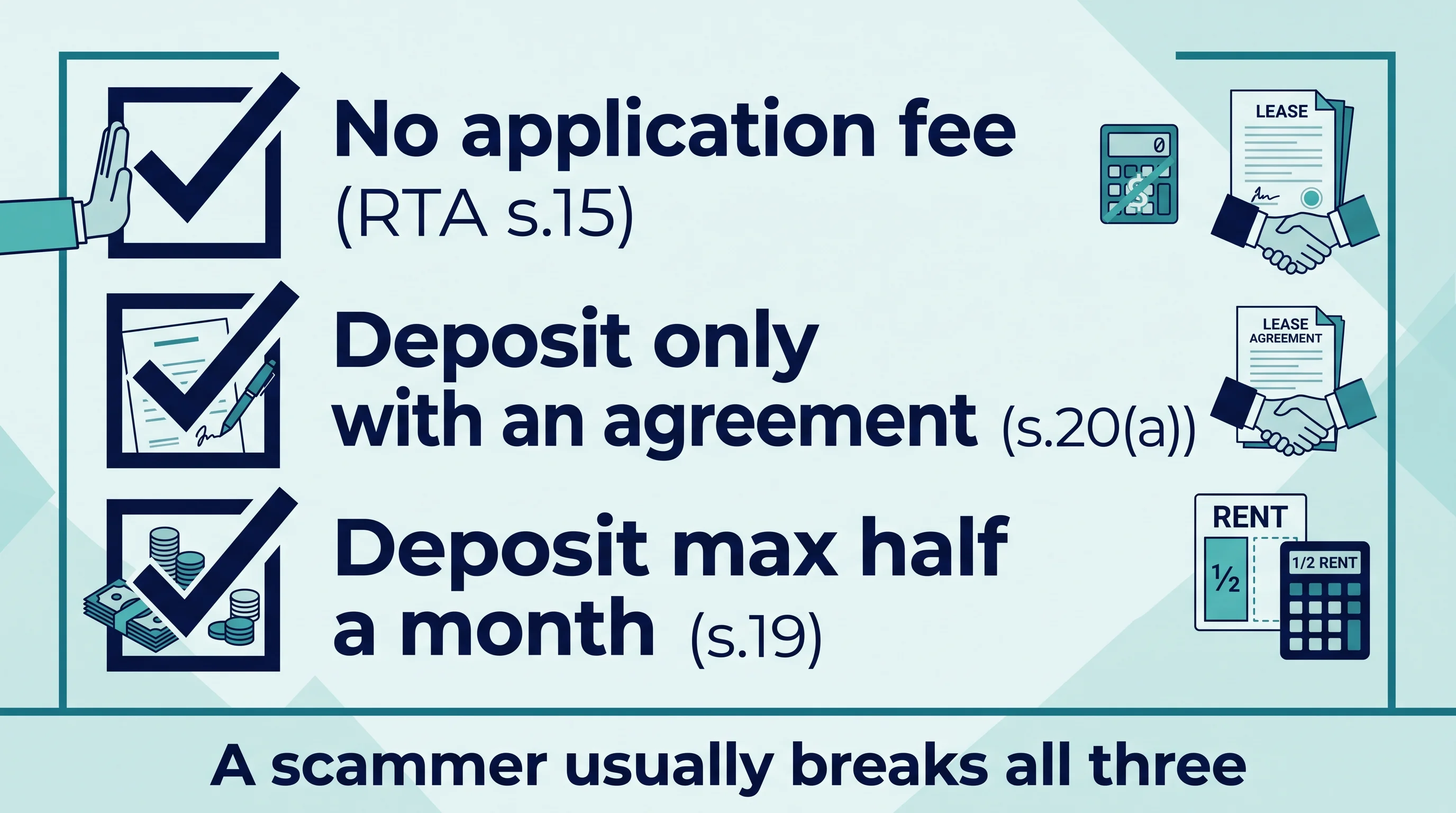
- No application fees in BC. A landlord can't charge to accept or process an application (RTA s.15).
- Deposits come with an agreement. A security deposit can only be required when the tenancy agreement is entered into (s.20(a)), and it's capped at half a month's rent (s.19).
- See it, meet them, check ID. The RCMP lists a landlord who won't meet in person as a warning sign.
- Avoid cash and wires. Don't send money until you've verified what you're paying for.
- Report it to the Canadian Anti-Fraud Centre (1-888-495-8501) and your local police.
BC Rental Scam Checklist
Check a BC listing before you send any money or personal details.
Get Free PDF →How do rental scams in BC work?
Most BC rental scams copy a real listing or invent one, price it below the market, and push you to pay before you can check it. The Competition Bureau describes ads for a sought-after area with great amenities and a low price, often posted by someone posing as a landlord who is away and can't show the unit.
The "landlord" then asks for a deposit, first month's rent or personal details to "hold" the unit, sometimes promising to mail the keys. Once the money is sent, the listing and the contact disappear. In a tight rental market, the pressure to act fast is exactly what the scam relies on.
What are the warning signs of a fake rental listing?
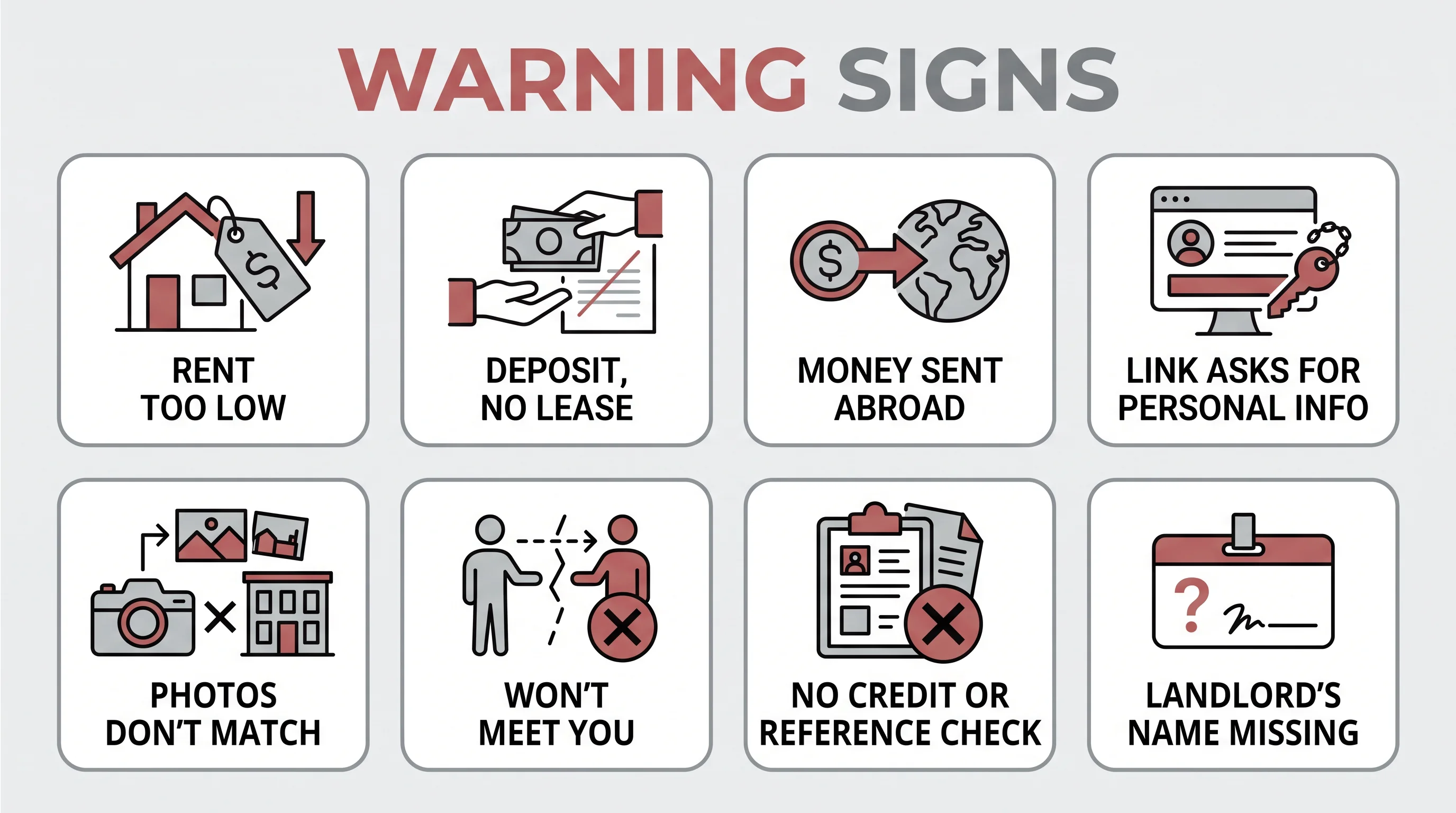
The RCMP in BC lists eight warning signs. One alone may have an innocent explanation; two or three together should stop you from paying anything.
| Warning sign (RCMP in BC) | What to do |
|---|---|
| Rent is lower than other similar places | Compare with similar units nearby |
| A deposit is wanted with no rental agreement or lease | Don't pay until there's a signed agreement |
| You're asked to send money outside the country | Stop; this is a classic scam step |
| An email sends you to a website asking for personal or financial information | Don't enter details; contact the landlord another way |
| Photos show only the outside, or don't match the address | Run a reverse image search; visit in person |
| The landlord doesn't meet you in person | Insist on a showing with the landlord or their agent |
| No credit or reference check is required | Treat as a red flag rather than a perk |
| The landlord's name is not on the rental documents | Ask who the landlord is and check the agreement |
How do BC tenancy rules help you spot a scam?
BC's tenancy law gives renters a few fixed points a scammer usually breaks. A real landlord in BC must not charge for accepting or processing an application or for investigating your suitability (RTA s.15), and can only require a security deposit when you and the landlord enter into the tenancy agreement (s.20(a)).
Some quick checks drawn from the RTA:
- "Application fee" or "processing fee"? Not allowed in BC (s.15). A request for one is either a scam or a landlord breaking the law.
- Deposit to "hold" the unit before any agreement? A security deposit can only be required when the agreement is entered into (s.20(a)). Pay only against a signed agreement.
- More than half a month's rent as a security deposit? Over the BC cap (s.19). See The Half-Month Cap: How Much Deposit a BC Landlord Can Collect.
- No landlord name or address? Every BC tenancy agreement must include the landlord's correct legal name and an address for service and telephone number (s.13(2)(b), (e)).
Consumer Protection BC adds that you may be asked for your social insurance number, bank account or credit card numbers, but that this information is not required to rent a place. Our guide to the BC Residential Tenancy Agreement (RTB-1) shows what a real agreement contains.
Check a property manager's licence
If someone says they manage the unit for an owner, you can look them up in the BC Financial Services Authority's Find a Professional search. Our explainer on BCFSA licensing for rental property management covers who needs a licence.
How do you protect yourself before paying?
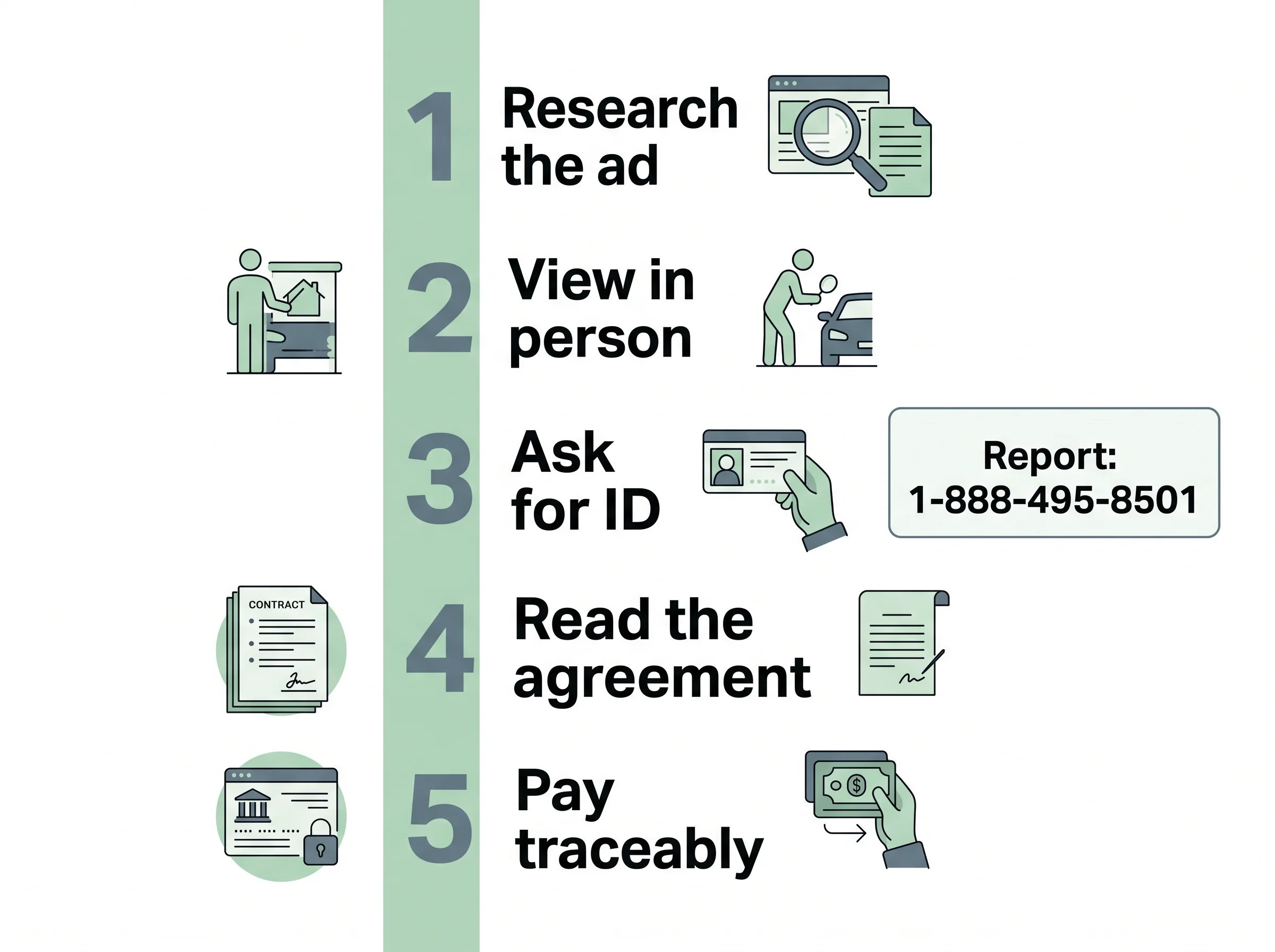
See the unit, meet the landlord and get a signed agreement before any money moves. The RCMP in BC recommends visiting the address and arranging a walk-through, asking the landlord for photo identification (and treating a refusal as a red flag), and making sure a proper tenancy agreement is drafted and signed by both parties.
A practical order of steps:
- Research the ad: compare the rent, reverse-search the photos and look for the same unit listed elsewhere.
- View in person with the landlord or their agent. For a new building, the RCMP suggests contacting the builder to confirm ownership.
- Ask for ID and check that the name matches the agreement.
- Read the agreement before signing. The landlord must give you a copy within 21 days (RTA s.13(3)).
- Pay traceably, and get a receipt. A landlord must give a receipt for rent paid in cash (standard term 5(3)).
Where do you report a rental scam in BC?
Report it to the Canadian Anti-Fraud Centre and to your local police. The Centre takes reports online at reportcyberandfraud.canada.ca, anonymously if you wish, or by phone at 1-888-495-8501, Monday to Friday, 10 a.m. to 4:45 p.m. Eastern time.
If you paid, also contact your bank or card issuer straight away, and report the listing to the website where you found it. Keep every message, ad screenshot and payment record; the police will need them.
Frequently asked questions
Is it legal for a BC landlord to charge an application fee?
No. RTA s.15 says a landlord must not charge for accepting or processing an application, investigating an applicant's suitability, or accepting someone as a tenant.
Should I pay a deposit to hold a unit I haven't seen?
No. The RCMP lists a deposit without a rental agreement as a warning sign, and in BC a security deposit can only be required when the tenancy agreement is entered into (RTA s.20(a)).
Can a landlord ask for my SIN or bank details on an application?
Consumer Protection BC says this information is not required to rent a place. Be very cautious about giving it, especially before you've met the landlord and seen the unit.
The landlord says they're overseas and will mail the keys. Is that a scam?
It matches the pattern both the RCMP and the Competition Bureau describe: a landlord who can't meet you and wants money first. Don't pay until you've seen the unit with someone who can prove they're the landlord or their agent.
Can the RTB get my money back from a scammer?
The Residential Tenancy Branch resolves disputes between landlords and tenants. If there was never a real landlord or tenancy, report to the police and the Canadian Anti-Fraud Centre, and contact your bank.
BC Rental Scam Checklist
Check a BC listing before you send any money or personal details.
Get Free PDF →Conclusion
Every BC rental scam needs you to pay before you check. Slow down, see the unit, meet the landlord, read a real tenancy agreement, and remember the two rules a scammer can't follow: no application fees, and no deposit before the agreement.
Know what a real BC tenancy agreement looks like
See the BC tenancy agreement Tenon10 creates, with the landlord's name, address for service, rent and deposit set out in writing.
Free BC form • Built for Canadian renters and landlords