In BC, every tenant has a legal right to quiet enjoyment under section 28 of the Residential Tenancy Act: reasonable privacy, freedom from unreasonable disturbance, exclusive possession of the unit, and reasonable use of common areas. If a landlord causes or ignores substantial, ongoing interference, a tenant can ask the Residential Tenancy Branch (RTB) for compensation or a rent reduction.
At a glance
- The right: RTA s.28, part of every BC tenancy, and it cannot be contracted out of (s.5).
- The test: substantial interference with ordinary, lawful enjoyment; temporary inconvenience is not enough (Policy Guideline 6).
- Other tenants: the landlord can be responsible if they knew of the problem and failed to take reasonable steps.
- Remedies: compensation (s.67), a rent reduction order (s.65(1)(f)), or, in serious cases, ending the tenancy for breach of a material term (s.45(3)).
- Never: deduct rent yourself as compensation without an RTB order.
What does quiet enjoyment mean in BC?
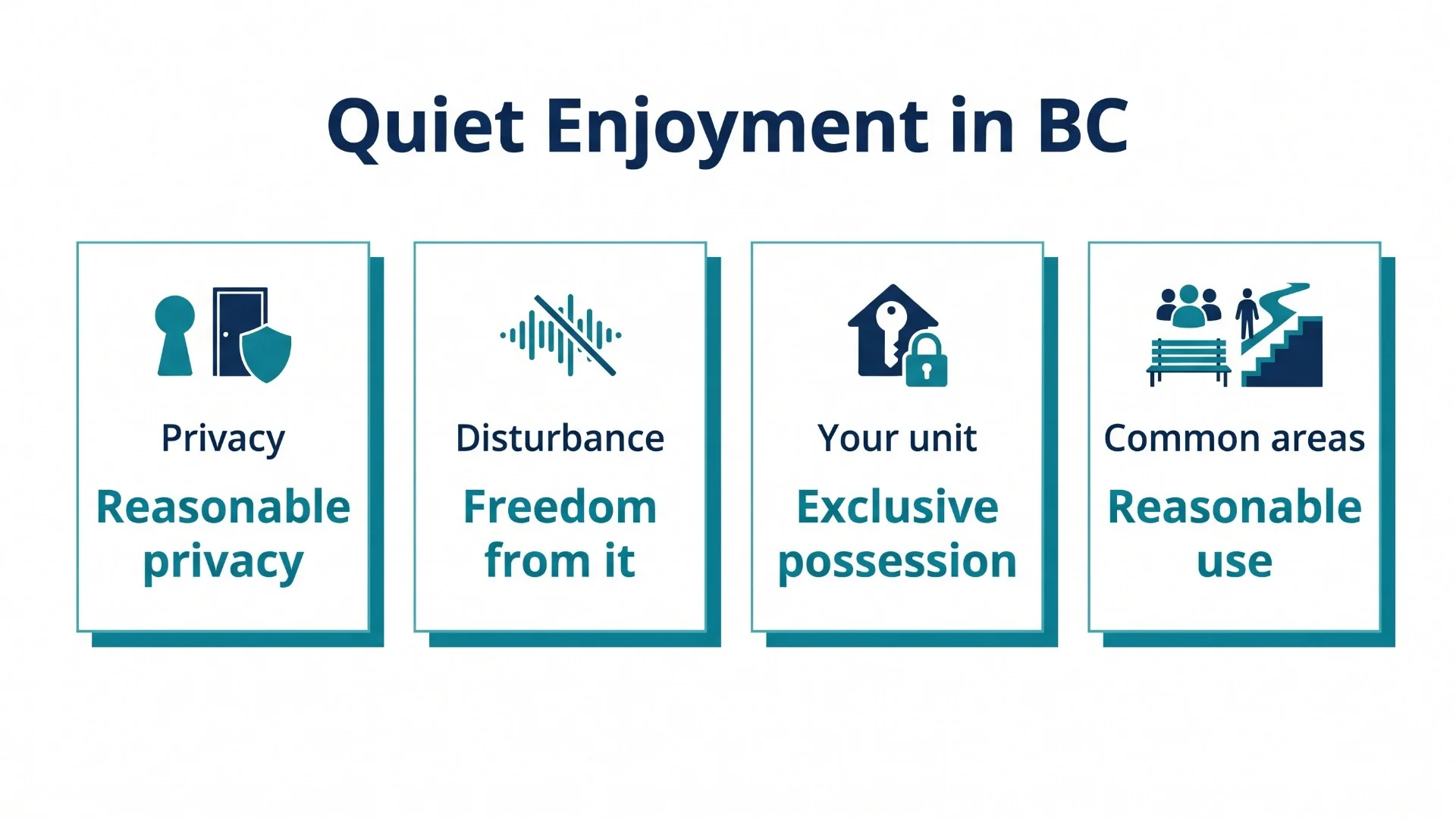
It means the right to live in your rental without unreasonable interference. Section 28 of the Residential Tenancy Act says a tenant is entitled to quiet enjoyment including, but not limited to, four rights:
- Reasonable privacy.
- Freedom from unreasonable disturbance.
- Exclusive possession of the rental unit, subject only to the landlord's limited right to enter under section 29.
- Use of common areas for reasonable and lawful purposes, free from significant interference.
"Quiet" does not mean silent. As the list shows, the right covers privacy, possession and the use of common areas as well as noise.
What counts as a breach of quiet enjoyment?

RTB Policy Guideline 6 says a breach means substantial interference with the ordinary and lawful enjoyment of the premises. It includes interference the landlord causes directly and situations where the landlord knew of an interference or unreasonable disturbance and failed to take reasonable steps to correct it.
The guideline draws a clear line: temporary discomfort or inconvenience is not a breach, while frequent and ongoing interference or unreasonable disturbance may be. It also asks the arbitrator to balance the tenant's right against the landlord's right and responsibility to maintain the property.
| Likely to count | Unlikely to count on its own |
|---|---|
| Repeated entry without the 24 hours' written notice section 29 requires | One entry with proper notice for a reasonable purpose |
| A neighbour's ongoing disturbance the landlord knows about and does nothing about | A single noisy party next door |
| Months of renovation that make part of the unit unusable | A day or two of necessary repair work |
| Harassing calls, messages or visits from the landlord | Reasonable written reminders about rent or rules |
Is my landlord responsible for noisy neighbours?
Sometimes. Policy Guideline 6 says a landlord can be held responsible for the actions of other tenants if it is established that the landlord was aware of the problem and failed to take reasonable steps to correct it. So the first step is to tell the landlord, in writing, what is happening. A landlord who then acts, for example by warning the other tenant or serving a notice for cause, is taking reasonable steps even if the problem takes time to resolve.
If the noise comes from another tenant of the same landlord, the landlord has tools you do not: section 47 of the Act allows a One Month Notice where a tenant or their guest has significantly interfered with or unreasonably disturbed another occupant or the landlord.
Can my landlord's entry breach quiet enjoyment?
Yes, when it falls outside section 29. Except in an emergency, with your permission, or in a few other narrow cases, a landlord must give at least 24 hours' and not more than 30 days' written notice stating a reasonable purpose and a date and time between 8 a.m. and 9 p.m. Our guide to BC landlord entry rules sets out every exception. Repeated or improper entries go to the heart of exclusive possession.
What about renovations and repairs?
Necessary work is the landlord's duty, but it can still reduce what you are paying for. Policy Guideline 6 says a tenant may be entitled to compensation for loss of use of part of the property even if the landlord made reasonable efforts to minimize disruption while making repairs or renovations. See our guide to notice, noise and compensation during window replacement for a worked example.
What can a BC tenant do about a breach?
Start in writing, then go to the RTB if it continues. The options are:
- Write to the landlord. Describe the problem, refer to section 28, and ask for a specific fix by a reasonable date.
- Apply for dispute resolution. The RTB can order compensation for damage or loss under section 67 and, under section 65(1)(f), that past or future rent be reduced by an amount equivalent to the reduction in the value of the tenancy. Guideline 6 says the amount depends on how seriously and for how long you were deprived of quiet enjoyment. See how to file with the RTB.
- End the tenancy, in serious cases. The courts have found quiet enjoyment to be a material term. Under section 45(3), if the landlord fails to correct a breach of a material term within a reasonable period after your written notice, you may end the tenancy. Guideline 6 warns that the standard of proof is high and that compensation may be more appropriate.
Is there a deadline to claim?
Yes. Where the Act sets no other time limit, section 60 says an application must be made within 2 years of the date the tenancy ends. You do not have to move out to claim; many tenants apply while the tenancy continues.
Frequently asked questions
Can my landlord install a camera that looks into my unit?
Section 28 protects reasonable privacy and exclusive possession of the unit. A camera aimed into your home raises both; raise it in writing and, if it continues, apply to the RTB.
Is a noisy neighbour a breach of quiet enjoyment by my landlord?
Only if the landlord knew of the problem and failed to take reasonable steps to correct it, according to Policy Guideline 6. Tell the landlord in writing first.
Can a lease clause waive my right to quiet enjoyment?
No. Section 5 of the Act says landlords and tenants cannot contract out of the Act, and any attempt has no effect.
How much compensation do tenants get?
There is no fixed amount. The arbitrator considers how serious the interference was, how far you were deprived of the use of your home and how long it lasted.
Does quiet enjoyment cover the building's common areas?
Yes. Section 28(d) includes use of common areas for reasonable and lawful purposes, free from significant interference.
Quiet enjoyment is the right that makes a rental a home. Document the problem, put it to the landlord in writing, and use the RTB when the interference is serious and ongoing.
Know your rights as a BC tenant
Free forms and plain-language guides for renters.
Free • No signup required