Your landlord says the building needs work and you have to go. Maybe it came as a letter, a form, or a package from the Residential Tenancy Branch (RTB) with a hearing date on it. Either way, it is your home, and the first question is simple: does this paper actually end your tenancy?
In British Columbia, a landlord cannot end a tenancy for renovations just by giving you a notice. Since July 1, 2021, they must apply to the RTB, and an arbitrator decides at a hearing whether the work truly needs you out. You get to take part in that hearing.
This guide helps you work out what you received, what the law requires, what you are owed if you do have to move, and the steps to take this week.
BC Renovation Eviction Checklist for Renters
A renter's checklist for a BC renovation eviction: identify what you received, test the landlord's case, meet the deadlines and claim what you are owed.
Get Free PDF →The rule: renovation evictions need an RTB order
Under section 49.2 of the Residential Tenancy Act, your landlord can only end your tenancy for renovations or repairs by getting an order from the RTB. The arbitrator must be satisfied of all four of these:
- The landlord intends in good faith to do the work and already has all the permits and approvals the law requires.
- The work requires your unit to be vacant.
- The work is necessary to prolong or sustain the use of the unit or building.
- Ending your tenancy is the only reasonable way to get the vacancy.
The RTB's Policy Guideline 2B says "vacant" means empty. Work that is merely faster or cheaper with you gone does not qualify, and cosmetic updates like new paint, flooring or cabinets rarely do.
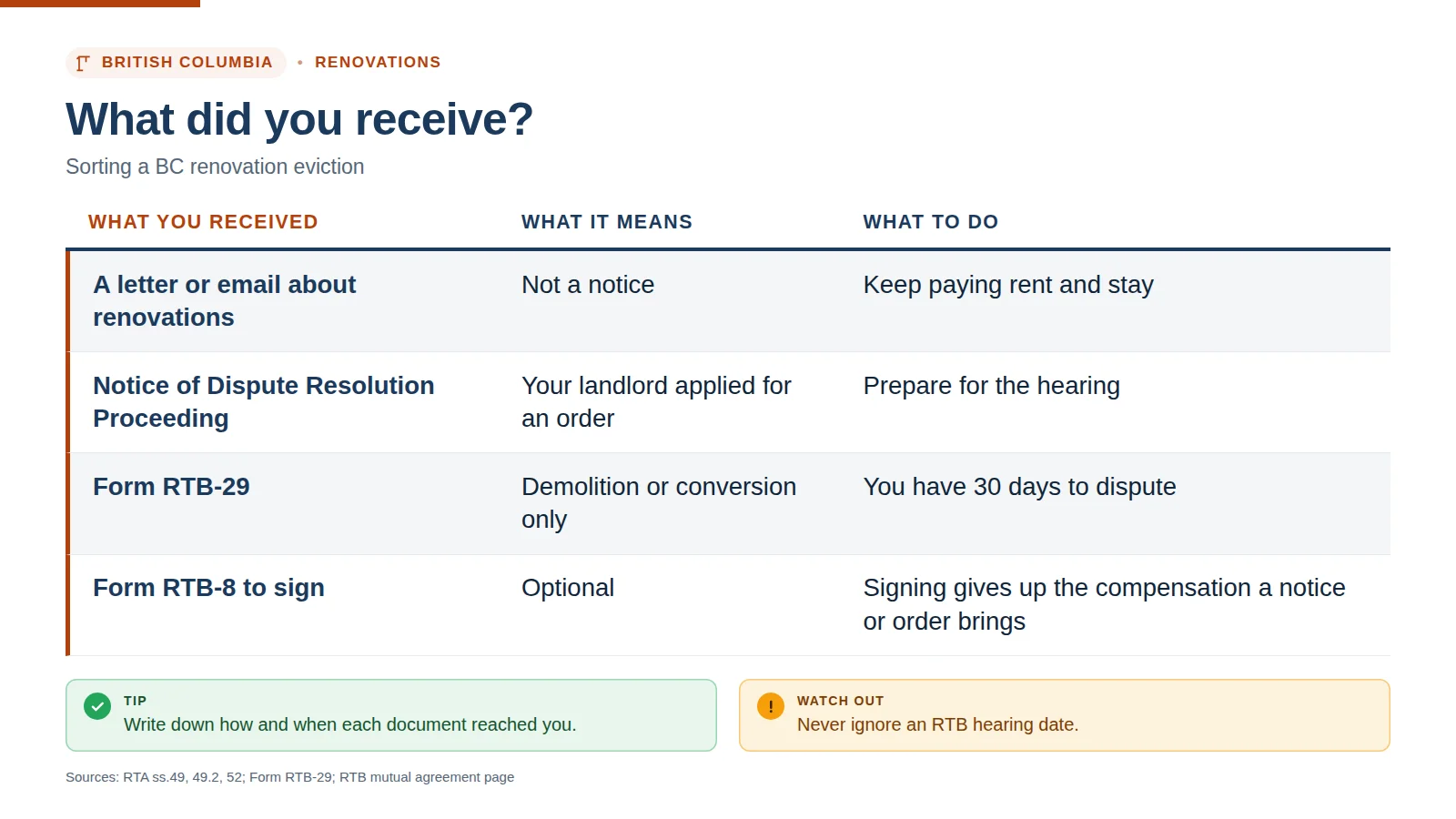
What did you actually receive?
| What you have | What it means | What to do |
|---|---|---|
| A letter or email asking you to leave for renovations | Not a notice to end tenancy. Section 52 says a landlord's notice must be in the approved form, and no approved form exists for renovations. | Keep paying rent and keep living there. Do not sign anything yet. Call the RTB if you are unsure. |
| A Notice of Dispute Resolution Proceeding from the RTB | Your landlord has applied for a renovation order. You are the respondent. | Read every page, note the hearing date, and prepare your evidence. |
| Form RTB-29, Four Month Notice to End Tenancy | This form is for demolition or conversion (strata, co-op, or non-residential use), not renovation. | Decide quickly whether to dispute. You have 30 days after receiving it. |
| A Mutual Agreement to End a Tenancy (Form RTB-8) to sign | A request that you agree to leave. | You do not have to sign. The RTB warns that ending by mutual agreement means you will not get the compensation a notice or order would have brought. |
If you got an RTB-29 for demolition or conversion
The landlord must already have the permits before giving it, and the move-out date must be at least four months after you receive it, on the last day of a rental period, and not before a fixed term ends. Example, with rent due on the 1st:
- Handed to you on Wednesday, November 18, 2026.
- Last day to apply for dispute resolution: Friday, December 18, 2026.
- Earliest move-out date: Wednesday, March 31, 2027.
If you do not dispute within the 30 days, the Act treats you as accepting that the tenancy ends on the date in the notice.
What you are owed if the tenancy does end
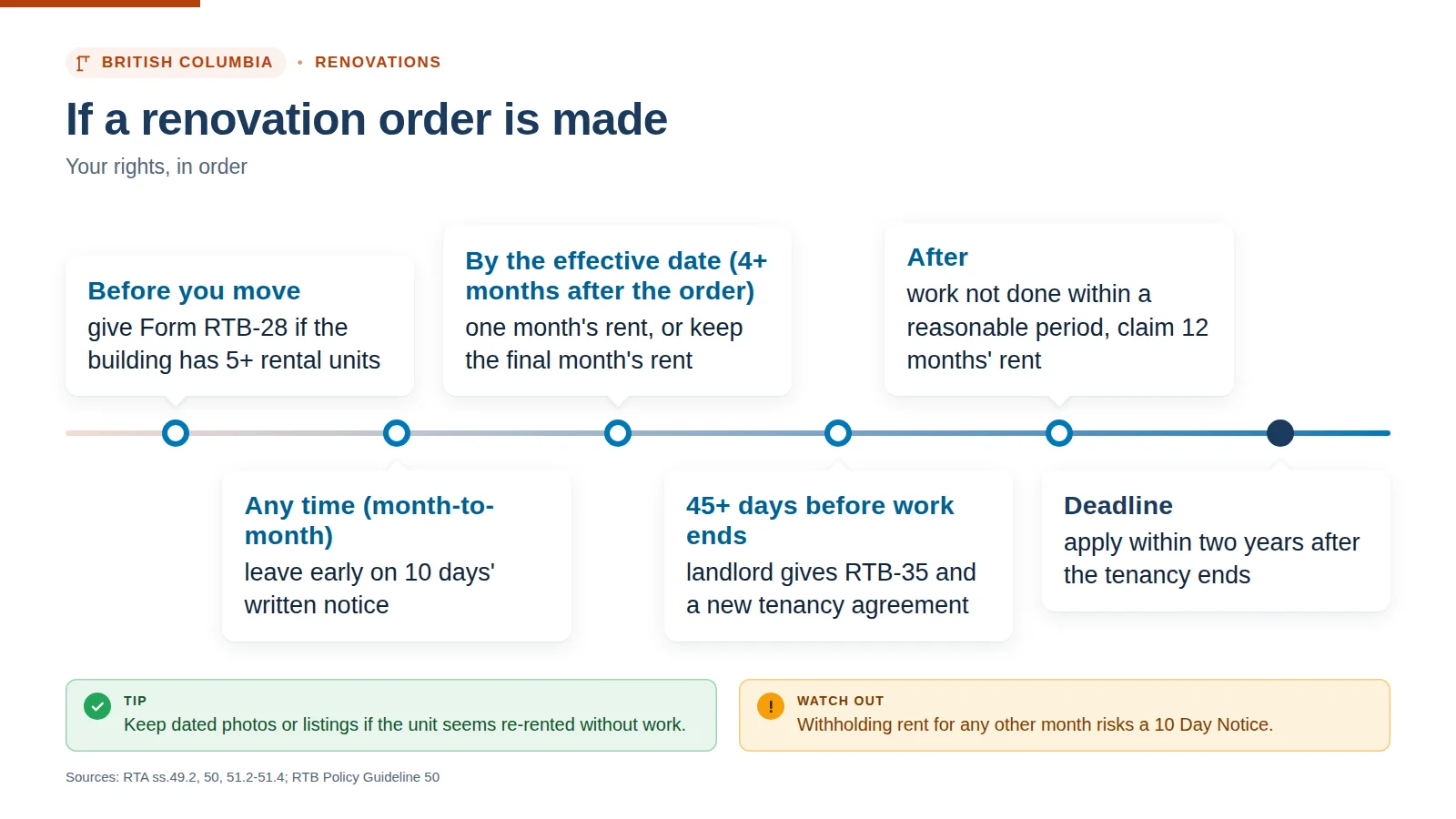
- Time. A renovation order's effective date must be at least 4 months after the order is made, on the day before rent is due, and not before a fixed term ends.
- One month's rent. Under section 51.4 you are entitled to the equivalent of one month's rent on or before the effective date. You can instead keep that amount by not paying rent for the final month.
- The option to leave early. In a month-to-month tenancy, section 50 lets you give at least 10 days' written notice and move out sooner. You keep the one-month compensation, and the landlord must refund rent you paid for any period after your move-out date.
- A right to come back. In buildings with 5 or more rental units, you can give the landlord Form RTB-28 before you move out to say you want to return. The landlord must then give you Form RTB-35 and a new tenancy agreement at least 45 days before the work is finished.
- Twelve months' rent if the work is not done. If the renovations are not accomplished within a reasonable period after the effective date, the landlord must pay you 12 times the monthly rent, unless an arbitrator finds extenuating circumstances. The same amount applies if the landlord ignores your right of first refusal.
You have two years from the end of the tenancy to apply for compensation, according to RTB Policy Guideline 50.
Common mistakes tenants make
- Moving out on a letter. A letter is not an order. Leaving voluntarily can cost you the compensation the Act would have given you.
- Ignoring the hearing. Under Rule 7.3 the arbitrator may go ahead without you, hearing only your landlord's side.
- Missing the evidence deadline. As the respondent, your evidence must be received by the landlord and the RTB at least 7 days before the hearing.
- Forgetting the RTB-28. In a building with 5 or more units, the right to return must be claimed before you move out.
- Not checking on the work later. If nothing happens, or the unit is re-rented without the work, you need dated photos or listings to support a claim.
What to do next
- Identify the document using the table above. If it is from the RTB, find the hearing date and your file number.
- Keep paying rent as usual until a valid order or notice says otherwise.
- Ask for the details. Request the permits and the scope of work in writing. If the landlord has applied, their evidence should be served on you.
- Test their case against the four points. Does the permit cover work that needs the unit empty? How many days of vacancy? Guideline 2B says that if the work needing vacancy takes 45 days or less and you are willing to live elsewhere for that time and give access, the tenancy generally should not need to end. Say so if it applies.
- Gather your evidence. Your tenancy agreement, rent receipts, photos of the unit, and every message about the renovation. Upload them with a short description and date for each file.
- Get help. The RTB answers questions, and its tenant pages also point to the Tenant Resource and Advisory Centre (TRAC), legal advocates and lawyers.
- If the order is granted, diarise the effective date, decide on the one-month compensation, and send your RTB-28 if your building qualifies.
How Tenon10 helps
Tenon10 keeps a tenancy's lease, notices and payment records together. If your landlord uses it, those shared records show your rent history and every notice served, which is exactly what you would bring to a hearing.
Tenon10 does not file RTB applications for anyone. Disputes are filed directly with the RTB.
FAQ
Can my landlord give me a Four Month Notice for renovations?
No. Renovations require an RTB order under section 49.2. The RTB-29 is for demolition and conversions.
Do I have to move out before the hearing?
No. Your tenancy continues unless and until an order ends it, and then not before its effective date.
Can I come back after the renovation?
In a building with 5 or more rental units, yes, if you give Form RTB-28 before moving out. Smaller buildings carry no right of first refusal.
What if my landlord re-rents the unit without doing the work?
You can apply to the RTB for 12 months' rent in compensation, within two years after the tenancy ended. The landlord has to prove the work was done.
BC Renovation Eviction Checklist for Renters
A renter's checklist for a BC renovation eviction: identify what you received, test the landlord's case, meet the deadlines and claim what you are owed.
Get Free PDF →Keep your tenancy records in one place
Tenon10 keeps your lease, notices and payment records together, so the facts are ready if a renovation dispute reaches the RTB.
Built for Canadian landlords and property managers.
Related BC guides
- Got a 10 Day Notice in BC? What Tenants Should Do Now
- Serving Documents in BC: Every Method the RTA Allows
- Getting Your Deposit Back in BC: A Tenant's Step-by-Step Guide
Sources: Residential Tenancy Act; RTB Policy Guideline 2B; RTB Policy Guideline 50; RTB: Types of evictions; RTB: Disputing an eviction; RTB: Mutual agreement to end a tenancy; Form RTB-29. This article is a summary of British Columbia rules as of October 2026, not legal advice. Check the Residential Tenancy Branch for your situation.