A BC landlord can give an end of employment notice to a caretaker, manager or superintendent who lives in the building once the job ends, on the RTB-33, effective at least one month after the tenant receives it (Residential Tenancy Act s.48). The tenant then has 10 days to dispute the notice at the Residential Tenancy Branch (RTB) (s.48(5)).
Unlike some provinces, BC does not end the tenancy automatically when the job ends: you still serve a notice with a proper effective date. This how-to covers when section 48 applies and the steps in order. For more landlord guides, see the BC Landlord Resource Center.
BC End of Employment Notice: Landlord Checklist
A one-page checklist for BC landlords ending a caretaker's or employee's tenancy after the job ends: section 48, the RTB-33, service, and the 10-day dispute window.
Get Free PDF →What you'll need
- The tenancy agreement, showing the unit was rented or provided for the term of the employment.
- The written record of the date the employment ended.
- The RTB-33, One Month Notice to End Tenancy For Cause or End of Employment (version 2026/04).
- The RTB-34 Proof of Service, to record how you served it.
When does section 48 let a BC landlord end a caretaker's tenancy?

Section 48 covers two situations. Under s.48(1), a landlord may end the tenancy of a person employed as a caretaker, manager or superintendent of the residential property if the unit was rented or provided for the term of the employment, the employment has ended, and the landlord intends in good faith to rent or provide the unit to a new caretaker, manager or superintendent. Under s.48(2), an employer may end the tenancy of any employee in a unit the employer rented or provided for the term of employment, once the employment has ended.
The RTB-33 has a checkbox for each. If neither fits, for example a former caretaker's unit you want to convert for a new caretaker's use with no employment link, that is a landlord's use ground under s.49(6)(e), with its own rules.
Steps: serving an end of employment notice in BC
- Confirm the employment has ended. The effective date cannot be earlier than the last day the tenant is employed by you (s.48(3)(b)).
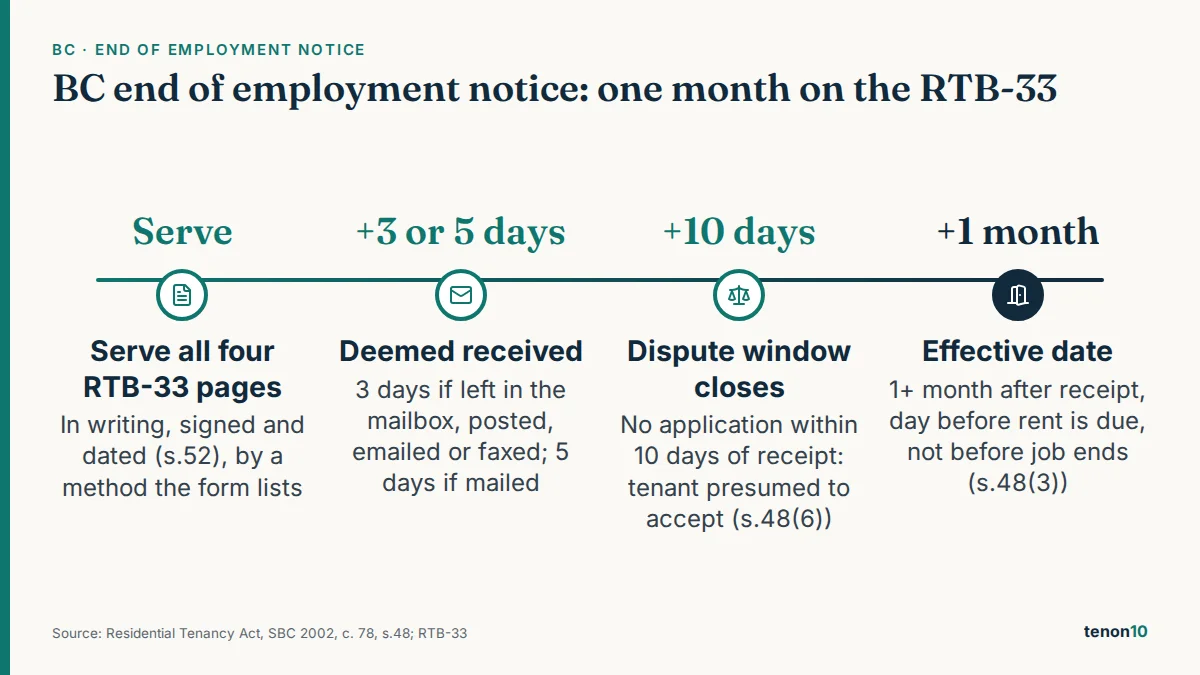
- Pick the effective date. It must be at least one month after the tenant receives the notice and the day before rent is due (s.48(3)). For rent due on the 1st, that is the last day of a month. If you get it wrong, s.53 changes it to the earliest date that complies.
- Fill in the RTB-33. Tick the end-of-employment box that fits, and complete the details section. The form says an arbitrator may cancel the notice if details are not provided. Sign and date it; a notice must be in writing, signed and dated, and give the address and effective date (s.52).
- Serve every page. The form states that the landlord must give the tenant all four pages. Use a method the form lists, such as in person, registered mail, the mailbox or mail slot, the door, or an email address the tenant gave for service.
- Know the deemed receipt date. Unless there is evidence otherwise, the tenant is treated as receiving it 3 days after it is left in the mailbox, posted on the door, or emailed or faxed, and 5 days after it is mailed.
- Complete the RTB-34. Record the date and method of service as evidence.
- Watch the 10-day dispute window. If the tenant does not apply within 10 days of receiving the notice, they are conclusively presumed to accept that the tenancy ends on the effective date and must move out by then (s.48(6)).
What happens if the BC tenant disputes or stays?
If the tenant disputes, a hearing follows. The RTB-33 notes the tenant must serve you a Notice of Proceeding package within 3 days of applying, and if the arbitrator upholds your notice, the arbitrator must grant you an order of possession (s.55(1)). For the good-faith element in s.48(1)(c), be ready to show the new caretaker arrangement.
If the tenant does not dispute and does not leave, you can apply for an order of possession (s.55(2)(b)), including through the Direct Request process, which is decided on written documents when the notice was not disputed. You may not take possession yourself: that needs a writ of possession from the Supreme Court (s.57(2)). See enforcing an order of possession in BC.
Troubleshooting
- The caretaker is also behind on rent. Unpaid rent is a separate ground with its own 10-day notice; see the RTB-30.
- You used the wrong effective date. It is corrected automatically under s.53; the RTB-33 also says an incorrect move-out date does not make the notice invalid.
- You also have cause. The same RTB-33 lists the cause grounds; see the one month notice for cause.
Frequently asked questions
How much notice does a BC caretaker get when the job ends?
At least one month after they receive the notice, ending the day before rent is due, and not before their last day of employment (RTA s.48(3)).
How long does the tenant have to dispute an end of employment notice in BC?
10 days after receiving it (s.48(5)). An arbitrator may extend the time only for a serious and compelling reason, the RTB-33 explains.
Does the BC tenancy end the day the job ends?
No. The landlord must give a notice that complies with s.48(3) and s.52.
Is there a separate form for end of employment?
No. It is the RTB-33, which covers both cause and end of employment.
BC End of Employment Notice: Landlord Checklist
A one-page checklist for BC landlords ending a caretaker's or employee's tenancy after the job ends: section 48, the RTB-33, service, and the 10-day dispute window.
Get Free PDF →Key takeaways
- Section 48 covers resident caretakers, managers and superintendents, and employer-provided housing.
- One month's notice on the RTB-33, ending the day before rent day (s.48(3)).
- 10 days to dispute; no dispute means the tenant accepts the end date (s.48(5)-(6)).
- Possession only by order and writ (ss.55, 57).
Primary source: the Residential Tenancy Act.
Serve BC notices with confidence
Free BC landlord and tenant forms with plain-language instructions.
Free • No signup required