

With raccoons in a BC rental, or squirrels, birds or bats, the landlord usually deals with the problem, because animals get in through openings in the building and RTA s.32(1) makes building repair the landlord's job. But BC's Wildlife Act bans poisoning wildlife (s.26(1)(f)) and destroying occupied nests (s.34), so exclusion comes before removal.
Animals get into attics, chimneys and wall cavities through gaps, and keeping the building in repair is the landlord's job. The complication is that British Columbia's Wildlife Act protects many of these animals, so removing them is not the same as getting rid of mice. This guide covers the landlord's duty, what the provincial rules say about raccoons, birds and bats, and how both sides should handle it.
Who deals with raccoons, squirrels or birds in a BC rental?
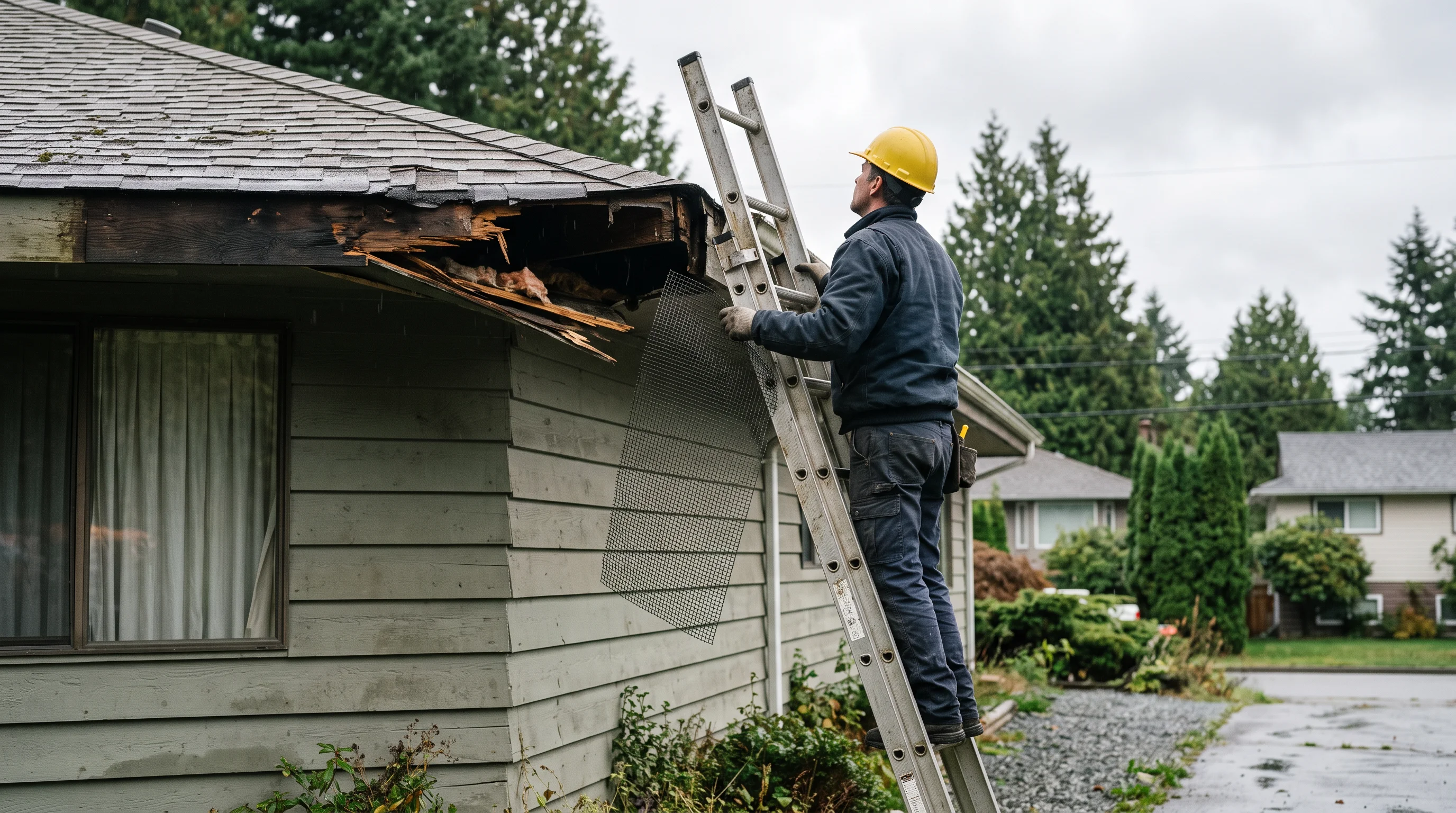
The landlord usually deals with animals in a BC rental, because a raccoon tearing at a soffit, squirrels in the insulation or a bird nest blocking a vent all start as building defects. Section 32(1) of the Residential Tenancy Act requires a landlord to maintain residential property in a state of repair that complies with health, safety and housing standards required by law and makes it suitable for occupation. The Residential Tenancy Branch (RTB) says municipal standards of maintenance bylaws decide whether the landlord must manage pest infestations beyond insects, and such bylaws can address the building's openings. The City of North Vancouver's Bylaw No. 7931, for example, requires exterior walls to be maintained to prevent or retard deterioration from infestations (s.16(1)(d)) and openings other than doors and windows to be protected against the entry of rodents, insects or vermin (s.17(2)). Check your own city's bylaw.
BC tenants have a part too. RTA s.32(2) requires reasonable cleanliness, and s.32(3) makes a tenant repair damage caused by their own actions or neglect. A tenant who feeds wildlife or leaves garbage open outside can make a problem worse. Section 33.1 of the Wildlife Act separately prohibits leaving attractants where they could draw in "dangerous wildlife", which is relevant in parts of BC where bears are a risk.
How does BC's Wildlife Act limit removing animals from a rental?
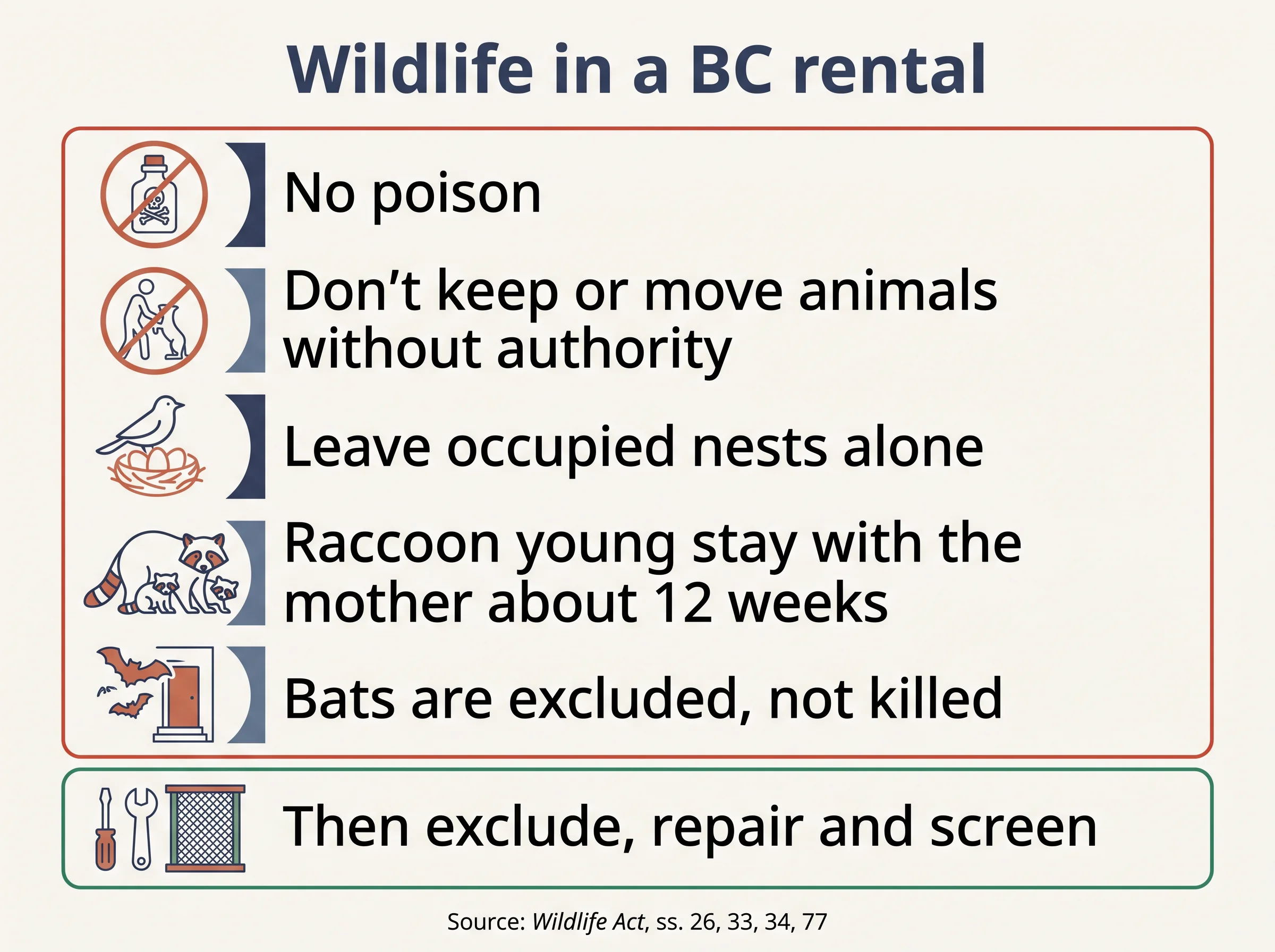
BC's Wildlife Act makes it an offence to poison wildlife, keep live wildlife without authority, release a non-domestic animal without authorization, or destroy an occupied bird's nest. Section 2 of the Wildlife Act vests ownership of all wildlife in British Columbia in the government, and the Act defines "wildlife" as raptors, threatened and endangered species, game, and other vertebrates prescribed by regulation. The offences that matter for a rental:
- Poison. Section 26(1)(f) makes it an offence to hunt, take, trap, wound or kill wildlife with poison. The province's raccoon page puts it plainly: do not use poison to kill any wildlife; it is illegal.
- Keeping live animals. Section 33(1) makes it an offence to have live wildlife in your possession except as authorized by a licence, permit or regulation.
- Release. Section 77(2) makes it an offence to release or abandon an animal other than a domestic animal, unless the regional manager authorizes it. Trapping an animal and driving it across town is not a casual option.
- Birds and nests. Section 34 makes it an offence, except as provided by regulation, to possess, take, injure, molest or destroy a bird or its egg, the nest of an eagle, peregrine falcon, gyrfalcon, osprey, heron or burrowing owl, or any other bird's nest while it is occupied by a bird or its egg.
Whether a particular species, such as a squirrel, is "wildlife" under the Act depends on the definitions and the regulations made under it. We have not found a single provincial page that answers this for every species, so the conservative course is to assume an animal is protected and confirm with the province before trapping, moving or killing it.
| Animal | Key BC rule | Practical approach |
|---|---|---|
| Raccoons | Trapping in season by registered trappers with a licence; no capture or killing without a permit where firearms are prohibited; no poison (Wildlife Act s.26(1)(f)) | Wait until the young can leave with the mother (about 12 weeks), then repair and screen |
| Bats | All 15 BC species protected from being killed or harassed | One-way exit in spring or fall, then seal; repairs around roosts October to March |
| Birds | Occupied nests protected; nests of eagles, peregrine falcons, gyrfalcons, ospreys, herons and burrowing owls protected at all times (Wildlife Act s.34) | Leave an occupied nest until empty, then clear and screen |
| Squirrels and others | Status depends on the Act's definitions and regulations | Assume protected and confirm with the province first |
How should raccoons be removed from a BC rental?
For raccoons in a BC rental with no permit or licensed trapper involved, the practical path is exclusion: wait until the animals have left or can leave, then repair and screen the entry point. The province's raccoon guidance says raccoons damage buildings when they try to enter attics, crawl spaces or chimneys, and recommends covering access points with heavy wire screening, pruning tree limbs and placing tin around trunks to stop roof access. It also says:
- raccoons may be trapped, in season, by registered trappers with a valid trapping licence;
- in an area where the use of firearms is prohibited, raccoons may not be captured or killed without a permit; and
- a mother and her young cannot be removed from the nest site until the young can leave with her, about 12 weeks; removing and relocating the young without the mother will likely cause them to starve.
Can bats be removed from a BC rental?
Bats in a BC rental can be excluded but not killed or harassed: all 15 species of bats in British Columbia are protected under the Wildlife Act, according to the province's bat guidance. It says not to use pesticides, loud music, ultrasonic devices, mothballs or bright lights to remove them. Its recommended method is a one-way exit, installed in spring or fall and left for a week or two, before sealing the entry points; repair work around roosts is best done from October to March. Because bats can rarely carry rabies, the province says never to touch a bat with bare hands and to seek medical advice after any bite or scratch.
What if birds nest in a BC rental's vent or soffit?
Under BC Wildlife Act s.34, a nest that is occupied by a bird or egg should be left until it is empty, and the nests of the listed raptors and herons are protected whether or not they are occupied. Once the nest is empty, the landlord can clear it and screen the opening. Where a nest blocks a dryer or bathroom vent and creates a safety risk, seek advice before acting.
Does a BC landlord need to give notice for wildlife work?
Only if someone enters the unit: a BC landlord must give written notice under RTA s.29 at least 24 hours and not more than 30 days ahead, with a reasonable purpose and a time between 8 a.m. and 9 p.m. Most wildlife work happens outside or in an attic, but a provider may need to enter the unit, for example to reach an attic hatch. See BC landlord entry rules. If a pesticide is used outdoors on private residential land, s.10(5.1) of the Integrated Pest Management Regulation requires a treatment notice to the occupant and all tenants of the land before use, unless the product is an excluded pesticide.
What can a BC tenant do about animals in the attic or walls?
A BC tenant should report animals to the landlord in writing and leave trapping, poisoning and sealing alone.
- Report it in writing to the landlord with dates, sounds, sightings and photos of any damage.
- Do not feed wildlife, and keep garbage and pet food secured.
- Do not try to trap, poison or seal in an animal yourself.
- If the landlord does nothing within a reasonable time, apply to the RTB for a repair order; see how BC tenants get repairs done and filing a dispute resolution application.
Wildlife entry is not on the RTA s.33 list of emergency repairs, though related damage (a raccoon tearing into the roof and causing a major leak) might be. See emergency repairs in BC.
Choosing a licensed pest-control provider: what should a BC landlord ask about wildlife?
For wildlife, ask a provider how it identifies the species and entry point, whether it uses exclusion (one-way exits and screening) rather than trapping, how it handles young, whether it has any permit or trapping licence it relies on, and whether it will do the follow-up repair or leave that to the landlord's contractor. Pesticide licensing is explained in our guide to pest-control licences in BC; for rodents, see mice and rats in a BC rental.
Frequently asked questions
Is a BC landlord responsible for raccoons in the attic?
Usually, yes. Raccoons get in through openings in the building, and RTA s.32(1) makes keeping the building in repair the BC landlord's job. Local standards of maintenance bylaws, such as North Vancouver's Bylaw 7931, can also require openings to be protected.
Can a BC landlord use poison on raccoons or squirrels?
Not on wildlife. Wildlife Act s.26(1)(f) makes it an offence to kill wildlife with poison, and the province's raccoon page says using poison on any wildlife is illegal. Treat a squirrel as protected until the province confirms otherwise.
Can I trap a raccoon and release it somewhere else in BC?
Not casually. Wildlife Act s.33(1) prohibits possessing live wildlife without authorization and s.77(2) prohibits releasing a non-domestic animal unless the regional manager authorizes it. The province says raccoons may be trapped, in season, by registered trappers with a valid trapping licence.
Can a bird's nest be removed from a BC rental's vent?
Not while it holds a bird or egg: Wildlife Act s.34 protects occupied nests, and the nests of eagles, peregrine falcons, gyrfalcons, ospreys, herons and burrowing owls at all times. Once the nest is empty, the landlord can clear it and screen the opening.
Are bats protected in BC?
Yes. The province says all 15 bat species in British Columbia are protected from being killed or harassed under the Wildlife Act. Exclusion with a one-way exit, then sealing, is the recommended approach.
More guides are in the landlord hub and tenant hub.
Keep a clear record of repairs
Find the British Columbia landlord and tenant forms we cover, including the condition inspection report, each with a plain-language guide.


