The bank says one number. Your trust journal says another. Your owner ledgers add up to a third. Until those three agree, you do not actually know whose money is in the account, and in British Columbia a rental property management brokerage is required to prove they agree every single month.
The monthly trust reconciliation is the heart of trust compliance under the Real Estate Services Act. It is also the record BCFSA's annual accountant's report is built on. Done monthly, it takes an afternoon. Left for three months, it turns into a forensic exercise with a deadline already missed.
This guide explains the two reconciliations the Real Estate Services Rules require, walks through a worked example, and lists the checks that catch problems early.
BC Monthly Trust Reconciliation Checklist
A month-end checklist for BC rental trust accounts: the Rule 80(c) bank reconciliation, the Rule 81(b) trust liability reconciliation, sign-off and the 5-week deadline.
Get Free PDF →The rule: two reconciliations, every month, within 5 weeks
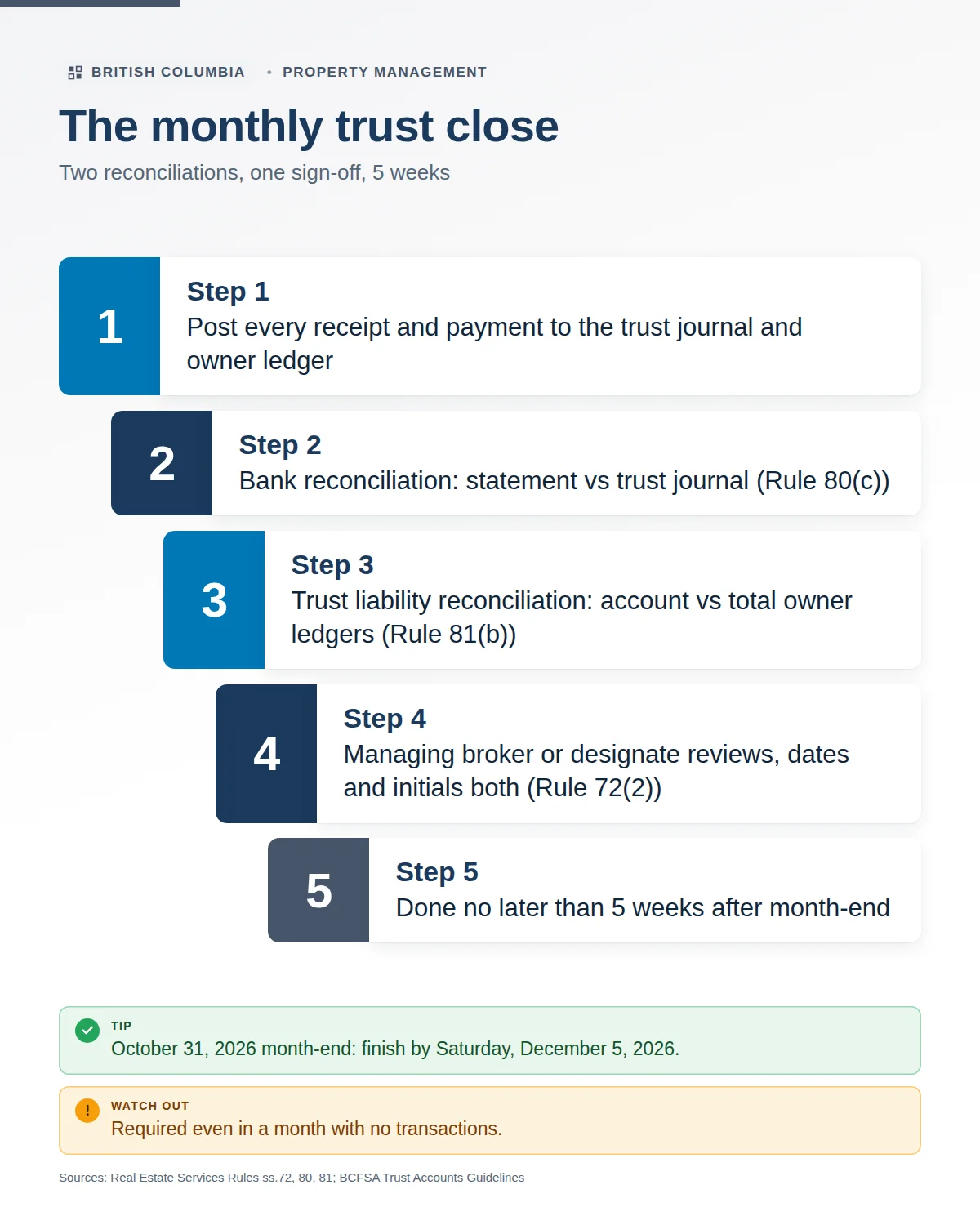
The Real Estate Services Rules require two separate reconciliations for a pooled rental trust account:
- The bank reconciliation (Rule 80(c)). For each account, reconcile the bank statement with your record of receipts and disbursements. This is required for every brokerage account, trust and general.
- The trust liability and asset reconciliation (Rule 81(b)). For each pooled trust account, list each person you hold money for and the amount, and reconcile the money in the account with the unexpended balances in the trust ledgers.
Both must be prepared in a timely fashion and no later than 5 weeks after the end of the month being reconciled. Rule 72(2) requires each to be reviewed, dated and initialled by a related managing broker or a person the managing broker designates.
BCFSA's Trust Accounts Guidelines add detail. A bank reconciliation is needed even in a month with no transactions. It should list the date and description of each outstanding cheque and deposit. Each reconciliation should show its date of preparation.
The 5-week deadline in practice
| Month being reconciled | Month-end | No later than (35 days) |
|---|---|---|
| September 2026 | Wednesday, September 30 | Wednesday, November 4, 2026 |
| October 2026 | Saturday, October 31 | Saturday, December 5, 2026 |
| November 2026 | Monday, November 30 | Monday, January 4, 2027 |
| December 2026 | Thursday, December 31 | Thursday, February 4, 2027 |
When the deadline falls on a weekend, finish on the last business day before it rather than counting on an extension.
A worked example
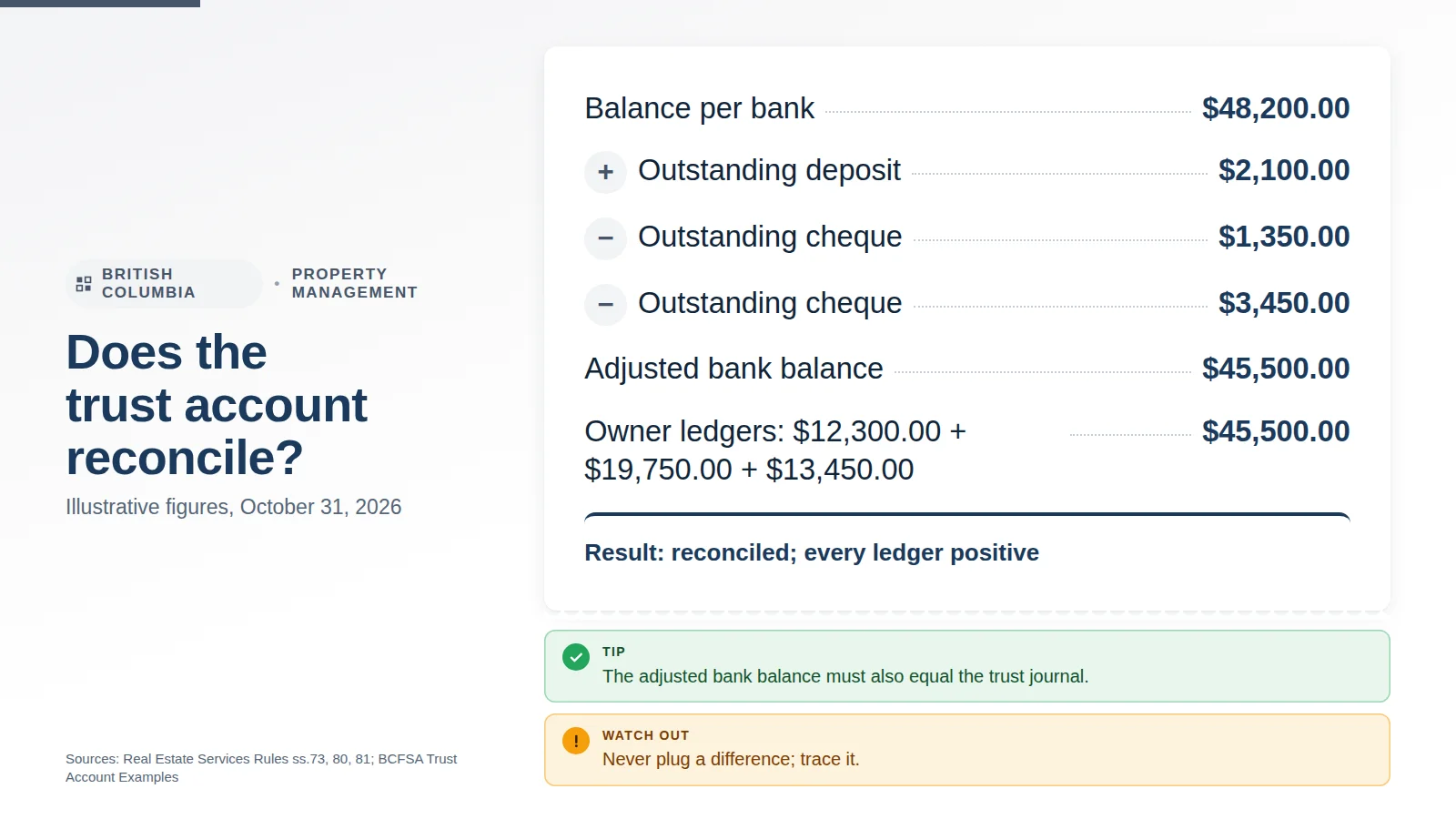
A brokerage manages properties for three owners from one pooled rental trust account. These are illustrative figures for October 2026.
Step 1: bank reconciliation
| Item | Amount |
|---|---|
| Balance per bank statement, October 31, 2026 | $48,200.00 |
| Add: deposit of October 31 not yet on the statement | + $2,100.00 |
| Less: outstanding cheque to plumber, October 29 | − $1,350.00 |
| Less: outstanding owner draw, October 30 | − $3,450.00 |
| Adjusted bank balance | $45,500.00 |
The adjusted bank balance must equal the balance in your trust journal (the Rule 80(b) record) at month-end.
Step 2: trust liability and asset reconciliation
| Owner ledger | Balance at October 31, 2026 |
|---|---|
| Owner A | $12,300.00 |
| Owner B | $19,750.00 |
| Owner C | $13,450.00 |
| Total trust liabilities | $45,500.00 |
The total of the owner ledgers equals the adjusted bank balance, so the account reconciles. Every ledger is positive, as Rule 73 requires.
Step 3: review and sign-off
The managing broker, or their designate, reviews both reconciliations, dates them and initials them. File them with the bank statement, deposit records and cancelled cheques for the month.
Checks that catch problems early
BCFSA's own worked examples show the brokerage reviewing each trust bank statement for three things. Make them part of every month:
- The statement agrees with your source documents. Every deposit matches a deposit record and every cheque or payment matches a cancelled cheque or banking record.
- No service charges were taken from the pooled trust account. BCFSA notes that section 30 of the Real Estate Services Act prohibits withdrawing them from a pooled trust account.
- Interest went where it should. Under section 29 of the Act, interest on a pooled trust account goes to the Real Estate Foundation, but BCFSA's guidelines say that obligation does not apply to an account held under the Residential Tenancy Act where the interest is to be paid to a tenant.
Add your own checks:
- No owner ledger negative at any point during the month, not just at month-end.
- Outstanding items from last month have cleared. A cheque still outstanding after several months needs follow-up.
- No unexplained differences carried forward as "adjustments".
- Every management fee withdrawn matches the owner's written service agreement.
Common mistakes
- Reconciling the bank but not the ledgers. A bank reconciliation alone does not show whose money is there. Rule 81(b) requires both.
- Plugging a difference. An unexplained variance is a finding, not a rounding issue. Trace it to the transaction.
- Skipping quiet accounts. BCFSA expects a bank reconciliation even in a month with no activity.
- Missing initials. An unsigned reconciliation does not meet Rule 72(2).
- Letting records fall behind. Rule 90 requires records to be kept up to date, and the accountant will ask for every month-end's reconciliation.
Keeping it manageable as you grow
- Post daily. Record receipts and payments to the journal and the owner ledger on the day they happen.
- Identify every deposit. Match each e-transfer to a tenant and property the day it arrives.
- Separate deposit money. BCFSA's guidelines report that the Real Estate Foundation strongly recommends a separate pooled trust account for security and pet damage deposits only, so their interest is not paid to the Foundation.
- Pay owners after funds clear. BCFSA's rental example pays net rents mid-month so tenant payments have cleared first.
- Keep the year's file together. Within 120 days after fiscal year-end, Rule 75 requires the brokerage to file financial statements, an accountant's report and a brokerage activity report with the superintendent (BCFSA's form for that report is the Brokerage Financial Information Filing). BCFSA's Regulatory Statement RESA 25-003 says the accountant receives the reconciliations for every month-end in the year, and for any month-end after year-end before the field work is done.
- Keep everything for 7 years. Rule 92 sets the minimum retention period.
How Tenon10 helps
Tenon10 keeps the lease, notice and payment records for every unit together, so the tenant side of each receipt is easy to trace when a deposit needs identifying.
Property managers on the PM plan get a ledger for each owner, owner statements, and a check that stops an owner payout larger than that owner's balance. The reconciliation itself stays your own monthly routine; see pricing for the PM plan.
FAQ
How soon after month-end must I reconcile?
No later than 5 weeks after the end of the month, for both the bank reconciliation and the trust liability and asset reconciliation.
Who has to sign the reconciliations?
A related managing broker, or a person the managing broker designates, must review, date and initial them.
Do I need a reconciliation if nothing happened that month?
Yes. BCFSA says a monthly bank reconciliation is required even with no transactions.
What does the trust liability reconciliation compare?
The money in the trust account against the total of the unexpended balances in each owner's trust ledger.
BC Monthly Trust Reconciliation Checklist
A month-end checklist for BC rental trust accounts: the Rule 80(c) bank reconciliation, the Rule 81(b) trust liability reconciliation, sign-off and the 5-week deadline.
Get Free PDF →Trace every receipt to a tenancy
Tenon10 keeps lease, notice and payment records together for each unit, and on the PM plan gives you a ledger and a statement for each owner.
Built for Canadian landlords and property managers.
Related BC guides
- BC Security and Pet Damage Deposits: The Complete Landlord Guide
- The 15-Day Rule: Returning a Deposit at the End of a BC Tenancy
Sources: Real Estate Services Rules; Real Estate Services Act; BCFSA: Trust Accounts Guidelines; BCFSA: Trust Account Examples; BCFSA: Brokerage Reporting Requirements. This article is a summary of British Columbia rules as of October 2026, not legal advice. Check BCFSA for your situation.