
In BC, accepting rent after a notice to end tenancy does not waive the notice if the rent covers the period up to the effective date. Money accepted for any time after that date, without a receipt saying it is for "use and occupancy only", could imply the landlord and tenant intend the tenancy to continue (RTB Policy Guideline 11).
A tenant who stays past the notice date often keeps paying, and refusing the money can feel wrong. This how-to shows BC landlords how to take it without reviving the tenancy. For more landlord guides, see the BC Landlord Resource Center.
Accepting Rent After a Notice to End Tenancy: Landlord Checklist
A one-page checklist for BC landlords accepting money after serving a notice to end tenancy, so the notice is not waived.
Get Free PDF →What you'll need
- A copy of the notice to end tenancy you served and its effective date.
- Your rent ledger, showing which period each payment covers.
- A receipt template that can carry the words "for use and occupancy only".
Can a BC landlord withdraw a notice to end tenancy?

Not alone. A landlord or tenant cannot unilaterally withdraw a notice; it may be withdrawn before its effective date only with the consent of the person it was given to. Guideline 11 recommends that a withdrawal be documented in writing and signed by both landlord and tenant. A notice can also be waived, but only with express or implied consent.
What is express and implied waiver?
- Express waiver: the parties clearly agree, for example in writing, that the notice is waived and the tenancy will continue.
- Implied waiver: there is no clear statement, but the parties' actions show they meant the tenancy to continue.
Accepting money after the effective date without a "use and occupancy only" receipt is the guideline's example of implied waiver.
Steps: accepting money after a notice without waiving it
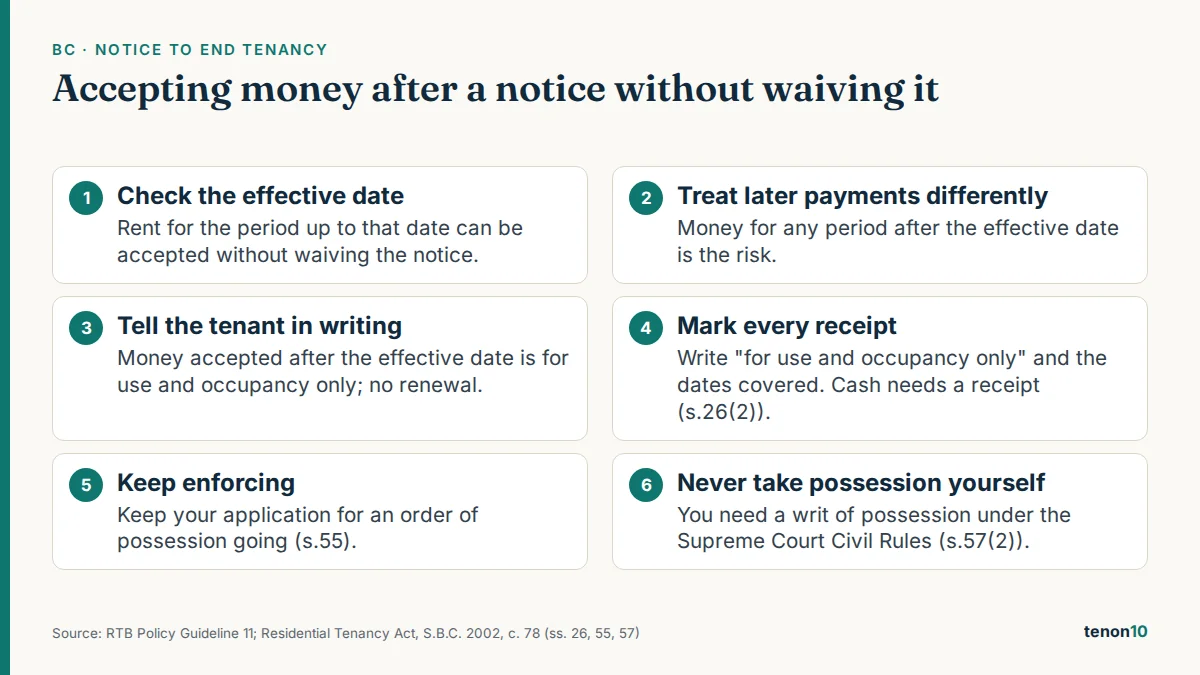
- Check the effective date. Rent for the period up to that date can be accepted without waiving the notice.
- Treat later payments differently. Money for any period after the effective date is the risk.
- Tell the tenant in writing. Say that any money you accept after the effective date is for use and occupancy only and does not continue or renew the tenancy. Guideline 11 lists this as evidence of intent.
- Issue a receipt with the words. Mark each receipt "for use and occupancy only" and the dates it covers. A receipt is required anyway for cash (s.26(2)).
- Keep enforcing. If the tenant disputed the notice or has not moved, keep your application for an order of possession going (s.55). Withdrawing your application or cancelling the hearing is evidence of intent under Guideline 11.
- Record the overholding period. A landlord may claim compensation from an overholding tenant for the period they occupy the unit after the tenancy ends (s.57(3)).
- Never take possession yourself. A landlord cannot take actual possession from an overholding tenant without a writ of possession under the Supreme Court Civil Rules (s.57(2)).
Special cases
| Situation | What the law says |
|---|---|
| 10 Day Notice for unpaid rent | If the tenant pays the overdue rent within 5 days of receiving the notice, the notice has no effect (s.46(4)(a)). See the 10 Day Notice guide. |
| Landlord's use notice withdrawn by agreement | The tenant is not entitled to compensation for the notice and must repay any compensation paid (Guideline 11). |
| Notice with an error | An arbitrator may amend a notice that does not comply with s.52 if the recipient knew or should have known the missing information and amending it is reasonable (s.68). |
Troubleshooting
- You already accepted a month after the date with a plain receipt. Intent is weighed on the evidence, including what you told the tenant and whether you kept enforcing. Put your position in writing now and keep your application going.
- You want the tenant to stay. Agree in writing, signed by both, that the notice is withdrawn and the tenancy continues.
- Cash payments. Always give a receipt; see rent receipts in BC.
Frequently asked questions
Does accepting rent after a notice to end tenancy cancel it in BC?
Not for the period up to the effective date. After that date, accepting money without a "use and occupancy only" receipt could imply the tenancy continues (Guideline 11).
Can I withdraw my notice if the tenant asks to stay?
Yes, with the tenant's consent; Guideline 11 recommends a written withdrawal signed by both.
What can I charge a tenant who stays past the date?
You may claim compensation for the period the overholding tenant occupies the unit (s.57(3)).
Can I change the locks once the date passes?
No. You need a writ of possession before taking actual possession (s.57(2)).
Accepting Rent After a Notice to End Tenancy: Landlord Checklist
A one-page checklist for BC landlords accepting money after serving a notice to end tenancy, so the notice is not waived.
Get Free PDF →Key takeaways
- Rent up to the effective date does not waive the notice.
- After it, say "use and occupancy only" in writing and on every receipt.
- Keep your order of possession application going.
- A withdrawal needs both parties' consent, ideally in writing.
Primary sources: RTB Policy Guideline 11 and the Residential Tenancy Act. More: the three month notice.
Keep your notice on track
Free BC landlord forms and guides with plain-language instructions.
Free • No signup required