In BC, a family corporation landlord's use notice lets a company that owns a rental end a tenancy under section 49(4) of the Residential Tenancy Act, but only if a person who owns voting shares, or that person's close family member, intends in good faith to live in the unit. The notice must come from the government portal and give three months.
Many BC landlords hold a rental condo or house through a holding company. When it is time for a shareholder or a family member to move in, the ordinary landlord's-use rule in s.49(3) does not fit, because that subsection is written for a landlord who is an individual. Section 49(4) is the corporate version. This guide walks through the definitions, the notice, the limits and the compensation risk. The general rules for individual owners are in BC's three-month landlord's use notice, and more landlord guides are in the BC Landlord Resource Center.
Family Corporation Landlord's Use: BC Checklist
A one-page checklist for BC family corporations ending a tenancy so a shareholder or close family member can move in.
Get Free PDF →What counts as a "family corporation" in BC?
Section 49(1) of the Act defines a family corporation as a corporation in which all the voting shares are owned by one individual, or by one individual plus one or more of that individual's brothers and sisters or close family members.
A "close family member" of an individual means the individual's parent, spouse or child, or the parent or child of that individual's spouse (s.49(1)).
| Who owns the voting shares? | Family corporation under s.49(1)? |
|---|---|
| One person holds all of them | Yes |
| A person and their spouse | Yes (spouse is a close family member) |
| A person and their sister | Yes (siblings are named) |
| A person and their adult child | Yes |
| A person and an unrelated business partner | No |
| A person and their cousin or niece | No (not on the list) |
The test is about voting shares. Check the company's share register before relying on s.49(4). If any voting share sits with someone outside the list, the corporation is not a family corporation, and s.49(4) is not available.
Does the company have to own the property outright?
For s.49(4), "landlord" means a family corporation that owns the rental unit, or that holds a reversionary interest for a term of more than three years and at least half the full reversionary interest (s.49(1)). In plain terms, a long-term head lease can qualify, a short one cannot.
Who can move in under section 49(4)?

A landlord that is a family corporation may end a tenancy if a person owning voting shares in the corporation, or a close family member of that person, intends in good faith to occupy the rental unit (s.49(4)).
- Can move in: a voting shareholder; that shareholder's parent, spouse or child; the shareholder's spouse's parent or child.
- Cannot move in under this rule: a non-voting shareholder alone, a sibling who holds no voting shares, an employee, a caretaker, a friend.
The government's guidance on landlord's use notices says the person moving in must live there for at least 12 months. That ties to the compensation rule in s.51(2), covered below.
What about selling the property to a family corporation?

Section 49(5) covers sales. If the landlord has entered into an agreement in good faith to sell the unit, all conditions of sale have been satisfied, and the purchaser asks the landlord in writing to give notice, the landlord can give notice where the purchaser is a family corporation and a voting shareholder, or that shareholder's close family member, intends in good faith to occupy the unit (s.49(5)(c)(ii)). For the full sale sequence, see selling a tenanted home in BC.
How much notice does a family corporation have to give?
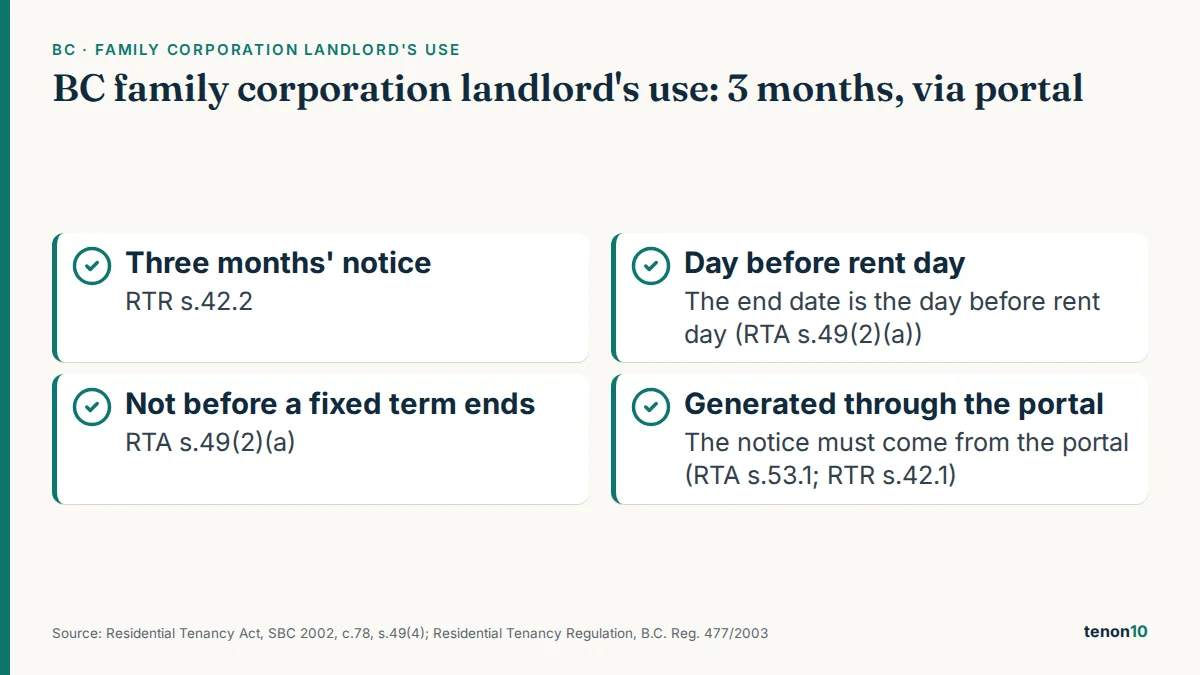
A notice under s.49(3), (4) or (5) must give three months, under s.42.2 of the Residential Tenancy Regulation. The effective date must also meet s.49(2): it must be the day before the day rent is payable, and not earlier than the end of the fixed term if the tenancy is for a fixed term.
| Rule | Where it comes from |
|---|---|
| Three months' notice | RTR s.42.2 |
| End date is the day before rent day | RTA s.49(2)(a) |
| Not before a fixed term ends | RTA s.49(2)(a) |
| Tenant has 21 days to dispute | RTR s.42.3 |
| Notice must be generated through the portal | RTA s.53.1; RTR s.42.1 |
Notices given before June 18, 2025 kept the older periods (RTR s.42.5). Any notice a corporation gives now is on the three-month rule.
Do you have to use the landlord's use web portal?
Yes. A notice to end a tenancy under s.49(3), (4), (5) or (6)(e) must be generated through the government's landlord's use portal (RTA s.53.1; RTR s.42.1). The government's page says the portal asks for the landlord's birthdate and the birthdates of related people, such as the person moving in, and that a notice generated there carries a unique Notice ID in the top left corner. A notice written on an old paper form instead of one generated by the portal does not meet the requirement.
The portal is at tenancydispute.gov.bc.ca. Have every birthdate on hand before you start.
When can a family corporation NOT use section 49(4)?
Section 49(6.1) bars notices under (3), (4) and (5) where the rental unit is in a building with five or more rental units that is either not strata-titled, or strata-titled with all the units owned by the same owner. A company that owns a whole small apartment building cannot use landlord's use to move a shareholder into one of its units.
The corporation must also comply with s.52 on form and content (s.49(7)). A notice with the wrong effective date, or one that is not signed and dated, is open to challenge. See every way a tenancy can end in BC for the other routes.
What does the tenant get, and what can the tenant do?
One month's compensation
A tenant who receives a notice under s.49 is entitled to an amount equal to one month's rent from the landlord, on or before the effective date (s.51(1)). The tenant may withhold the last month's rent instead, and that is treated as payment of the compensation (s.51(1.1)).
Leaving early
The tenant may end the tenancy earlier, on a date before the effective date, by giving at least 10 days' written notice and paying the proportion of rent up to that date (s.50). That does not cancel the one month's compensation (s.50(3)). Tenants can read the rules in moving out early after a landlord's use notice.
Disputing
The tenant has 21 days after receiving the notice to apply for dispute resolution (RTR s.42.3). If the tenant does not dispute within that time, the tenant is conclusively presumed to have accepted that the tenancy ends on the effective date and must vacate by then (s.49(9)).
What if the shareholder never moves in?
This is the biggest risk for a corporate landlord. Unless the landlord (or the purchaser who asked for the notice) establishes that the stated purpose was accomplished within a reasonable period after the effective date, and that the unit was used for that purpose for at least 12 months (or a prescribed period of not less than six months) beginning within a reasonable period after the effective date, the landlord must pay the tenant an amount equal to 12 times the monthly rent under the tenancy agreement (s.51(2)).
The director may excuse the payment if extenuating circumstances prevented the purpose from being accomplished or the use from lasting the required time (s.51(3)). For how that works in practice, see BC's 12-month compensation rule.
What is the practical sequence for a family corporation?
- Confirm all voting shares sit with one person and their siblings or close family members.
- Confirm the company owns the unit (or a qualifying reversionary interest).
- Check the building is not caught by the five-unit bar in s.49(6.1).
- Pick an effective date at least three months out, the day before rent day, after any fixed term.
- Generate the notice through the portal, with the occupant's details.
- Serve it properly, then pay or credit one month's rent by the effective date.
- Make sure the occupant moves in promptly and stays at least 12 months.
Tax and records
When a company-owned rental becomes a shareholder's residence, the change in use can have tax consequences for the corporation and the shareholder. The tax side is outside the Residential Tenancy Act, so look at BC taxes for landlords and the Canada Revenue Agency's guidance before giving notice. Keep the corporate records showing who lives in the unit for the whole 12-month period.
Frequently asked questions
Can a numbered company with two unrelated owners use landlord's use?
No. If the voting shares are split between unrelated people, the company is not a family corporation under s.49(1), and s.49(4) is not available.
Can my sister move in if she is not a shareholder?
Not on the strength of being your sister alone. Under s.49(4), the occupant must be a voting shareholder or a close family member of one (parent, spouse, child, or a spouse's parent or child). A sibling qualifies only if she owns voting shares herself.
Is the notice period different for a company?
No. It is three months under RTR s.42.2, the same as for an individual landlord.
What does the tenant receive?
One month's rent under s.51(1), and 12 months' rent under s.51(2) if the purpose is not carried out for the required time without extenuating circumstances.
Family Corporation Landlord's Use: BC Checklist
A one-page checklist for BC family corporations ending a tenancy so a shareholder or close family member can move in.
Get Free PDF →Key takeaways
- Section 49(4) is the landlord's use route for a family corporation.
- All voting shares must be held by one person, alone or with siblings or close family members.
- The occupant must be a voting shareholder or their close family member.
- Three months' notice, generated through the portal, and not in a 5+ unit rental building.
- Failing to occupy for 12 months risks 12 months' rent in compensation.
Keep your BC tenancy records in one place
Leases, notices and payments, organised for BC landlords.
Free to start