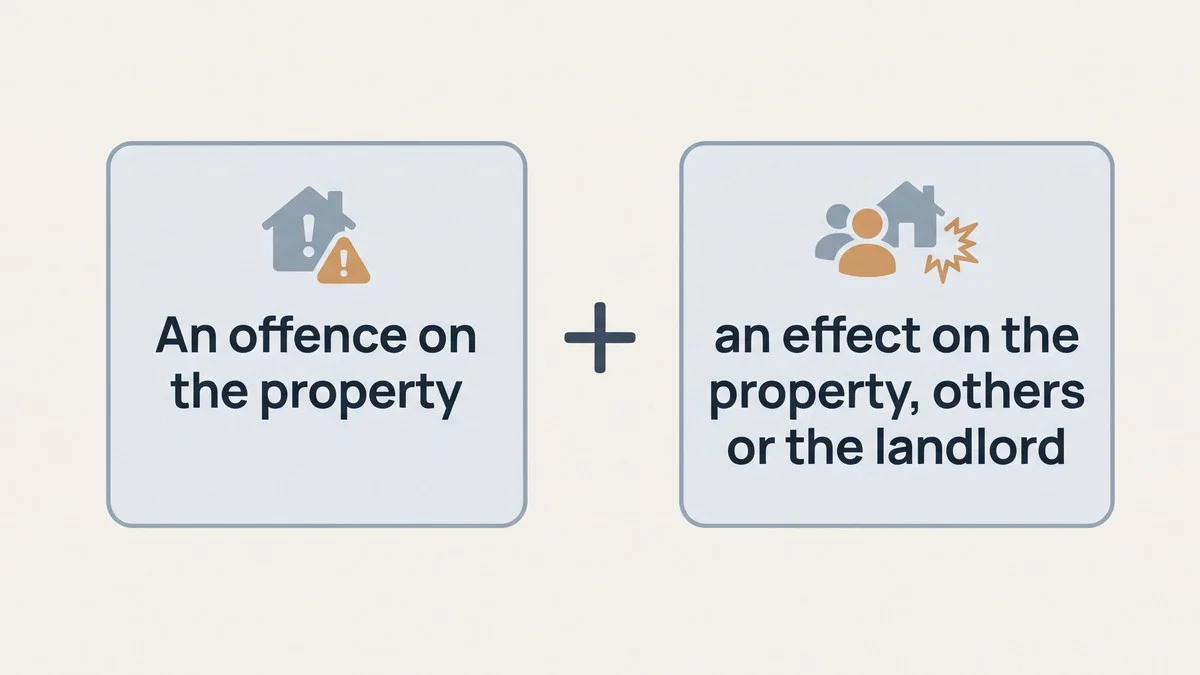
Illegal activity can end a tenancy in BC, but not every broken law qualifies. Under section 47(1)(e) of the Residential Tenancy Act and RTB Policy Guideline 32, a landlord must show that the tenant, or someone the tenant let onto the property, committed an offence, and that it affected the property, other occupants or the landlord.
What counts as illegal activity under the RTA?
A breach of federal, provincial or municipal law that is an offence. Guideline 32 says the activity must be a prosecutable offence, but no prosecution is required, so a municipal bylaw breach handled with a bylaw ticket can still count. Not every breach is an offence: failing to pay rent breaks the Act but is not an offence under section 95, so it is handled as unpaid rent, not illegal activity.
Is the crime alone enough to end the tenancy?

No. Citing Petrov v Plan A Real Estate Services Ltd, 2025 BCCA 163, the guideline says illegal conduct alone is not enough. Under section 47(1)(e), the activity must have caused, or be likely to cause, at least one of these:
- damage to the landlord's property;
- an adverse effect on another occupant's quiet enjoyment;
- an adverse effect on another occupant's security, safety or physical well-being; or
- jeopardy to a lawful right or interest of another occupant or the landlord.
The guideline's examples: using an illicit drug, without a significant impact on others, likely does not meet the test, while running a methamphetamine lab in the unit does. A serious crime committed somewhere else usually does not qualify; it must happen in the rental unit or on the residential property.
What does a landlord need to prove?
If the tenant disputes the notice, the landlord carries the burden on a balance of probabilities, meaning more than 50% likely. No criminal conviction is needed. The guideline says the landlord should give the arbitrator and the tenant a legible copy of the statute or bylaw that was broken, and may add police reports or witness statements. Because the activity must be an offence, the landlord should establish its elements: a fire started by accident while cooking, for example, is unlikely to be arson.
Is the tenant responsible for guests?
Yes. A guest's or occupant's illegal activity on the property can support ending the tenancy even if the tenant took no part in it.
Frequently asked questions
Which notice does a landlord use?
The One Month Notice to End Tenancy for Cause (RTB-33), ticking the illegal activity ground. See our RTB-33 guide.
How long does the tenant have to dispute it?
Ten days after receiving the notice, under section 47(4). See the tenant's ten-day clock.
What if the danger is too urgent to wait a month?
Section 56 lets a landlord apply to end the tenancy early for illegal activity with one of those effects where waiting for a one-month notice would be unreasonable or unfair to the landlord or other occupants. See how to file with the RTB.
Does unpaid rent count as illegal activity?
No. It is not an offence under section 95, so it goes through the rent notice process instead.
Serve a cause notice the RTB will accept
Fill in the One Month Notice to End Tenancy for Cause online.
Free • No signup required