In BC, your landlord's 15-day deadline to return your security deposit or pet damage deposit does not start until the tenancy has ended and the landlord has your forwarding address in writing (Residential Tenancy Act s.38(1)). If you do not give a written forwarding address within one year after the tenancy ends, the landlord may keep the deposit and your right to it is extinguished (s.39).
Many renters move out, wait for a cheque, and never get one because the landlord had nowhere to send it. The forwarding address is the step that starts the clock, and the one most often skipped. This how-to shows BC tenants how to give it so it counts. For more renter guides, see the BC Tenant Resource Center.
BC Forwarding Address: Deposit Checklist for Renters
A one-page checklist for BC renters: the written forwarding address, the RTB-47, service and deemed receipt, the RTB-41, day 15 and the one-year limit.
Get Free PDF →What you'll need
- The address where you want the deposit sent, and an email address if you want one on record.
- The landlord's address for service, from your tenancy agreement.
- The RTB-47, Tenant's Notice of Forwarding Address for the Return of Security and/or Pet Damage Deposit (optional, but it covers what the landlord needs).
- The RTB-41, Proof of Service Tenant Forwarding Address for the Return of Security and/or Pet Damage Deposit, to record how you gave it.
Why does the forwarding address matter for your BC deposit?

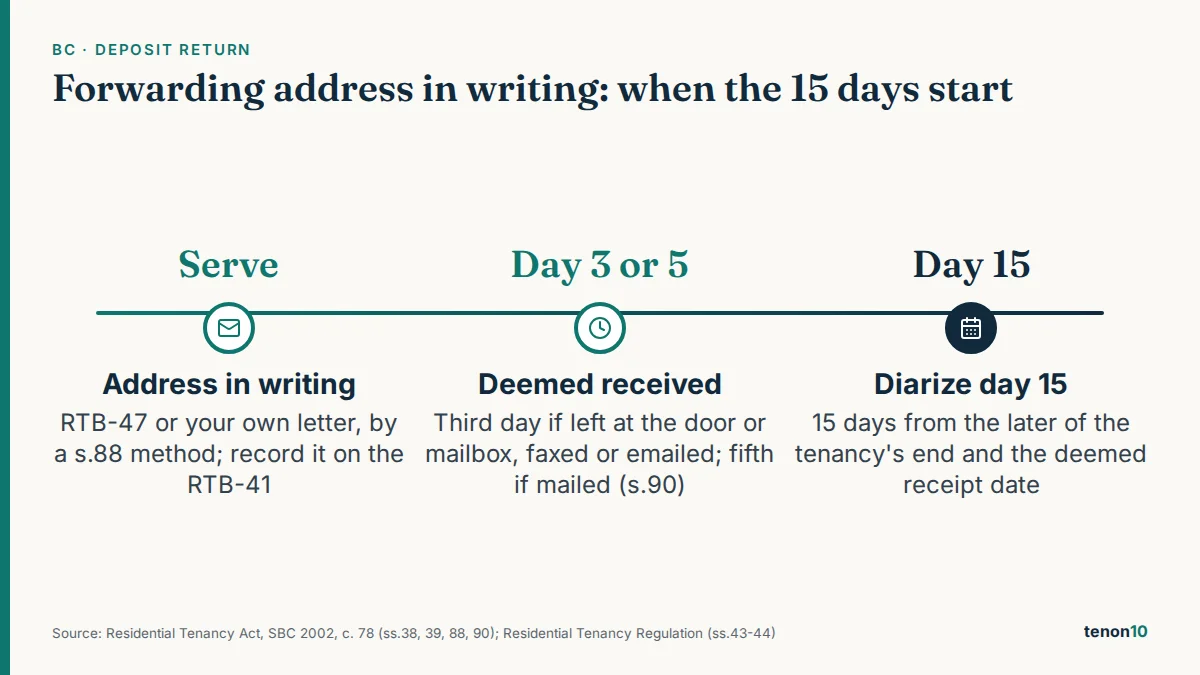
In BC, the landlord must, within 15 days after the later of the end of the tenancy and the date they receive your forwarding address in writing, either repay the deposit with interest or apply for dispute resolution to claim against it (s.38(1)). Without the written address, that 15-day period never starts. For the full return process, see getting your deposit back in BC, and for the landlord's side, the 15-day rule.
Steps: giving your forwarding address
- Put it in writing. Telling the landlord your new address in a phone call is not giving it in writing. Write out the full address.
- Use the RTB-47 or your own letter. The RTB-47 has spaces for the landlord's name and address for service, your names, and your forwarding address, email and phone.
- Or write it on the move-out inspection report. The RTB-41 lists giving the forwarding address on the move-out inspection report as one way to provide it. Ask for a copy of the signed report.
- Serve it by a permitted method. Under s.88, you can hand it to the landlord or their agent, mail it to the address where they live or carry on business as a landlord, leave it in their mailbox or mail slot, attach it to their door, or fax or email it to a number or address they gave for service (Residential Tenancy Regulation s.43).
- Know when it counts as received. Unless received earlier, a mailed record is deemed received on the fifth day after mailing, and a record attached to the door, left in the mailbox or faxed on the third day (s.90); an emailed record on the third day after it is emailed (Regulation s.44).
- Record service on the RTB-41. Fill in the date, time and method, and keep the form with any receipt or confirmation.
- Diarize day 15. Count 15 days from the later of the tenancy's end and the deemed receipt date.
What happens after the landlord has your address?
Within the 15 days, the landlord must repay the deposit with interest or file a claim against it (s.38(1)). They may keep an amount only if you agreed in writing at the end of the tenancy, or if the RTB orders it (s.38(4)), or to cover an earlier RTB order you still have not paid (s.38(3)). Repayment can be by mail, by leaving it in your mailbox or mail slot, in person, or by electronic payment or transfer (s.38(8)).
Interest is set by Regulation s.4: 4.5% below the prime lending rate of the Province's principal banker on January 1 of each year, compounded annually. See interest on BC deposits.
If the landlord does neither within 15 days, they may not claim against the deposit and must pay you double the amount (s.38(6)). See when a BC landlord must pay back double.
Troubleshooting
- You moved out months ago and never gave an address. Give it now in writing. You have one year after the tenancy ends (s.39).
- You skipped both move-out inspection dates. If the landlord offered two opportunities and you took part in neither, your right to the deposit is extinguished (s.36(1)), and the 15-day rule does not apply (s.38(2)). See skip the inspection, lose the deposit claim.
- Day 15 has passed with no money and no claim. You can apply for dispute resolution for the return of double the deposit (s.38.1). An application must be made within 2 years after the tenancy ends if no other time limit applies (s.60).
Frequently asked questions
Is an email a forwarding address in writing?
An email is in writing. To be served by email, it should go to an email address the landlord gave as an address for service (Regulation s.43). Record it on the RTB-41.
Do I have to use the RTB-47?
No. The Act requires the forwarding address in writing; the RTB-47 is the Branch's form for it.
How long do I have to give my forwarding address in BC?
One year after the end of the tenancy (s.39). After that, the landlord may keep the deposit.
BC Forwarding Address: Deposit Checklist for Renters
A one-page checklist for BC renters: the written forwarding address, the RTB-47, service and deemed receipt, the RTB-41, day 15 and the one-year limit.
Get Free PDF →Key takeaways
- The landlord's 15 days start only after the tenancy ends and they receive your forwarding address in writing (s.38(1)).
- Miss the one-year window and your right to the deposit is extinguished (s.39).
- Serve the address by a section 88 method and record it on the RTB-41.
- No repayment or claim within 15 days means double the deposit (s.38(6)).
Get your deposit paperwork right
Free tenant and landlord forms with plain-language instructions.
Free • No signup required