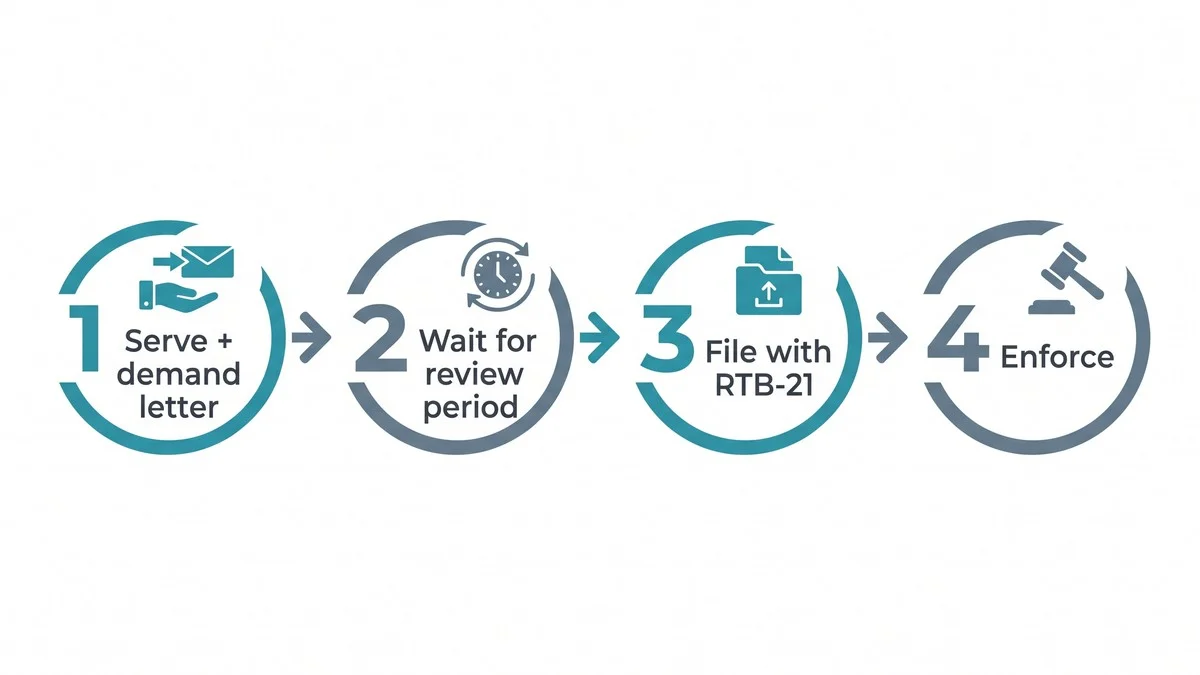
In BC, the Residential Tenancy Branch (RTB) issues monetary orders but does not collect them. To enforce an RTB monetary order, serve it with a demand letter, wait out the review period, then file it in Provincial Court (small claims) if it is $35,000 or less, where garnishment, seizure and registration against land become available.
The RTB's monetary order page sets out the steps, and sections 84 and 85 of the Residential Tenancy Act (RTA) say which court an order can be filed in. This guide walks a landlord or tenant holding an RTB monetary order through each step, from the demand letter to the court's collection tools, and covers the two shortcuts the Act allows without going to court at all.
Does the RTB collect money for you in BC?
No. In BC, the RTB's serve and enforce orders page says the RTB does not serve or enforce orders: the successful party must serve the order and, if the other party does not pay, go to small claims court. The order is final and binding, and the other party must pay.
The court will not collect for you either. The BC Small Claims guide Getting Results says collecting money is not the court's responsibility: the court has procedures and tools, but it is up to the creditor to use them, and there is no guarantee of being paid if the debtor simply cannot pay.
Can you collect a BC monetary order without going to court?
Sometimes. In BC, RTA s.72(2) lets a tenant who is owed money by the landlord under an RTB order deduct it from rent, and lets a landlord who is owed money by the tenant deduct it from the security deposit or pet damage deposit. RTA s.38(3) limits the landlord's deposit deduction to an amount the director ordered the tenant to pay that remains unpaid at the end of the tenancy, and the RTB's guidance says the same.
| Who is owed | Shortcut | Limit | Source |
|---|---|---|---|
| Tenant, tenancy ongoing | Deduct the order amount from rent | Only the amount of the RTB order | RTA s.72(2)(a) |
| Landlord, tenancy ended | Keep the amount from the security or pet damage deposit | Only an ordered amount still unpaid at the end of the tenancy | RTA ss.72(2)(b), 38(3) |
| Anyone else | File in court and use enforcement tools | Provincial Court up to $35,000; otherwise Supreme Court | RTA ss.84, 85 |
Step 1: How do you serve a BC monetary order and demand letter?
In BC, the successful party serves the other party with a copy of the order and a demand letter. The RTB lists what the demand letter should contain:
- the date, your name and address, and the other parties' names and addresses;
- a statement that the letter is a "demand letter";
- a reasonable deadline for payment, the payment methods you accept and where payment should be delivered;
- your intention to file in small claims court if you are not paid; and
- your signature.
The RTB notes the letter can be used as evidence in small claims court. If you cannot serve the order by any normal method, you can apply to the RTB for a substituted service order, online or on form RTB-13, with proof that you made reasonable efforts. Our guide to serving documents in BC covers the methods.
Step 2: How long must you wait before enforcing?
In BC, an RTB order can be filed in court only after any review has been refused, dismissed or concluded, or after the time to apply for review has expired (RTA ss.84(1) and 85(2)). The RTB's guidance is to wait for the 15-day review period to end and then contact the RTB to check whether the other party applied for review; if they did, you must wait for a decision on that application before taking further action. How review works is covered in our guide to RTB review consideration.
Step 3: Which BC court do you file the order in?
In BC, an RTB order for financial compensation or the return of personal property can be filed in Provincial Court and enforced as a judgment of that court if the amount, excluding interest and costs, is within the small claims limit (RTA s.85(1)). That limit is $35,000 under the Small Claims Court Monetary Limit Regulation. Any RTB decision or order, of any amount, can be filed in the Supreme Court and enforced as an order of that court (RTA s.84).
For a small claims filing, the RTB says to contact the nearest court registry first to confirm what your case needs, then file:
- the original monetary order, or a certified copy;
- a completed Confirmation of Service of Monetary Order for Enforcement (form RTB-21); and
- any receipts or tracking documents that prove service.
The Small Claims guide adds that you also file an address for service form with a certified copy of the tribunal's order; there is a fee to file the order for enforcement but none for the address form. The RTB says filing fees can be added to your court claim.
Step 4: What can a BC small claims court do to get you paid?
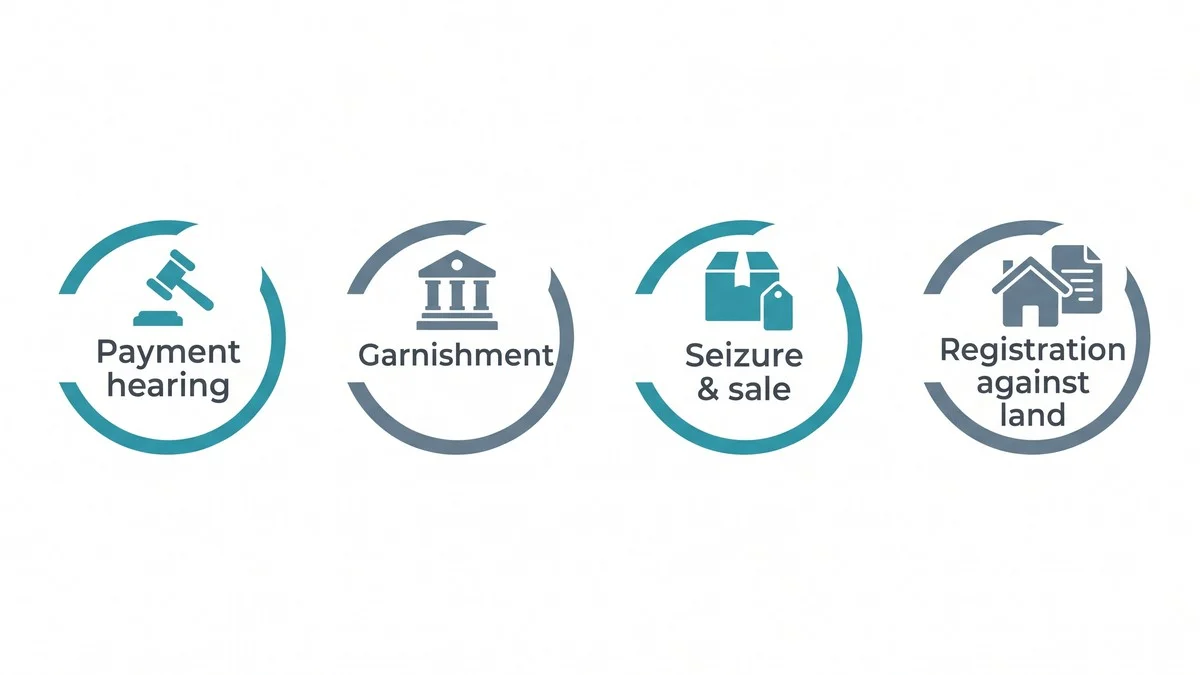
In BC, once the order is filed, the creditor can use the small claims enforcement tools. The RTB and the Getting Results guide describe the main ones:
- Payment hearing. A hearing about the debtor's finances, where a judge may order payment at once or on a schedule. The creditor files a summons and must have it personally served; the guide says a debtor who was served with a summons can be arrested for not attending.
- Garnishment. A garnishing order lets you collect money a third party owes the debtor, most often wages or a bank account. The guide says it is a one-time measure that catches only what is there when it is served (or wages owed within seven days of the supporting affidavit), the rules are strict, and a joint account cannot be garnished.
- Seizure and sale. A court bailiff can seize and sell the debtor's personal property, subject to exemptions under the Court Order Enforcement Act. The guide warns the costs can be relatively high, with a risk of no recovery if the debtor has nothing worth taking.
- Registration against land. If the debtor owns land in BC, a certificate of judgment can be registered at the land title office, which normally prevents the debtor from selling or mortgaging the land until the debt is paid. The guide calls it one of the simpler and less costly procedures.
What if the other party is the one who owes rent or damages after moving out?
That is the most common landlord case: a tenant leaves owing more than the deposit covers. The landlord keeps what the order allows from the deposit under s.38(3) and enforces the balance through the steps above. If the deposit issue itself is still open, read the 15-day rule for returning a deposit first, because a landlord who misses that deadline can end up owing the tenant double.
Frequently asked questions
How do I enforce an RTB monetary order in BC?
Serve the order with a demand letter, wait for the review period to pass, then file the order (or a certified copy) with form RTB-21 and proof of service at a Provincial Court registry if it is $35,000 or less. Then use the court's tools, such as a payment hearing, garnishment or registration against land.
Does the RTB garnish wages?
No. The RTB does not enforce orders. Garnishment is a court process that becomes available after the RTB order is filed in Provincial Court or the Supreme Court (RTA ss.84 and 85).
What if the monetary order is over $35,000?
Provincial Court filing under RTA s.85 is limited to amounts within the small claims limit, excluding interest and costs. Any RTB decision or order can be filed in the Supreme Court under s.84.
Can a tenant deduct an RTB monetary order from rent?
Yes. RTA s.72(2)(a) lets a tenant deduct an amount the RTB ordered the landlord to pay from rent due to the landlord. The RTB suggests telling the landlord in writing why.
Is there a guarantee I will be paid?
No. The BC Small Claims guide says there is no guarantee; if the debtor cannot pay, there may be little you can do now, although circumstances can change.
The bottom line on BC monetary orders
An RTB monetary order is a right to be paid, not a payment. Use the rent or deposit shortcut if the Act gives you one; otherwise serve, wait, file and enforce through the court. For the rest of the dispute process, see filing a dispute resolution application with the BC RTB, and browse the BC Landlord Resource Center and BC Tenant Resource Center.
Build the record before you need it
Fill in BC's free Condition Inspection Report (RTB-27), the record that backs up a damage claim.
Free • No signup required