

In BC, a tenant can end a fixed-term tenancy early for family violence or long-term care (household violence also counts) by giving the landlord one month's written notice with a confirmation statement on form RTB-49, signed by an authorized third party. The tenancy then ends on the day before rent is due, at least one month after the landlord receives the notice.
The rule is section 45.1 of the Residential Tenancy Act (RTA), with the details of who may sign the statement in Part 7 of the Residential Tenancy Regulation. It exists so that a person at risk, or a person who needs long-term care, is not held to a lease that runs for months longer. This guide explains who qualifies, who can sign the RTB-49, how to give the notice, and what landlords may and may not do when they receive one.
Who can end a fixed-term tenancy under section 45.1 in BC?
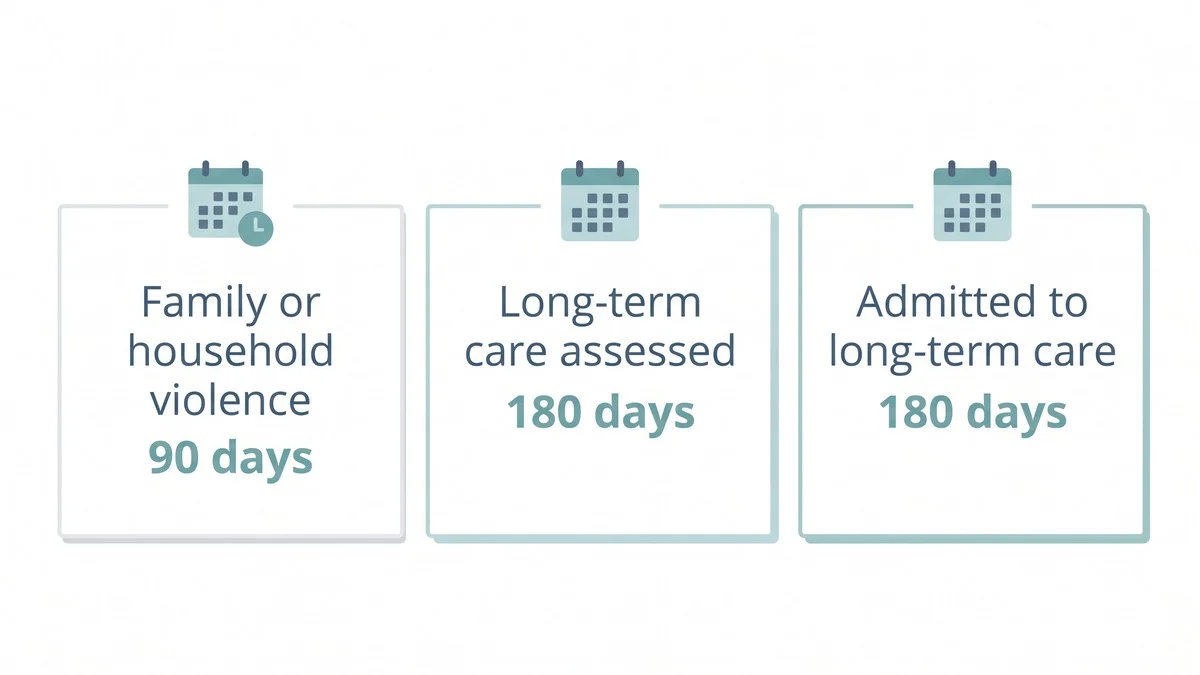
In BC, a tenant on a fixed-term tenancy is eligible under RTA s.45.1(2) if an authorized person confirms one of three situations:
- if the tenant stays, the safety or security of the tenant, or of a dependant who lives in the unit, is or is likely at risk from family violence by a family member of the tenant (both terms as defined in the Family Law Act), or the tenant or an occupant is or is likely at risk from household violence;
- the tenant has been assessed as requiring long-term care; or
- the tenant has been admitted to a long-term care facility.
"Household violence" in s.45.1(1) covers violence by anyone that has harmed, or is likely to harm, a tenant's or occupant's quiet enjoyment, security, safety or physical well-being. It includes physical and sexual abuse and attempts, and psychological or emotional abuse such as intimidation, harassment, threats, stalking, unreasonable control of someone's money or autonomy, and intentional damage to property. For a person under 19, direct or indirect exposure to violence against the tenant or occupant counts. The RTB-49 form adds that the tenant must be named on the tenancy agreement.
What about a month-to-month tenancy?
A tenant on a periodic (month-to-month) tenancy does not need section 45.1. Under RTA s.45(1), any periodic tenant can end the tenancy with one month's written notice, effective the day before rent is due, without giving a reason. Our guide to giving notice as a BC tenant covers the timing.
| Situation | Notice needed | Statement needed | Source |
|---|---|---|---|
| Periodic tenancy, any reason | One month, effective the day before rent is due | None | RTA s.45(1) |
| Fixed term, family or household violence | One month, effective the day before rent is due | RTB-49 made within 90 days before use | RTA s.45.1; Reg s.42(3)(a) |
| Fixed term, long-term care | One month, effective the day before rent is due | RTB-49 made within 180 days before use | RTA s.45.1; Reg s.42(3)(b) |
| Fixed term, no special ground | Cannot take effect before the end date in the agreement | Not applicable | RTA s.45(2) |
Who can sign the RTB-49 confirmation statement?

In BC, only the people listed in sections 39 and 40 of the Residential Tenancy Regulation can sign the confirmation statement, and only after assessing the tenant's circumstances (Regulation s.41). The approved form is the Ending Fixed-Term Tenancy Confirmation Statement (RTB-49).
For family or household violence, Regulation s.39 lists, among others:
- staff of victim-services and other support organisations funded by the provincial victim services program or BC Housing who support people at risk of violence;
- police officers and other constables within the meaning of the Police Act, and government victim court support caseworkers;
- physicians, nurses, psychiatric nurses and psychologists authorized under the Health Professions and Occupations Act;
- registered clinical counsellors, registered social workers and practising BC lawyers;
- child welfare workers designated under the Child, Family and Community Service Act, settlement-services staff of government-funded organisations, college and university counsellors, and named roles in Indigenous organisations, First Nations and Métis Nation British Columbia.
For long-term care, Regulation s.40 lists a medical practitioner, the manager of a long-term care facility responsible for its operation or admissions, and certain health authority designates.
How does a BC tenant give notice under section 45.1?
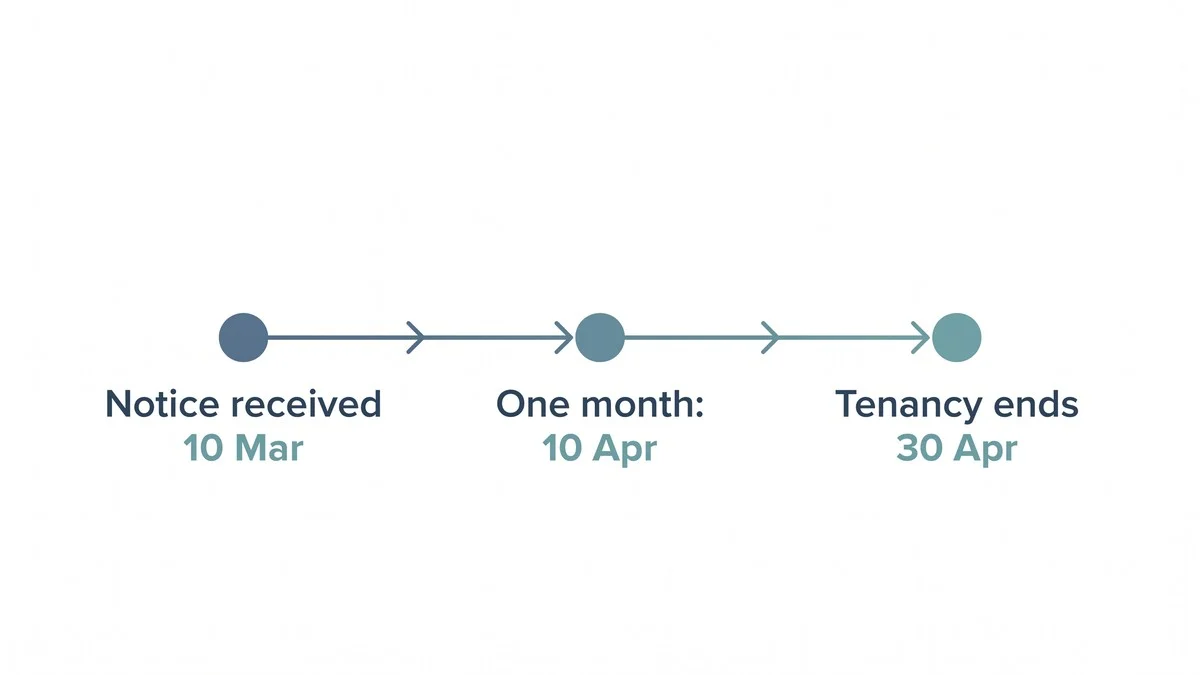
In BC, the tenant gives the landlord written notice to end the tenancy on a date that is at least one month after the landlord receives it and is the day before rent is due (RTA s.45.1(3)). The notice must meet RTA s.52: it must be in writing, signed and dated by the tenant, give the rental unit's address, state the effective date and the grounds, and be accompanied by the RTB-49 statement (s.52(d.1)).
If the tenant picks an effective date that is too early or not the day before rent is due, RTA s.53 deems the notice changed to the earliest date that complies, so a date error does not cancel the notice. How the notice is delivered matters for when the landlord is deemed to receive it; our guide to serving documents in BC sets out the methods.
Example. Rent is due on the 1st. The landlord receives the notice and RTB-49 on 10 March. One month after receipt is 10 April, so the earliest day before a rent day that is not earlier than that is 30 April. The tenancy ends on 30 April.
What must a BC landlord do with a confirmation statement?
In BC, a landlord who receives an RTB-49 must keep the statement and its contents confidential (Regulation s.42(4)). The RTB-49 form adds that a landlord must not use or disclose the form or its contents without the tenant's consent, and that unauthorised use or disclosure may lead to an investigation by the Office of the Information and Privacy Commissioner.
The landlord cannot challenge whether the tenant really qualifies. RTA s.58(2)(b) says the RTB must not resolve a dispute about whether a tenant is eligible to end a fixed-term tenancy under section 45.1. The RTB-49 form explains what a landlord can still apply about: that the statement was signed by someone not authorised under the regulation, that the tenant's notice did not comply with the Act, or other claims unrelated to the notice. The person who signed can be required to give evidence only about their authority and the authenticity of their signature (RTA s.45.2(3)).
What happens to co-tenants when one tenant ends the tenancy?
In BC, if one of two or more tenants on the same agreement ends a fixed-term tenancy under section 45.1, the remaining tenants must also move out unless they enter into a new tenancy agreement with the landlord (RTA s.45.3). The RTB-49 form says the same. Remaining tenants who want to stay should talk to the landlord about a new agreement before the effective date. Our guide to co-tenants, roommates and occupants in BC explains how shared tenancies work.
What happens to the security deposit?
The usual deposit rules apply. Once the tenancy ends and the tenant gives a forwarding address in writing, the landlord has 15 days to return the deposit with any interest or to apply to the RTB to keep some of it (RTA s.38(1)). See getting your deposit back in BC for the full process, and consider giving the landlord a safe forwarding address, such as a support organisation's or a lawyer's, if your new address must stay private.
Frequently asked questions
Do I need a police report to end my BC lease for family violence?
No. What the Act requires is a confirmation statement on the RTB-49 from a person authorised under Regulation s.39. Police officers are on that list, but so are victim-services workers, doctors, nurses, counsellors, social workers, lawyers and others.
Does the violent person have to be a family member?
No. A tenant also qualifies where the tenant or an occupant is or is likely at risk from household violence, which is defined by what happened rather than by who did it.
Can my BC landlord refuse to accept the notice?
A landlord cannot dispute whether you are eligible; the RTB will not hear that question (RTA s.58(2)(b)). A landlord can apply if the statement was signed by an unauthorised person or if the notice did not comply with the Act, which is why the notice should meet every s.52 requirement.
How long is an RTB-49 valid?
A statement about family or household violence can be used only if it was made within 90 days before it is used; a long-term care statement within 180 days (Regulation s.42(3)).
Can I end a lease early in BC if a parent moves into long-term care?
Section 45.1 applies to the tenant who has been assessed as needing long-term care or has been admitted to a facility. A person acting for that tenant under a representation agreement or power of attorney can receive the statement (Regulation s.42(1)(b)).
The bottom line
Section 45.1 lets a BC tenant leave a fixed-term tenancy on one month's notice when violence or long-term care makes staying unsafe or impossible, with an RTB-49 from an authorised third party as the only proof. Landlords must keep the statement confidential and cannot dispute eligibility. More guides are in the BC Tenant Resource Center and the BC Landlord Resource Center, and every route out of a tenancy is in Ending a Tenancy in BC: Every Way It Can End.
Find the BC tenancy forms you need
Free BC landlord and tenant forms and guides, in one place.
Free • No signup required


