In BC, a landlord can take away or cut back a service or facility such as parking, storage or laundry only by giving 30 days' written notice on the RTB-24 form and lowering the rent by the value lost. A service that is essential to living in the unit, or that is a material term of the tenancy agreement, cannot be removed at all.
The rule is section 27 of the Residential Tenancy Act (RTA), and the Residential Tenancy Branch (RTB) explains how arbitrators apply it in Policy Guideline 22: Termination or Restriction of a Service or Facility. This guide covers what counts as a service or facility, which ones can never be removed, how the RTB-24 notice works, and what a tenant can do when a service disappears without notice or without a fair rent reduction.
What counts as a "service or facility" in a BC tenancy?
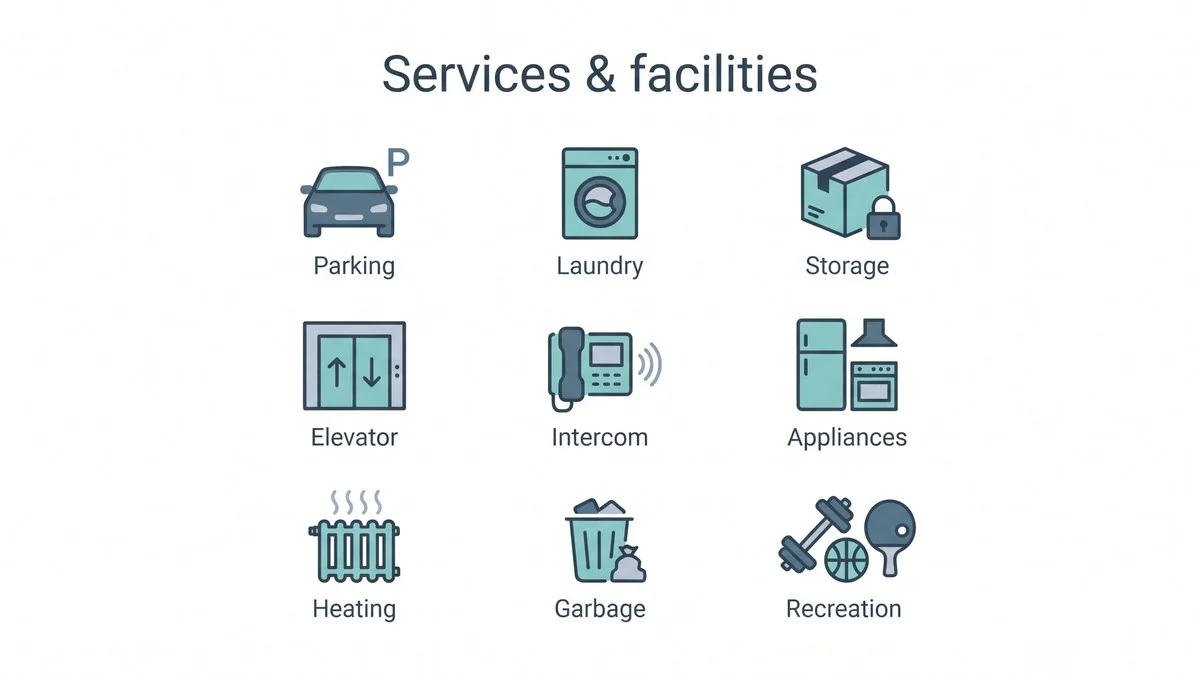
In BC, a "service or facility" is anything on the RTA s.1 list that the landlord provides or agreed to provide with the tenancy. The list includes appliances and furnishings, utilities, cleaning and maintenance services, parking spaces, cablevision, laundry, storage, an elevator, common recreational facilities, intercom systems, garbage facilities, heating and housekeeping services. The word "includes" means the list is not closed.
These matter because they are part of what the tenant pays for. The RTA s.1 definition of "rent" covers money paid for the right to possess the unit, for the use of common areas and for services or facilities. Take a facility away and the tenant is getting less for the same rent, which is why section 27 ties every lawful removal to a rent reduction.
Which services can a BC landlord never take away?
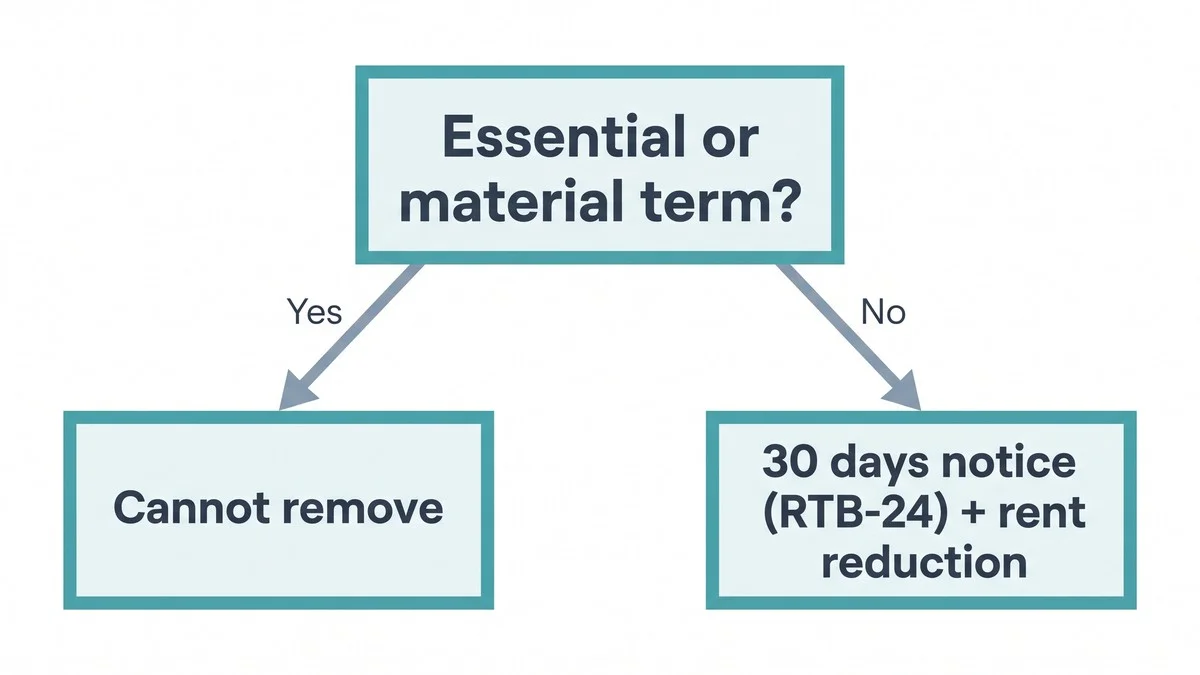
Under RTA s.27(1), a BC landlord must not terminate or restrict a service or facility if it is essential to the tenant's use of the rental unit as living accommodation, or if providing it is a material term of the tenancy agreement. No notice and no rent reduction makes removing one of these lawful.
Policy Guideline 22 explains both tests:
- Essential. A service or facility is essential if it is necessary, indispensable or fundamental. The arbitrator asks whether a reasonable person in similar circumstances would find that losing it made it impossible or impractical to use the unit as a home. The guideline's example is an elevator in a multi-storey apartment building.
- Material term. A material term is one both parties agree is so important that the most trivial breach gives the other party the right to end the agreement. The same term can be material in one agreement and not in another, so the arbitrator looks at the facts around how the tenancy was made.
The guideline adds that an arbitrator will consider whether the tenant can get a reasonable substitute. Its example is basic cable: where the tenant can buy a comparable service, cable may be neither essential nor a material term. The RTB-24 form itself tells tenants that a service is not essential if the tenant can get it, or a reasonable substitute, from another source.
| Type of service or facility | Can the landlord remove or restrict it? | What the landlord must do |
|---|---|---|
| Essential to living in the unit (e.g. an elevator in a multi-storey building) | No | Keep providing it (RTA s.27(1)(a)) |
| A material term of the tenancy agreement | No | Keep providing it (RTA s.27(1)(b)) |
| Any other service or facility (often parking, storage, a recreation room) | Yes | 30 days' written notice on the RTB-24 and a rent reduction equal to the value lost (RTA s.27(2)) |
How does a BC landlord give notice to remove a service or facility?
In BC, a landlord who removes or restricts a non-essential service must do two things under RTA s.27(2): give 30 days' written notice in the approved form, and reduce the rent by an amount equivalent to the reduction in the value of the tenancy agreement. The approved form is the Notice Terminating or Restricting a Service or Facility (RTB-24).
The RTB-24 asks the landlord to state:
- the date the change takes effect, at least 30 days after the notice;
- the service or facility affected and how it will be terminated or restricted;
- the amount the rent will be reduced by (weekly, monthly or another period); and
- the new rent and the date it takes effect, with the landlord's signature and date.
The notice has to be served like any other RTA document. Our guide to serving documents in BC sets out the methods and the deemed-receipt days that should be added before counting the 30 days.
How much should the rent go down?
The RTA does not give a formula. Section 27(2)(b) requires a reduction equivalent to the drop in the value of the tenancy, and Policy Guideline 22 lists "whether the rent reduction reflects the reduction in the value of the tenancy" as one of the issues an arbitrator decides. In a dispute, each side will need evidence of what the lost service was worth.
What can a BC tenant do if a service is removed?
In BC, a tenant who thinks a removed service was essential or a material term, or that the rent reduction is too small, can apply to the RTB for dispute resolution. The RTB-24 form tells tenants to raise their concerns with the landlord first and not to withhold any rent, and says an arbitrator can order the service restored, the rent reduced by an appropriate amount, or a monetary order for the lost value.
Those orders come from RTA s.65(1)(f), which lets the director order that past or future rent be reduced by an amount equivalent to a reduction in the value of a tenancy agreement, and s.67, which covers compensation for loss caused by a breach. An application costs $100 under Residential Tenancy Regulation s.8(c). Our step-by-step guide to filing a dispute resolution application with the BC RTB covers the process.
Policy Guideline 22 puts the burden of proof on the tenant where the tenant claims a service was removed without a proper rent reduction, and lists six issues the parties must address: whether it is a service or facility under section 1, whether it was terminated or restricted, whether it is a material term, whether it is essential, whether notice was given on the approved form, and whether the rent reduction reflects the drop in value.
What if a service stops because something breaks?
In BC, a service that is lost for a long time through no one's fault can still lead to a rent reduction. Policy Guideline 22 says that where a service or facility is terminated or restricted for quite some time, through no fault of the landlord or tenant, an arbitrator may find a breach of contract and award a reduction in rent. Where the loss was caused by the landlord's negligence and the tenant suffered damage or loss as a result, the tenant may also be compensated.
Some breakdowns overlap with the landlord's repair duty under RTA s.32. Heating is both a listed facility and, when the primary heating system fails, an emergency repair under s.33. Our guide to repairs and maintenance in BC covers that side.
Can a BC landlord limit guests' use of common areas?
Yes, within limits. Standard term 9(2.1) in the Residential Tenancy Regulation lets a landlord impose reasonable restrictions on guests' use of common areas, subject to section 27. Policy Guideline 22 says a restriction on guest use of a common area that is not a "facility" under section 1 is not covered by section 27, so no notice or rent reduction is needed. Our guide to guests in a BC rental covers the rest of the guest rules.
How fast must you ask for a review of an RTB decision about services?
Within 5 days. Under RTA s.80(1)(b)(ii), an application for review consideration of an RTB decision about services or facilities under section 27 must be made within 5 days after the party receives the decision. Review is available only on the narrow grounds in s.79(2), such as new evidence that was not available at the hearing.
Frequently asked questions
Can my BC landlord take away my parking spot?
Only if parking is not essential to living in the unit and not a material term of your agreement, and only with 30 days' notice on the RTB-24 and a rent reduction equal to its value (RTA s.27). If you think it was a material term, or the reduction is too low, you can apply to the RTB.
Can a BC landlord close the laundry room?
Laundry is a listed facility under RTA s.1. Closing or restricting it needs 30 days' notice on the RTB-24 and a matching rent reduction, unless laundry is essential or a material term, in which case it cannot be removed. Whether laundry is essential depends on the facts, including whether a reasonable substitute is available.
Does a BC landlord need an RTB-24 to fix or replace an appliance?
No. Repairing or replacing an appliance keeps the service in place; the RTB-24 is for terminating or restricting a service or facility. A long outage can still lead to a rent reduction under Policy Guideline 22.
Can I withhold rent until a removed service comes back?
No. Rent must be paid when due unless the RTA gives a right to deduct (s.26(1)). The RTB-24 form itself tells tenants not to withhold rent and to apply to the RTB instead.
What does it cost to dispute a service removal in BC?
The RTB filing fee for a standard application is $100 (Residential Tenancy Regulation s.8(c)). The director may order the fee repaid by the other party (RTA s.72(1)).
The bottom line on services and facilities
A BC landlord can cut a non-essential service such as a parking stall or storage locker, but only with an RTB-24, 30 days' notice and a fair rent reduction, and never an essential service or one that was a material term of the deal. Tenants who disagree should keep paying rent and take it to the RTB. More BC guides are in the BC Landlord Resource Center and the BC Tenant Resource Center.
Free BC tenancy forms
Start with a clear tenancy agreement that lists every included service and facility.
Free • No signup required