In BC, a landlord who ends a tenancy with a landlord's-use notice owes the former tenant 12 months' rent, on top of the usual one month's compensation, unless the landlord proves the stated purpose was carried out within a reasonable period and the unit was used for it for at least 12 months (RTA s.51(2)). Only extenuating circumstances excuse the payment.
When does the 12 months' rent penalty apply in BC?
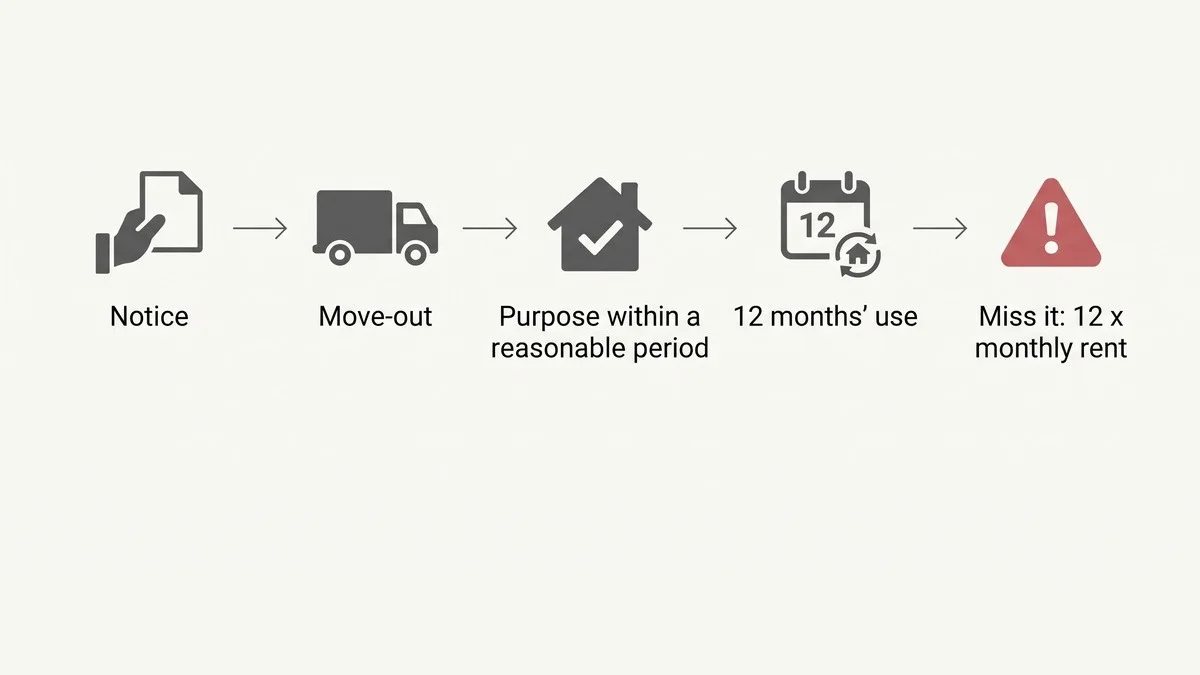
It applies to every notice under section 49 of the Residential Tenancy Act. The 12-month use period applies to notices given on or after April 3, 2024; earlier notices needed 6 months (Policy Guideline 50).
| Reason on the notice | What must be proven | Who pays if not |
|---|---|---|
| Landlord or close family member moves in (RTB-32L) | Moved in within a reasonable period and lived there 12 months | Landlord |
| Buyer or their close family moves in (RTB-32P) | Same | The purchaser who asked for the notice |
| Demolition | Demolished within a reasonable period | Landlord |
| Conversion (strata, co-op, caretaker, non-residential) | Converted and used that way for 12 months | Landlord |
How the move-in notice itself is given, and its timing, is covered in BC's three-month notice for landlord's use.
The two payments, worked through
Every tenant who receives a valid section 49 notice gets one month's rent from the landlord on or before the notice's effective date (s.51(1)). The tenant may instead withhold that amount from the last month's rent (s.51(1.1)). Guideline 50 adds that withholding rent for any other month is unpaid rent, for which the landlord may give a 10 Day Notice. If an arbitrator cancels the notice, no compensation is owed.
Example. A tenant pays $2,400 a month. The landlord gives a notice ending the tenancy on June 30 so the landlord's daughter can move in.
- One month's compensation: $2,400. The tenant simply does not pay June's rent.
- If the daughter never moves in, or moves out after five months: 12 times the monthly rent, $28,800, unless the landlord shows extenuating circumstances. This is in addition to the $2,400 (s.51(2)).
Leaving early. A tenant who receives a section 49 notice for a periodic tenancy can leave sooner by giving at least 10 days' written notice (s.50(1)). Guideline 50 gives two examples for a June 30 notice where the tenant leaves June 15: a tenant who withheld June's rent is owed 15 days' rent; a tenant who paid June's rent is owed one month's rent plus 15 days' rent. The landlord is expected to make that refund by the notice's effective date.
What counts as a reasonable period or an extenuating circumstance?

Guideline 50 treats a landlord who moved in on September 29, after an August 30 effective date, as within a reasonable period, and allows longer where substantial repairs are needed first. The purpose on the notice must be the one carried out: a landlord cannot move in briefly and re-rent, though roommates who share the owner's kitchen or bathroom are allowed.
A longer period may also be reasonable if a purchaser finds significant damage that must be repaired before moving in, or planned work uncovers unexpected repairs. For a demolition, the guideline notes that the size of the building, asbestos removal and municipal deconstruction rules all affect how long is reasonable.
The purpose must also be the one on the notice. A landlord who gave notice to move in cannot convert the unit to a non-residential use instead, even though that would have been a valid reason of its own. Re-renting the whole unit, a private part of it, or offering it as travel accommodation before the 12 months are up all fail the test.
Extenuating circumstances are events a reasonable landlord could not anticipate or control, such as a parent who dies a month after moving in or a unit destroyed by wildfire. A buyer changing their mind, a long vacation or running out of renovation money do not qualify.
| Likely extenuating (Guideline 50 examples) | Likely not extenuating |
|---|---|
| The parent who moved in dies a month later | The purchaser decides after possession the unit does not suit them |
| The unit is destroyed in a wildfire | A planned extended vacation during the occupancy period |
| An employer delays a previously approved transfer | Moving for a job that was never offered, then taking one elsewhere |
| Unforeseen renovation delays, a municipal stop-work order and a family member's health issues combined | Not budgeting enough for planned renovations |
What evidence does each side need?
The onus is on the landlord, or the purchaser who asked for the notice, to prove both conditions. In practice:
- Landlord or purchaser: the move-in date, and records that cover the full 12 months, such as utility and internet accounts in the occupant's name, a driver's licence or ICBC address change, insurance, mail and any renovation invoices that explain a delay. If an extenuating circumstance is claimed, keep documents from when it happened, such as a stop-work order or an employer's letter.
- Former tenant: the notice and the date it was received, any rental listing for the unit, screenshots with dates, photos of the property, and written statements from neighbours. Save listings as soon as you see them; they are often taken down.
The RTB's deadlines and file formats for evidence are in preparing evidence for an RTB hearing.
How does a former tenant claim 12 months' rent?

- Gather evidence that the unit was not used as stated: a new rental listing, photos, neighbours' statements.
- Apply for dispute resolution, naming the right respondent (the purchaser, if a buyer asked for the notice); see how to file with the RTB.
- Apply within two years of the tenancy ending (RTA s.60(1)); the RTB cannot extend that.
- Serve the application and evidence on each respondent as the RTB directs; the methods are in serving documents in BC.
- Prepare for the hearing: what happens at an RTB hearing.
You need not wait out the 12 months if the evidence already shows the landlord will not occupy the unit.
Applying too early has a cost, though. If the landlord is still inside the 12 months and there is no clear evidence they have failed, Guideline 50 says the claim may not yet be possible to assess, and an arbitrator can dismiss it with or without leave to reapply. Strong early evidence includes the landlord not moving in within a reasonable period, or other people living there under an established tenancy agreement.
Common mistakes
- Naming the wrong respondent. If a buyer asked for the notice, the purchaser pays. Guideline 50 warns that naming the wrong party can lead to the application being adjourned or dismissed without leave to reapply.
- Letting the two years run out. The two-year limit runs from the end of the tenancy, not from the date the landlord stops using the unit, and cannot be extended.
- Relying on good intentions. A landlord who meant well but did not meet the conditions still pays, unless extenuating circumstances apply.
- Short-term renting the unit. Offering it as travel accommodation before the 12 months are up counts as failing to use it for the stated purpose.
See every way a BC tenancy can end and the BC Tenant Resource Center.
Frequently asked questions
Is the 12 months' rent instead of the one month's compensation?
No. Section 51(2) makes it payable in addition to the one month's rent owed under section 51(1).
Does it matter that the landlord acted in good faith?
No. Guideline 50 says intent is not relevant: if the conditions were not met and no extenuating circumstance applies, the compensation is owed.
What if the landlord did move in for 12 months but the notice was in bad faith?
Guideline 50 says bad faith alone cannot found a section 51(2) claim if the unit was used as stated. A tenant may still seek compensation for damage or loss under section 7.
Can a tenant also claim moving costs?
Not for the same contravention. Guideline 50 says a tenant paid under section 51(2) cannot also claim damages based on the same breach.
Does this apply to renovation orders?
A similar 12 months' rent rule applies under section 51.4 when renovations under an RTB order are not done within a reasonable period.
What about a fixed-term lease with a vacate clause?
Section 51.1 has its own rule: the landlord must take steps to occupy within a reasonable period and live there for at least 6 months, or pay 12 times the monthly rent, except in extenuating circumstances.
Can the landlord file a counterclaim after two years?
Yes, if the tenant's original claim was filed within the two-year limit and that proceeding has not concluded.
Planning to move into your rental?
See how the BC Three Month Notice for landlord's use (RTB-32L) works before you give it.
Free • No signup required