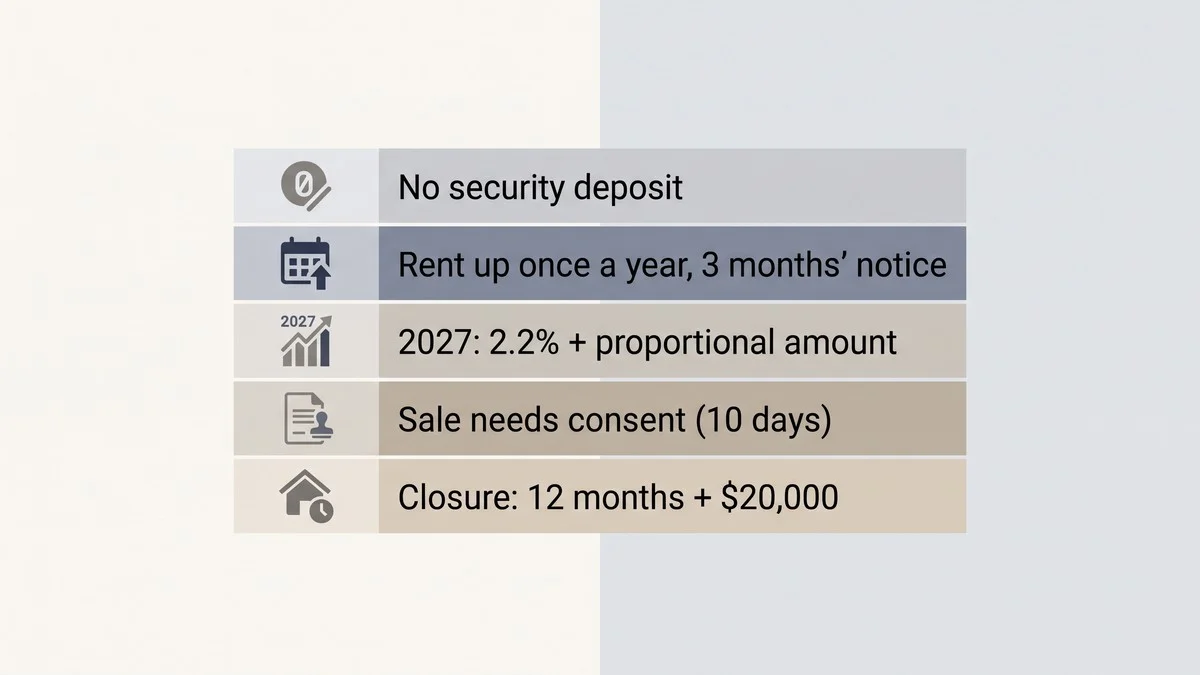
The Manufactured Home Park Tenancy Act (MHPTA) governs BC tenancies where a tenant owns a manufactured home and rents the site, or pad, it sits on. It allows one rent increase a year on three months' notice, bans security deposits, and requires 12 months' notice plus $20,000 compensation to close a park for conversion.
Who does BC's Manufactured Home Park Tenancy Act cover?
In BC, the MHPTA covers manufactured home site tenancies and parks (MHPTA s.2). If one landlord rents both the home and the site to the same tenant, the Residential Tenancy Act applies instead (s.4(a)). Nobody can contract out of the MHPTA (s.5), agreements must be written (s.13(1)), and disputes go to the Residential Tenancy Branch (RTB).
As with other BC rentals, a park landlord must not charge anything for accepting or processing an application, checking an applicant's suitability, or accepting someone as a tenant (s.15).
What are the key rules for BC park owners and pad tenants?

| Topic | What the MHPTA requires | Source |
|---|---|---|
| Security deposit | The landlord must not require or accept one | s.17(2) |
| Rent increase | Once every 12 months, 3 months' notice on the approved form; 2.2% plus a proportional amount for 2027 | ss.35–36; Regulation s.32 |
| Selling the home on its site | Assigning the tenancy needs the landlord's written consent; no reply within 10 days means consent is deemed | s.28; Regulation ss.45–46 |
| Park rules | Made by the park committee or, if none, the landlord; cannot conflict with the Act | s.32 |
| Tenant moving out | At least one month's notice, ending the day before rent is due | s.38 |
| Park conversion | 12 months' notice and $20,000 paid by the effective date | ss.42, 44; Regulation s.33.1 |
When can a park landlord enter a pad site?
Only in the situations listed in s.23. The usual one is written notice given at least 24 hours and not more than 30 days ahead, stating a reasonable purpose and a date and time between 8 a.m. and 9 p.m., unless the tenant agrees to another time. The landlord may also enter with the tenant's permission given at the time or within the previous 30 days, under an RTB order, if the site has been abandoned, in an emergency to protect life or property, or to collect rent or serve a document.
These limits back up the tenant's right to quiet enjoyment: reasonable privacy, freedom from unreasonable disturbance, exclusive possession of the site, and use of common areas for reasonable and lawful purposes (s.22). A landlord also must not unreasonably restrict access to the park for the tenant or the tenant's guests (s.24(1)).
Who repairs what in a manufactured home park?
- Landlord: keeps the park in a reasonable state of repair and complies with housing, health and safety standards required by law (s.26(1)). A landlord is not required to maintain improvements a tenant made to the site unless the tenancy agreement says so (s.26(5)).
- Tenant: keeps the site and common areas reasonably clean and sanitary, and repairs damage they, or people they let into the park, cause. Reasonable wear and tear is not the tenant's to fix (s.26(2)–(4)).
Emergency repairs cover urgent work on major pipe leaks, damaged or blocked water or sewer pipes, or the electrical systems (s.27(1)). The landlord must post, or give the tenant in writing, the name and number of the person to call. A tenant may arrange the repair only after calling that number at least twice and then giving the landlord reasonable time. The landlord must reimburse a tenant who gives a written account with receipts, and if it does not, the tenant may deduct the amount from rent (s.27(3)–(7)).
How do park rules get made or changed?
The park committee makes the rules, or the landlord if there is no committee (s.32). Under the Regulation, a rule change must be reasonable and do one of four things: promote the tenants' convenience or safety, protect the condition of the park or the landlord's property, regulate access to or fairly share a service or facility, or regulate pets in common areas (Regulation s.30(1)).
- Notice: tenants get written notice on the approved form at least 3 months before a change takes effect (Regulation s.29(2)).
- Frequency: a landlord can change the rules at most once a year; a park committee can do so as often as it sees fit (Regulation s.30(2.1)).
- Enforceability: a rule binds a tenant only if it applies to all tenants fairly, is clear enough to follow, was properly notified, and does not change a material term of the tenancy agreement (Regulation s.30(3)).
- New tenants: before signing, a prospective tenant must be given the rules in effect and any rule change notices not yet in effect (Regulation s.29(1)).
Tenants or the landlord can start a park committee by calling a meeting on at least two weeks' written notice; the meeting needs the landlord and tenants representing a majority of the homes, in person or by proxy (s.31; Regulation s.16). A park committee may also help the landlord and a tenant settle a dispute voluntarily (s.33).
How can a park landlord end a pad tenancy?
| Ground | Notice | Tenant's response time |
|---|---|---|
| Unpaid rent (s.39) | At least 10 days | 5 days to pay in full (cancelling the notice) or dispute |
| Cause (s.40), such as repeated late rent, significant disturbance, illegal activity, extraordinary damage or an uncorrected breach of a material term after written warning | At least one month, ending the day before rent is due | 10 days to dispute |
| End of employment as park caretaker or manager (s.41) | At least one month | 10 days to dispute |
| Park conversion (s.42) | At least 12 months | 15 days to dispute |
Unpaid utility charges the tenant owes the landlord under the agreement can be treated as unpaid rent once they are more than 30 days past a written demand (s.39(6)). Every landlord's notice must be in writing, signed and dated, give the site address, the effective date and the grounds, and be on the approved form (s.45). A tenant who misses the dispute deadline is presumed to accept the notice and must leave by its effective date.
What should a BC park owner or pad tenant do first?
- Serve rent increases on the RTB's site forms: RTB-45 for the standard amount, RTB-11a when adding the proportional amount. The 2027 BC rent increase limit explains the base figure.
- Selling a home in a park? Ask for the landlord's written consent first; a refusal must cite a ground in Regulation s.48.
- Take disagreements to the RTB; see how to file a dispute resolution application.
Compare how a residential tenancy ends in BC.
If a dispute does reach a hearing, the process is the same RTB process used for other BC tenancies: what happens at an RTB hearing and preparing evidence.
Frequently asked questions
Can a BC park landlord take a deposit for a pad?
No. MHPTA s.17(2) bans security deposits for site tenancies, and a tenant who paid one may deduct it from rent (s.17(3)).
How much can BC pad rent go up in 2027?
Up to 2.2% plus a proportional amount: the year's change in local government levies and regulated utility fees, divided by the number of sites in the park (Regulation s.32).
Can a park landlord refuse the buyer of my home?
Only on the grounds in Regulation s.48, such as credit information showing the buyer is unlikely to pay rent, or arrears you owe. No answer to a proper request within 10 days means consent is deemed given.
What happens if a BC park is closing?
The landlord needs all permits first, then gives 12 months' notice and pays $20,000 by the effective date. Tenants have 15 days to dispute the notice (s.42(4)).
Can the park owner walk onto my site without notice?
Not normally. Without your permission or 24 hours' written notice, entry is limited to an emergency, an abandoned site, an RTB order, or collecting rent or serving a document (s.23).
Does a new park rule apply to me if I signed my agreement before it?
Yes, if it was made and notified properly, even where it conflicts with an ordinary term of your agreement. It cannot override a standard term or other material term (s.32(4); Regulation s.30(3)(d)).
More plain-language BC rental guides
Rent increases, notices, deposits and disputes for BC landlords, in one place.
Free • No signup required