Ontario vs BC Landlord Rules: A Guide for Owners in Both
Ontario's 2027 guideline is 1.9%; BC's limit is 2.2%. Rent increases, deposits, entry and unpaid-rent notices compared side by side for owners with rentals in both provinces.
Narrow 234 published guides by topic, province, who you are and the kind of help you need. Every filter shows how many guides it leaves.
Shaded tiles have guides written for that province.
28 of 234 guides
Showing Rights & Legal, for property managers matching “Notice”, newest first.
Ontario's 2027 guideline is 1.9%; BC's limit is 2.2%. Rent increases, deposits, entry and unpaid-rent notices compared side by side for owners with rentals in both provinces.
Every ground for a BC One Month Notice for Cause, how to set the effective date, what the RTB-33 needs, service and deemed receipt, the tenant's 10-day window and enforcing an order of possession.
From September 21, 2026, the L1 non-payment hearing changes shape: a tenant who wants to raise section 82 issues — maintenance, illegal entry, harassment — inside the arrears case must first pay at least 50% of the arrears claimed, at least seven days before the hearing, with advance notice of the issues. The right to
Ottawa city council passed its Rental Renovation Licence bylaw 21–5 on July 15, 2026, and it takes effect January 1, 2027: a municipal licence within 7 days of issuing an N13, a building permit secured before the notice goes out, and a city-produced tenant rights guide served alongside it. Here's what the bylaw actuall
Compliance doesn't scale smoothly with your portfolio — it steps. A purchaser's own-use notice works at three units and fails at four. Fire alarm obligations change character the day a building has a monitored system. Toronto's RentSafeTO program switches on at three storeys and ten units, the multi-residential tax cla
Every property management relationship runs on one document most people read twice: once before signing, once during a dispute. The service agreement decides who speaks for the owner, what the manager may spend without asking, what the fee schedule actually contains, how many days' notice ends the relationship — and wh
Ontario has no single heating law. Your minimum temperature and your heating season come from your municipality — and Toronto's dates moved in 2025, which most guides still haven't noticed. What the province requires, what four cities require, and the winter obligations that start before you think.
Every day a unit sits empty costs you rent you never get back — and most vacancy isn't created by the market. It's created inside the turnover process: the notice window that gets treated as dead time, the make-ready that starts after the keys come back, the listing that goes live before the unit is ready. Ontario hand
Every message to a tenant carries a legal weight — and most landlords can't tell the three tiers apart. Some things must be LTB forms, and no friendly letter can substitute. Some must be written with exact contents the RTA prescribes: the 24-hour entry notice's reason, date, and time; the email-service consent that mak
Every LTB journey follows the same road: a notice, an application on the Tribunals Ontario Portal, a queue, a fork at mediation, a hearing, an order — and sometimes the Sheriff. This pillar guide maps the entire process end to end for landlords, tenants, and property managers: which notice starts which application, wha
An LTB eviction order is not possession — only the Sheriff can enforce it, and the Sheriff has a queue of their own. This guide covers the whole after-the-order world for landlords and tenants: the filing package and the six-month deadline, the fees and the regional wait, the Notice to Vacate, what actually happens on
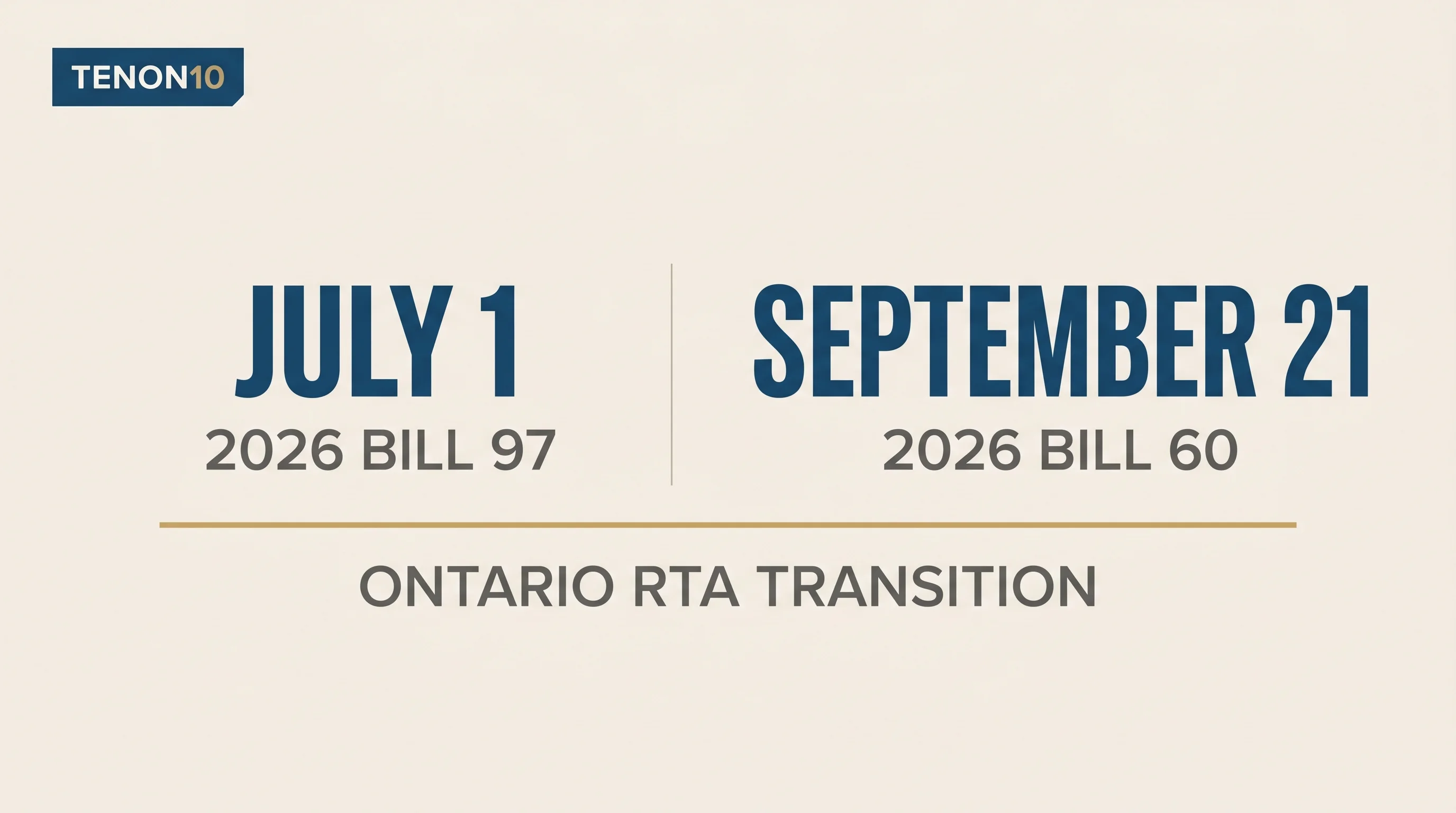
On September 21, 2026, the N4's waiting period drops from 14 days to 7 for monthly tenancies — the most-felt change in the entire Bill 60 package. Here's what the week actually is (a payment window, not an eviction countdown), everything that doesn't change, the 50%-arrears defence rule arriving with it, and the transi
Ontario's right of first refusal used to fail at the follow-through: tenants left, renovations dragged, and nobody wrote. The new rules change the physics — missed updates or a skipped 60-day window are now deemed a denial of the right itself. Here's the complete lifecycle: the letter before you leave, the notices the
Ontario's renoviction rules now run on paperwork: a qualified professional's report, building permits, written timeline estimates, update obligations, a completion notice, and a 60-day window for the tenant to come back. Here's the full document trail — what landlords must produce, what tenants can demand, and where mu
Bill 60 gives Ontario landlords a new choice on own-use evictions: serve the N12 the fast way and pay a month's compensation, or give at least 120 days' notice and pay nothing. On a $3,000 unit, that timing choice is worth $3,000. This guide breaks down exactly how the new 120-day path works under RTA s.48.1(2), when i
The tenant who always pays — but always pays late — is exactly who the N8 exists for. Here's how Ontario's end-of-term notice works: what "persistent" late payment really means, the four lesser-known grounds, the last-day-of-the-period timing rule that voids most N8s, and why the Board usually orders a payment plan bef
The N6 is Ontario's notice for two serious situations: illegal acts at the rental unit, and misrepresented income in rent-geared-to-income housing. It carries the shortest notice periods in the LTB stack — 10 or 20 days — and no remedy window, but the burden of proving what happened at the hearing is entirely the landl
If your rental was first occupied after November 15, 2018, the annual guideline doesn't cap your rent increases — but using the N1 instead of the N2, skipping the 90-day notice, or failing to prove the exemption can void the increase entirely. Here's how the N2 actually works.
Your landlord can't just show up. In Ontario, entering your rental almost always takes 24 hours' written notice, stating the reason and a time between 8 a.m. and 8 p.m. — and the LTB enforces that to the minute. But there are narrow exceptions (a real emergency, your consent at the door), a fixed list of valid reasons,
The N13 is the notice an Ontario landlord uses to end a tenancy to demolish, convert, or do major repairs that need the unit empty. This guide walks through the three grounds, the 120-day notice rules, the compensation and right-to-return, and exactly how the process works — for both landlords serving one and tenants w
The N9 is the form Ontario tenants use to end their own tenancy — and getting the notice period and termination date right is what makes it valid. Here's how much notice you need to give, how to calculate the correct end date, and the mistakes that leave you on the hook for another month's rent.
The N7 is Ontario's notice for ending a tenancy when a tenant causes serious problems — safety threats, wilful damage, or dangerous misuse. Here's when landlords can use it, the strict 10-day timeline, why it can't be voided, and the mistakes that get applications thrown out at the LTB.
Ontario landlords face the biggest rental law changes in years. Bill 60's N4 and landlord's-own-use N12 changes are in force for notices given on or after September 21, 2026 — a 7-day N4, and no compensation on a landlord's-own-use N12 (never a purchaser's) served with at least 120 days' notice; the 15-day LTB review r
The N5 is Ontario's most-used notice for tenancy issues that aren't about money — interference, damage, or overcrowding. This 2026 guide explains the unique two-N5 rule, what tenants can do to void the notice, and what landlords must document to make an N5 stand up at the LTB.
Showing 24 of 28
Load more guides