Ontario vs BC Landlord Rules: A Guide for Owners in Both
Ontario's 2027 guideline is 1.9%; BC's limit is 2.2%. Rent increases, deposits, entry and unpaid-rent notices compared side by side for owners with rentals in both provinces.
Narrow 241 published guides by topic, province, who you are and the kind of help you need. Every filter shows how many guides it leaves.
Shaded tiles have guides written for that province.
80 of 241 guides
Showing for property managers matching “ontario”, newest first.
Ontario's 2027 guideline is 1.9%; BC's limit is 2.2%. Rent increases, deposits, entry and unpaid-rent notices compared side by side for owners with rentals in both provinces.
Safety & Scam PreventionTSSA published a carbon monoxide backgrounder ahead of CO Awareness Week (Nov. 1–7). Here is what the Fire Code requires of landlords for Ontario carbon monoxide alarms before winter.
Since July 24, 2026, the Landlord and Tenant Board's final orders have been publishing to Ontario's Open Data Catalogue — free, no login, monthly updates, with history filling back to December 2021 in phases. It's the biggest transparency shift the rental market has seen in years, and the most misused tool of the fall:
From September 21, 2026, the L1 non-payment hearing changes shape: a tenant who wants to raise section 82 issues — maintenance, illegal entry, harassment — inside the arrears case must first pay at least 50% of the arrears claimed, at least seven days before the hearing, with advance notice of the issues. The right to
Rights & LegalOn September 21, 2026, "persistent late payment" stops being a judgment call and becomes a statutory test: under O. Reg. 516/06, rent counts as late only if it's unpaid more than seven days after the due date, and a tenant is persistently late after at least three late payments within any six-month period — a floor, no
Every stalled listing has a specific broken stage, and almost no Ontario landlord knows which one theirs is. Views without enquiries is a pricing or photography problem. Enquiries without showings is a reply problem. Showings without applications means the unit or the listing is overselling. Applications without a sign
Post a well-priced unit in a decent Ontario market and you will not get three enquiries — you will get forty, most of them within the first forty-eight hours, most of them one line long, and a meaningful share of them from people who will never reply again. This is the triage system: how to structure the listing so the
A name is not an identity. Every rental application arrives with one attached, and almost none of them get checked — which is why fake pay stubs, borrowed credit files, and applicants who are not who the form says they are keep reaching the lease-signing table. This guide is the verification layer: what an Ontario land
Days-on-market is the number every Ontario landlord guesses at and almost nobody measures — and the guess usually runs in the expensive direction. This piece puts a real figure on it: what current listing data says about how long a unit actually sits in Toronto, Ottawa, Hamilton, and the smaller Ontario markets, why th
The tenant credit check is the most misunderstood step in Ontario screening — landlords fear it's complicated, applicants fear it hurts their score, and both fears are out of date. Here's the whole process: the written consent that must come first, where to actually run the check (and what each route costs), why rental
The rental application is the one screening document you design in advance — and Ontario law effectively writes its table of contents: five authorized information categories, a written consent block for the credit check, and a short list of fields that should never appear (starting with the SIN line most template forms
The complete lawful screening sequence, from the listing to the lease: seven stages, each with its legal instrument and its output — the listing that screens by self-selection, enquiry triage, the showing that isn't a loophole, the application built from the five authorized factors, verification including the new publi
Nine places Ontario landlords actually list rentals — Kijiji, Facebook Marketplace, Craigslist, Rentals.ca, Zumper, PadMapper, ViewIt.ca, RentSeeker, and the agent-gated Realtor.ca — compared honestly on cost, audience, posting friction, scam exposure, and where each one earns its place. Dated cells, no pay-to-play, an
Advertising a rental in Ontario is a five-step craft with a legal layer at every step: confirm the unit can lawfully be listed, price it to the market that exists, write and shoot a listing that works, choose platforms deliberately (only one major site is agent-gated), and run enquiries without drowning. This pillar co
Ontario's 2027 rent increase guideline is 1.9% — and the first day a landlord can serve an N1 for a January 1, 2027 increase is October 3, 2026, exactly 90 days out. This is the timing piece: the serve-date math for any 2027 effective date, the 12-month rule check, what the effective date controls (including which year
Eight weeks from now, Ontario's second wave of tenancy-law changes takes effect: the 7-day N4, the 120-day no-compensation N12 route, the renoviction documentation rules, and the fixed-term changes — all on September 21, 2026, per the LTB's own operational update. This is the preparation checklist: what changes, what d
Three Ontario cities now license renovation evictions, and a pattern has emerged: all three give landlords seven days from the N13 to apply, and almost everything else differs — Hamilton charges $715 per unit with annual renewals, Toronto $700 with compensation proven before approval, and Ottawa (from January 1, 2027)
As of July 24, 2026 at 5:00 p.m., every Tribunals Ontario Portal notification to LTB applicants, respondents, and other parties comes from a new address — [email protected] — replacing the old ontario.ca sender. If your inbox rules, safe-sender list, or spam filter still expect the old address, hearing
As of July 24, 2026, the LTB's final orders are public data: every non-confidential order from January through May 2026 is live on Ontario's Open Data Catalogue, with orders back to 2021 following in phases and new ones publishing monthly — on a disclosed 2-to-3-month lag. This guide covers what's in the release and wh
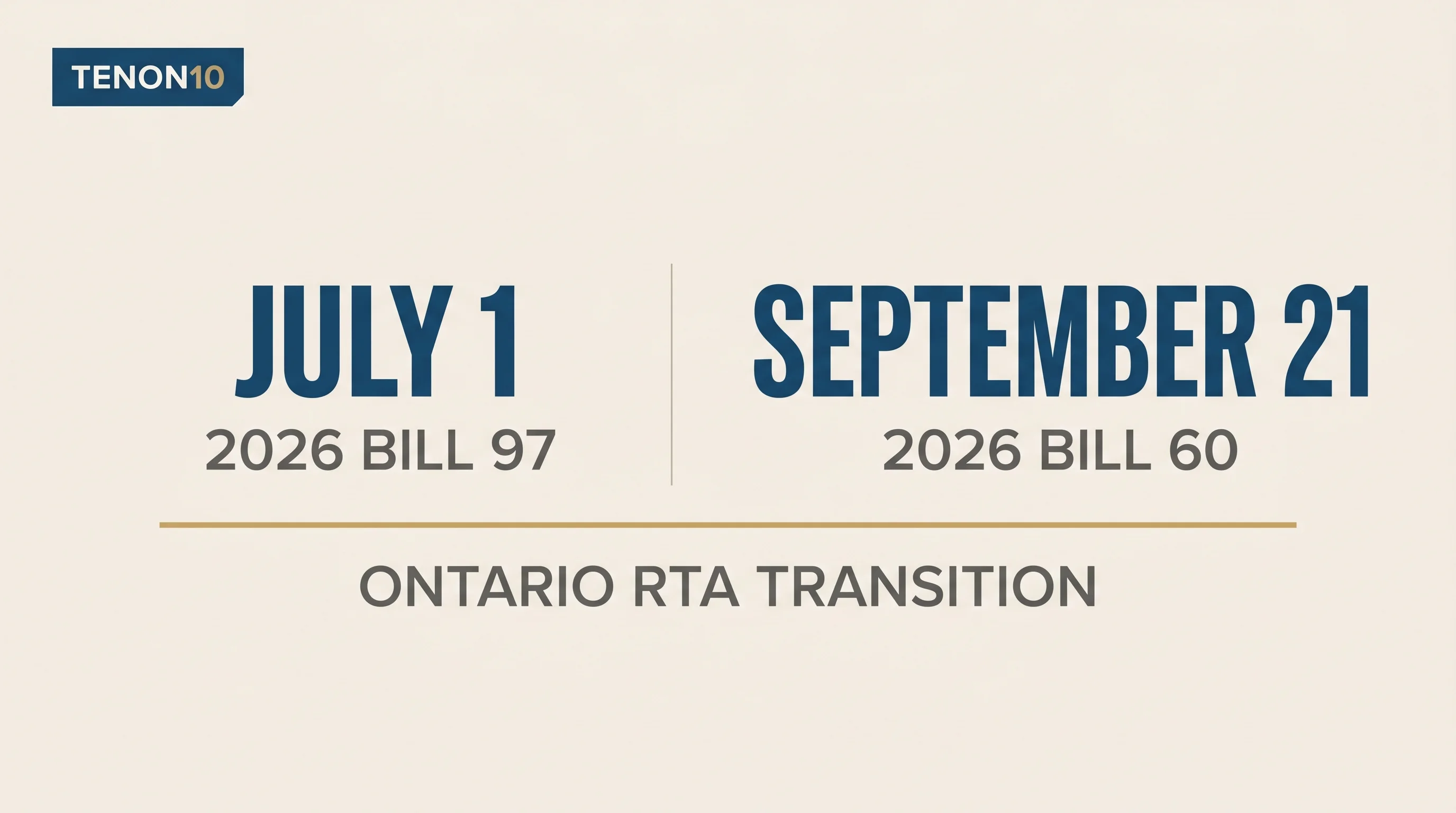
Ontario's biggest tenancy-law overhaul in a generation arrived in two waves. On July 1, 2026, the quiet procedural wave took effect: review deadlines cut to 15 days, the LTB's Payment Agreement Form mandatory for repayment plans, directed service of above-guideline increase orders tightened to 7 days, tenants' new righ
Every complaint a tenant brings you is two things at once: a problem to fix and a test of whether your word means anything. Ontario landlords who handle complaints well run a system — acknowledgment inside a day, categories that route urgent from routine, one written record per issue, and a close-the-loop message when
Compliance doesn't scale smoothly with your portfolio — it steps. A purchaser's own-use notice works at three units and fails at four. Fire alarm obligations change character the day a building has a monitored system. Toronto's RentSafeTO program switches on at three storeys and ten units, the multi-residential tax cla
Ontario has no property management licence — and that sentence misleads more PM founders than any other. Lease units for other people as a business and you're "trading in real estate" under TRESA, which means a RECO-registered brokerage: a broker of record, representation agreements, the Information Guide before you se
A housing co-op looks like a rental building and runs like a small democracy: members instead of tenants, occupancy charges instead of rent, by-laws instead of a lease, and a board — not a landlord — in charge. For property managers, that changes the client, the money, and the eviction machinery entirely: the Co-operat
Ontario's trust-account rules are having their biggest overhaul in a generation: after roughly $10 million went missing from brokerage trust accounts, RECO's mandatory annual financial filings arrive October 1, 2026 — with monthly trust reporting planned for 2027. Here's what Ontario property managers need to run clean
House hacking sounds like a financing strategy. In Ontario it's a legal one. Whether your tenant shares a kitchen or bathroom with you decides whether the Residential Tenancies Act applies at all — and whether the Human Rights Code does either. Same house, same rent, same person. One fact, two statutes, and most of the
Nobody asked whether you wanted to be a landlord. A parent died, or a move happened, and now there's a tenancy with your name on it — a rent you didn't set, terms you didn't write, a deposit you never took. The lease is attached to the property, not the person. You stepped into the shoes, and the Act doesn't care that
Ontario has no single heating law. Your minimum temperature and your heating season come from your municipality — and Toronto's dates moved in 2025, which most guides still haven't noticed. What the province requires, what four cities require, and the winter obligations that start before you think.
Most Ontario landlords screen on income first — three times the rent, or a 30% cut-off. The Human Rights Commission says that rule is illegal, and the regulation makes income the one tool you can't use on its own. Credit and rental history can stand alone. Income can't. Here's what you may actually ask.
The reference table for Ontario rental investors: cap rates and average rents for every major city, in one place, with the methodology shown and every figure dated. Multifamily cap-rate bands from CBRE and broker data (Toronto's compressed 4s to the 6-plus territory of smaller markets), CMHC average rents by city from
"What's the average rent?" is an unanswerable question until you say which bedroom count, which city, and which data series. This reference page holds the table everyone needs and nobody maintains: studio through three-bedroom rents for every major Ontario city, in both series — CMHC's occupied-stock averages and curre
There is no single best Ontario city to buy a rental property — there's a best city for your strategy, and the numbers to prove it. This data-driven guide compares Ontario's major rental markets the way an underwriter would: cap rates and price-to-rent ratios, CMHC vacancy rates and average rents, property taxes, tenan
Scaling a rental portfolio isn't buying the first property eleven more times — it's a ladder with three rungs and a wall between each. Rungs one through four run on residential rules: 20% down, the stress test, your personal income carrying every door. Then comes the wall almost nobody warns you about: most major banks
Every day a unit sits empty costs you rent you never get back — and most vacancy isn't created by the market. It's created inside the turnover process: the notice window that gets treated as dead time, the make-ready that starts after the keys come back, the listing that goes live before the unit is ready. Ontario hand
One unit, rent is a payment. Twenty units, rent is a system — rails, reminders, reconciliation, arrears escalation, and owner draws, all running against rules the platforms don't mention: in Ontario you can't require post-dated cheques or automatic payments, you can't charge late fees, and receipts are a legal duty. Th
Every message to a tenant carries a legal weight — and most landlords can't tell the three tiers apart. Some things must be LTB forms, and no friendly letter can substitute. Some must be written with exact contents the RTA prescribes: the 24-hour entry notice's reason, date, and time; the email-service consent that mak
Every LTB journey follows the same road: a notice, an application on the Tribunals Ontario Portal, a queue, a fork at mediation, a hearing, an order — and sometimes the Sheriff. This pillar guide maps the entire process end to end for landlords, tenants, and property managers: which notice starts which application, wha
Every guide in this series ends the same way: "…and then you wait." This one measures the wait. Arrears cases now schedule in about three months; most other applications take five to seven; some tenant applications have taken years. How Ontario's busiest tribunal fell from 32-day orders to a 53,000-case backlog, what t
The landlord said they needed the unit for family. You moved out. A week later it was on the market at $500 more. Ontario law presumes what that looks like: an own-use eviction followed by re-listing within 12 months is presumed bad faith — and suddenly the landlord must prove innocence. Here's the T5 application from
In Ontario, a lease that ends doesn't end anything — it converts. So "renewal" is really a strategy question: stay month-to-month or sign a new fixed term? The answer is different for landlords (retention economics, flexibility), tenants (no-fault eviction protection, leverage you didn't know you had), and property man
Ontario's rent guideline isn't always the ceiling. Through an Above-Guideline Increase, landlords can recover extraordinary tax hikes, major capital work, and security costs — but only on three statutory grounds, under strict caps, with a hearing at the end and an expiry date built in. Here's the full process: grounds,
On September 21, 2026, the N4's waiting period dropped from 14 days to 7 for monthly and yearly tenancies — the most-felt change in the entire Bill 60 package. Here's what the week actually is (a payment window, not an eviction countdown), everything that didn't change, the half-the-arrears rule that arrived with it, a
Ontario's right of first refusal used to fail at the follow-through: tenants left, renovations dragged, and nobody wrote. The new rules change the physics — missed updates or a skipped 60-day window are now deemed a denial of the right itself. Here's the complete lifecycle: the letter before you leave, the notices the
Ontario's renoviction rules now run on paperwork: a qualified professional's report, building permits, written timeline estimates, update obligations, a completion notice, and a 60-day window for the tenant to come back. Here's the full document trail — what landlords must produce, what tenants can demand, and where mu
Bill 60 gives Ontario landlords a new choice on own-use evictions: serve the N12 the fast way and pay a month's compensation, or give at least 120 days' notice and pay nothing. On a $3,000 unit, that timing choice is worth $3,000. This guide breaks down exactly how the new 120-day path works under RTA s.48.1(2), when i
As of July 1, 2026, the maximum fine for an RTA offence is $100,000 for individuals and $500,000 for corporations — double the old caps. Here's which offences carry that exposure, why directors and officers can be personally liable, and the compliance file that keeps the new numbers theoretical.
The tenant who always pays — but always pays late — is exactly who the N8 exists for. Here's how Ontario's end-of-term notice works: what "persistent" late payment really means, the four lesser-known grounds, the last-day-of-the-period timing rule that voids most N8s, and why the Board usually orders a payment plan bef
The N6 is Ontario's notice for two serious situations: illegal acts at the rental unit, and misrepresented income in rent-geared-to-income housing. It carries the shortest notice periods in the LTB stack — 10 or 20 days — and no remedy window, but the burden of proving what happened at the hearing is entirely the landl
If your rental was first occupied after November 15, 2018, the annual guideline doesn't cap your rent increases — but using the N1 instead of the N2, skipping the 90-day notice, or failing to prove the exemption can void the increase entirely. Here's how the N2 actually works.
A credit check is just one piece of tenant screening — and the moment you go beyond it, the legal lines get sharp. Criminal record checks, references, employment and income verification, eviction history, even a social-media search: each is governed by the Human Rights Code, Ontario's screening regulation, and privacy
When a landlord won't fix a serious problem, tenants have a route many don't know about: the municipal property standards officer. These bylaw inspectors can order repairs, set deadlines, and even bill the landlord for work the city does itself — and their orders are powerful evidence at the Landlord and Tenant Board.
The expense section is where a T776 is won or lost — it's the largest part of the form and where landlords both overpay (by missing deductions) and get audited (by claiming the wrong ones). This deep-dive walks every T776 expense line, the one distinction that governs all of them — current vs. capital — and the traps t
Capital Cost Allowance lets Canadian landlords deduct a slice of their building's cost each year — but it's the most misunderstood line on a rental tax return. It's optional, it can't create a loss, and every dollar you claim can come back to bite you as fully taxed "recapture" when you sell. This guide explains how CC
There's no single "Ontario heating law" — the minimum temperature your landlord must maintain, the dates it applies, and the fines all come from your city's bylaw. Toronto requires 21°C (Oct 1–May 15); Ottawa requires 20°C by day and 16.67°C overnight; Hamilton requires 20°C (Sept 15–May 15). This guide lays out the ex
Bed bugs, cockroaches, mice — in Ontario, dealing with them is almost always the landlord's job, and paying for it is too. There's an actual regulation that says a rental must be kept "reasonably free of rodents, vermin and insects," a landlord can't pass the exterminator's bill to a tenant without proving the tenant c
There's no "mold law" in Ontario — but there doesn't need to be. Mold caused by a building problem (a leak, bad ventilation, water getting in) is the landlord's to fix under the same duty to keep a unit in a good state of repair. This guide draws the responsibility line clearly: what the landlord must remediate (and pa
In Ontario, keeping a rental in good repair isn't optional or negotiable — it's a legal duty that a landlord can't sign away, and that applies even if the tenant knew about the problem before moving in. This is the complete guide to maintenance standards under the RTA: what "good state of repair and fit for habitation"
Heat, water, electricity, gas — these are "vital services" in Ontario, and a landlord can't withhold or deliberately interfere with them, ever. Not for unpaid rent, not for a damaged unit, not until an eviction is actually enforced. There's a minimum heat standard (and stricter city bylaws), a rule that makes the landl
Your landlord can't just show up. In Ontario, entering your rental almost always takes 24 hours' written notice, stating the reason and a time between 8 a.m. and 8 p.m. — and the LTB enforces that to the minute. But there are narrow exceptions (a real emergency, your consent at the door), a fixed list of valid reasons,
Can your Ontario landlord make you get tenant insurance? There's no law that requires it — but a landlord can make it a condition of your lease, and once it's in a signed lease, it's enforceable. Here's what tenant insurance actually covers (your stuff and your liability, not the building), what a landlord can and can'
"Subletting" and "assigning" get used interchangeably — but in Ontario they're legally different, and mixing them up can cost you. A sublet means you're coming back; an assignment means you're gone for good. The rules on landlord consent differ too: a landlord can refuse a general assignment outright, but can't unreaso
Here's the twist that surprises people: a "no smoking" clause in an Ontario lease IS enforceable — unlike a "no pets" clause, which is void. But the rule has limits. A landlord can't add a smoking ban mid-tenancy, a clause that names tobacco doesn't automatically cover cannabis or vaping, and even a grandfathered smoke
That "no pets" line in your Ontario lease? It's void — section 14 of the Residential Tenancies Act makes no-pet clauses unenforceable once you're a tenant. But the rule has real limits: a landlord can refuse a pet owner before you sign, a condo declaration can still ban pets, and behaviour like damage, danger, or aller
Ontario doesn't legally require a move-in or move-out inspection — but skipping one is how landlords lose damage claims and tenants lose deposits. Because Ontario bans damage deposits, an inspection report isn't a deduction tool; it's your evidence at the Landlord and Tenant Board. Here's how to document a rental prope
As of July 1, 2026, a rent-arrears repayment agreement filed with the Landlord and Tenant Board must use the Board's official form — no more handwritten deals on the back of an envelope. Here's how the new s.206 rule works: what the mandatory form covers, the section 78 clause that lets a landlord skip a new eviction n
As of July 1, 2026, Ontario tenants have an explicit right to install a window or portable air conditioner — even when the landlord doesn't provide cooling. But the right comes with conditions: written notice first, a safe install, and a seasonal electricity charge the landlord can add in a way that breaks all the usua
No pay stub doesn't mean no proof. Self-employed applicants — freelancers, contractors, gig workers, small-business owners — are a fast-growing share of Ontario renters, and screening them out for lacking a T4 is both bad business and a legal risk. This guide shows landlords which documents actually verify self-employe
Screening the right tenant is the single best way to avoid problems later — but in Ontario you have to do it within strict Human Rights Code limits. This complete guide walks landlords and property managers through a legal, effective screening process: applications, credit and reference checks, income verification, wha
The N13 is the notice an Ontario landlord uses to end a tenancy to demolish, convert, or do major repairs that need the unit empty. This guide walks through the three grounds, the 120-day notice rules, the compensation and right-to-return, and exactly how the process works — for both landlords serving one and tenants w
"Renoviction" is when a landlord uses renovations to end a tenancy — sometimes legitimately, sometimes not. This complete guide explains how the N13 process actually works, the compensation and right-to-return rules, the new licensing crackdown under Bill 60/97, and how both landlords and tenants can stay on the right
The N9 is the form Ontario tenants use to end their own tenancy — and getting the notice period and termination date right is what makes it valid. Here's how much notice you need to give, how to calculate the correct end date, and the mistakes that leave you on the hook for another month's rent.
The N7 is Ontario's notice for ending a tenancy when a tenant causes serious problems — safety threats, wilful damage, or dangerous misuse. Here's when landlords can use it, the strict 10-day timeline, why it can't be voided, and the mistakes that get applications thrown out at the LTB.
Ontario landlords face the biggest rental law changes in years. Bill 60's N4 and landlord's-own-use N12 changes are in force for notices given on or after September 21, 2026 — a 7-day N4, and no compensation on a landlord's-own-use N12 (never a purchaser's) served with at least 120 days' notice; the 15-day LTB review r
The N5 is Ontario's most-used notice for tenancy issues that aren't about money — interference, damage, or overcrowding. This 2026 guide explains the unique two-N5 rule, what tenants can do to void the notice, and what landlords must document to make an N5 stand up at the LTB.
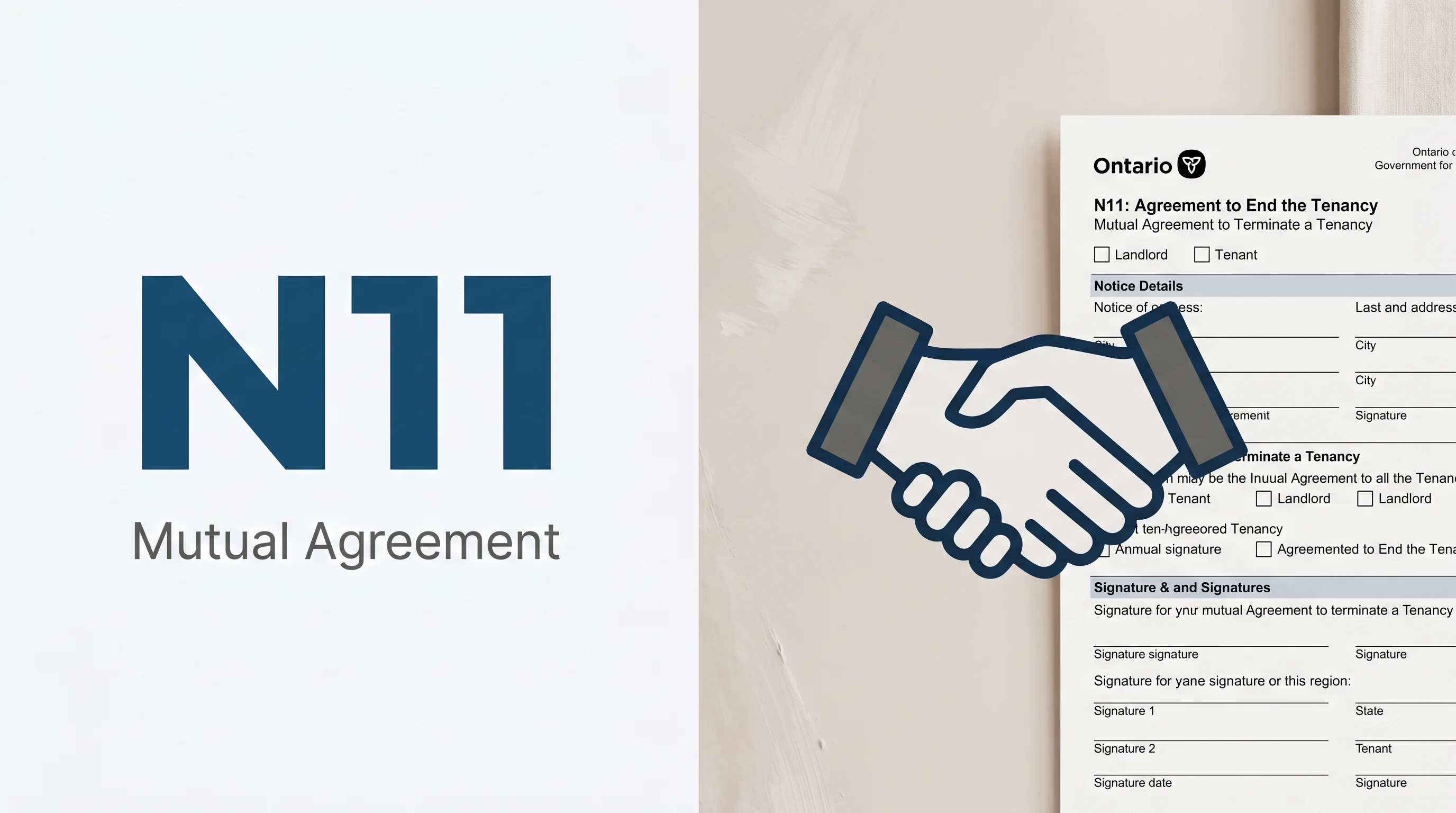
Both parties want to end the tenancy peacefully? The N11 is Ontario's cooperative path — no LTB hearing, no notice periods, no penalties. This 2026 guide explains when N11 makes sense, how to negotiate fair terms, and the protections both sides need to understand before signing.
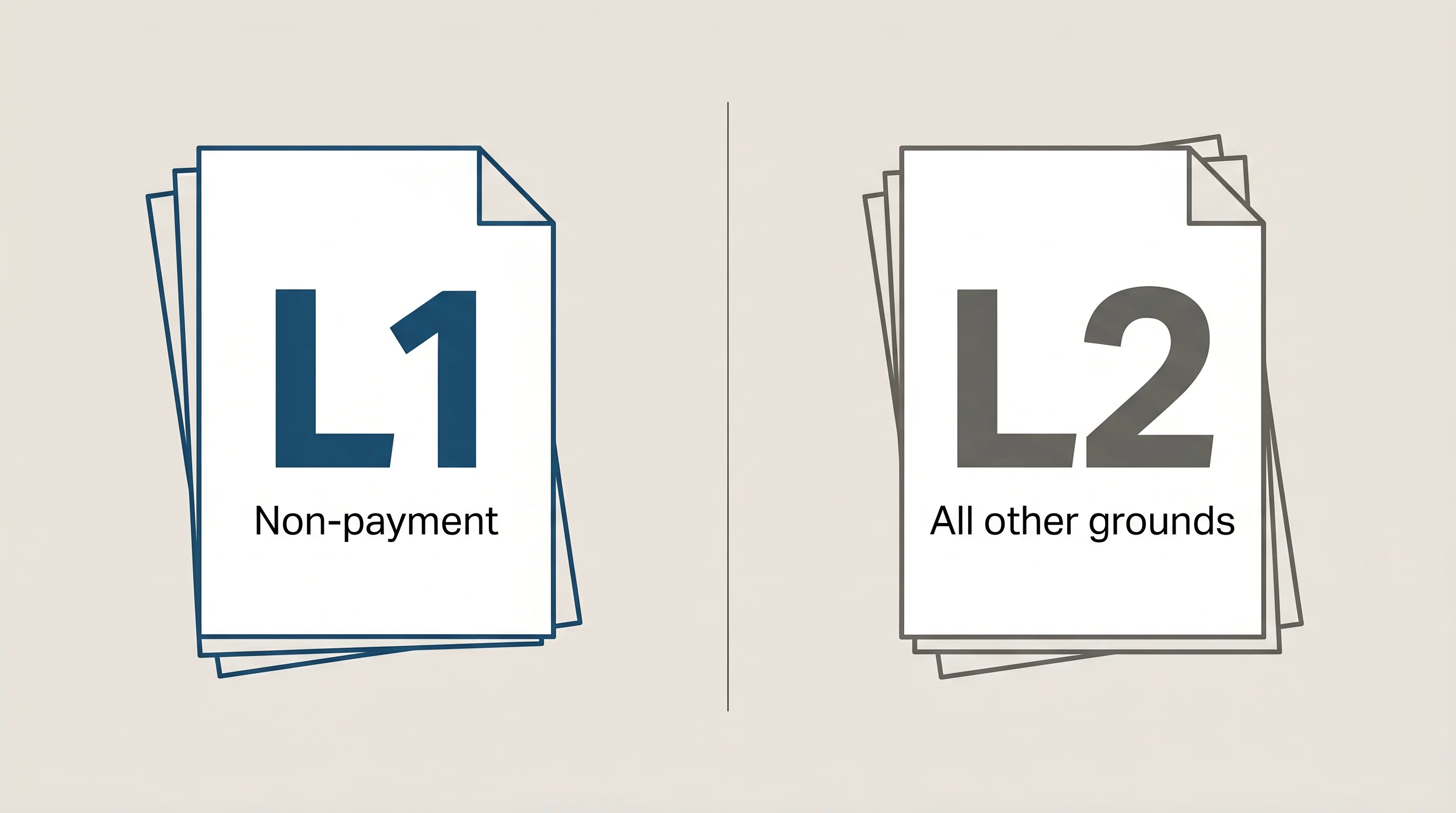
Confused about whether to file an L1 or L2 at the Ontario LTB? This 2026 guide breaks down when each application applies, what notices they follow, how hearings differ, and what documentation landlords need to win.
Thinking about renting out your property in Ontario? A complete 2026 guide to becoming a landlord — from your first legal obligations under the RTA to setting rent, screening tenants, collecting rent, and avoiding the mistakes that catch first-timers off guard.
A complete 2026 guide to Ontario N12 notices. Understand when own-use ends a tenancy, the compensation rules under Bill 60, the good faith requirement, and how the process works for landlords, property managers, and tenants receiving an N12.
A complete 2026 guide to rent increases in Ontario. Understand the 2.1% provincial guideline, the 90-day N1 notice requirement, when rent increases apply, what voids them, and how the process works for landlords, property managers, and tenants alike.
Ontario PMs need more than generic software. Here's what to evaluate in 2026 — from LTB form automation and rent increase compliance to Canadian payments, RBAC, and trust accounting.