Explore the library

Narrow 189 published guides by topic, province, who you are and the kind of help you need. Every filter shows how many guides it leaves.

Pick a province

Shaded tiles have guides written for that province.

85 of 189 guides

Showing Rights & Legal, Ontario, newest first.

Results

  • Rights & Legal
    ONArticle

    The Renoviction Paper Trail: N13 Documents and the Right of First Refusal After September 21

    An N13 renoviction runs on paper, and from September 21, 2026 there's more of it: Bill 97 amends the RTA's right-of-first-refusal rules, adding written-notification duties for landlords once a tenant has preserved the right — including keeping the tenant updated when the completion date slips, which it usually does. Th

    12 min read
  • Rights & Legal
    ONArticle

    The 15-Day Review Window: How to Challenge an LTB Order Before It's Final

    Since July 1, 2026, the clock to challenge a Landlord and Tenant Board order has run half as long: a Request to Review must be filed within 15 days of the order's issue date — down from 30 — under new s.209(3) of the RTA, with orders issued before that date keeping the old deadline. Two months in, the mistakes have a p

    12 min read
  • Rights & Legal
    CanadaArticle

    The LTB Order Catalogue: How to Use Ontario's New Public Orders — Lawfully

    Since July 24, 2026, the Landlord and Tenant Board's final orders have been publishing to Ontario's Open Data Catalogue — free, no login, monthly updates, with history filling back to December 2021 in phases. It's the biggest transparency shift the rental market has seen in years, and the most misused tool of the fall:

    11 min read
  • Rights & Legal
    ONArticle

    Ontario's 50% Arrears Rule: The New Price of Raising Issues at a Non-Payment Hearing

    From September 21, 2026, the L1 non-payment hearing changes shape: a tenant who wants to raise section 82 issues — maintenance, illegal entry, harassment — inside the arrears case must first pay at least 50% of the arrears claimed, at least seven days before the hearing, with advance notice of the issues. The right to

    11 min read
  • Rights & Legal
    ONArticle

    Ontario's New Persistent Late Payment Test: The 3-in-6 Rule and the Other 7-Day Clock

    On September 21, 2026, "persistent late payment" stops being a judgment call and becomes a statutory test: under O. Reg. 516/06, rent counts as late only if it's unpaid more than seven days after the due date, and a tenant is persistently late after at least three late payments within any six-month period — a floor, no

    12 min read
  • Rights & Legal
    ONArticle

    Mississauga's Renoviction Licence Starts September 1: What Landlords Need to Know

    From September 1, 2026, serving an N13 in Mississauga starts a second clock the province doesn't run: within seven days, the landlord must apply to the City for a Rental Repairs and Renovations Licence — and no work starts, and no tenant leaves, until both the building permit and the licence are in hand. Here's the mun

    12 min read
  • Rights & Legal
    ONArticle

    Rent Control and What You Can Advertise

    Rent control in Ontario doesn't limit what rent you can advertise — and that surprise cuts both ways. Vacancy decontrol means a new tenancy's rent is set freely, so the number in your ad is yours to choose; but the moment a tenant signs at that number, the control regime takes over, and the advertised rent becomes the

    13 min read
  • Rights & Legal
    ONArticle

    Advertising a Basement Apartment: What's Legal in Ontario

    Before a basement apartment can be advertised, it has to be a legal unit — and "legal" is a specific, checkable status, not a vibe: zoning that permits the second unit, Building and Fire Code compliance, electrical safety, and registration where your municipality requires it. This guide walks the legality layer in orde

    13 min read
  • Rights & Legal
    ONArticle

    The Human Rights Code and Rental Advertising: What Ontario Landlords Can't Say

    Rental ad discrimination rarely looks like discrimination — it looks like friendliness: "perfect for young professionals," "ideal for a quiet couple," "great family neighbourhood." Under Ontario's Human Rights Code, the ad is where compliance starts, and warmly-phrased tenant preferences are the same violation as blunt

    14 min read
  • Rights & Legal
    ONArticle

    Do You Need a Licence to Rent Out Property in Ontario?

    The short answer: Ontario has no provincial licence for renting out residential property. The complete answer is why the question stays confusing — licensing is municipal, and three different licence types now share the word: ordinary rental licensing in some cities, renoviction licensing in Hamilton, Toronto, and Otta

    10 min read
  • Rights & Legal
    ONArticle

    Can You Refuse a Tenant With Pets in Ontario?

    Ontario pet law does something almost nobody expects, and both sides routinely get it backwards: at the application stage, a landlord may generally choose not to rent to someone because they have a pet — but once the tenancy exists, a "no pets" lease clause is void, and a tenant who gets a pet after moving in usually c

    11 min read
  • Rights & Legal
    ONArticle

    Can You Ask for First and Last Month's Rent in Ontario?

    Yes — and almost everything attached to that yes is where landlords get into trouble and tenants overpay. First month's rent is just rent; last month's is Ontario's only legal deposit, capped at one rental period, earning interest every year at that year's guideline rate. Damage, security, cleaning, and pet deposits ar

    12 min read
  • Rights & Legal
    ONArticle

    How to Advertise a Rental Property in Ontario: The Complete Guide

    Advertising a rental in Ontario is a five-step craft with a legal layer at every step: confirm the unit can lawfully be listed, price it to the market that exists, write and shoot a listing that works, choose platforms deliberately (only one major site is agent-gated), and run enquiries without drowning. This pillar co

    15 min read
  • Rights & Legal
    ONArticle

    Renoviction Licensing by Ontario City: Toronto, Hamilton and Ottawa Compared

    Three Ontario cities now license renovation evictions, and a pattern has emerged: all three give landlords seven days from the N13 to apply, and almost everything else differs — Hamilton charges $715 per unit with annual renewals, Toronto $700 with compensation proven before approval, and Ottawa (from January 1, 2027)

    15 min read
  • Rights & Legal
    ONArticle

    Ottawa's Renoviction Bylaw: What Landlords Must Do Before January 1, 2027

    Ottawa city council passed its Rental Renovation Licence bylaw 21–5 on July 15, 2026, and it takes effect January 1, 2027: a municipal licence within 7 days of issuing an N13, a building permit secured before the notice goes out, and a city-produced tenant rights guide served alongside it. Here's what the bylaw actuall

    15 min read
  • Rights & Legal
    ONArticle

    LTB Portal Emails Changed Sender: Check Your Spam Filter

    As of July 24, 2026 at 5:00 p.m., every Tribunals Ontario Portal notification to LTB applicants, respondents, and other parties comes from a new address — [email protected] — replacing the old ontario.ca sender. If your inbox rules, safe-sender list, or spam filter still expect the old address, hearing

    5 min read
  • Rights & Legal
    ONArticle

    LTB Orders Are Now Public: What Ontario's Open Data Release Means for Landlords

    As of July 24, 2026, the LTB's final orders are public data: every non-confidential order from January through May 2026 is live on Ontario's Open Data Catalogue, with orders back to 2021 following in phases and new ones publishing monthly — on a disclosed 2-to-3-month lag. This guide covers what's in the release and wh

    15 min read
  • Rights & Legal
    ONArticle

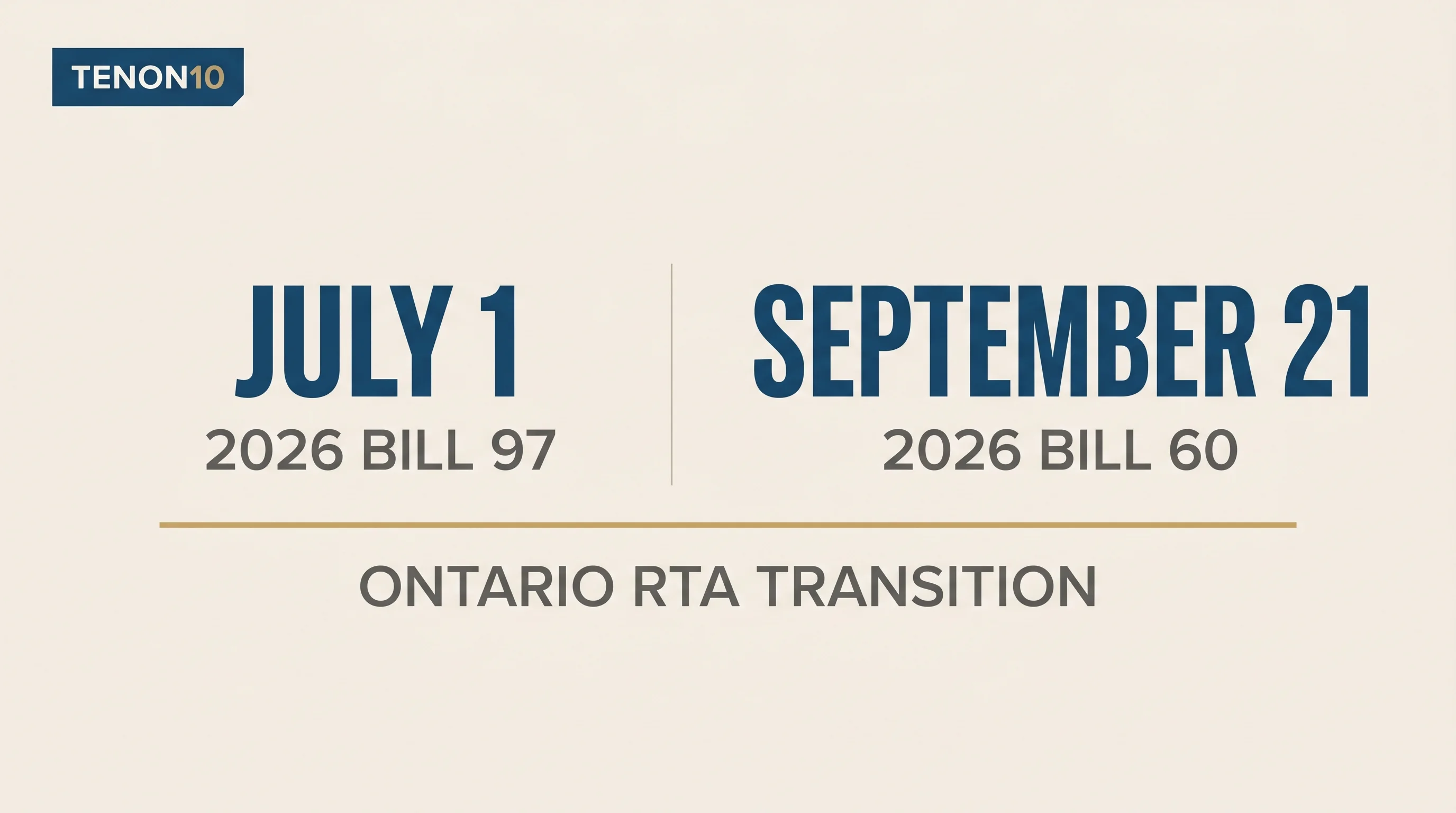
    Bill 60 and Bill 97, Six Months In: What Landed July 1 — and What September 21 Brings

    Ontario's biggest tenancy-law overhaul in a generation arrived in two waves — and the first one wasn't the one making headlines. Since July 1, the quiet procedural wave has been in force: review deadlines cut to 15 days, the LTB's Payment Agreement Form now mandatory for every repayment plan, above-guideline document s

    16 min read
  • Rights & Legal
    ONArticle

    Handling Tenant Complaints in Ontario: The System That Turns Problems Into Trust

    Every complaint a tenant brings you is two things at once: a problem to fix and a test of whether your word means anything. Ontario landlords who handle complaints well run a system — acknowledgment inside a day, categories that route urgent from routine, one written record per issue, and a close-the-loop message when

    22 min read
  • Rights & Legal
    ONArticle

    Multi-Unit vs Single-Unit Compliance in Ontario: Where the Rules Change as You Scale

    Compliance doesn't scale smoothly with your portfolio — it steps. A purchaser's own-use notice works at three units and fails at four. Fire alarm obligations change character the day a building has a monitored system. Toronto's RentSafeTO program switches on at three storeys and ten units, the multi-residential tax cla

    21 min read
  • Rights & Legal
    ONArticle

    House Hacking in Ontario: Living in One Unit, Renting the Other

    House hacking sounds like a financing strategy. In Ontario it's a legal one. Whether your tenant shares a kitchen or bathroom with you decides whether the Residential Tenancies Act applies at all — and whether the Human Rights Code does either. Same house, same rent, same person. One fact, two statutes, and most of the

    30 min read
  • Rights & Legal
    ONArticle

    Accidental Landlord in Ontario: You Inherited or Kept a Property — Now What?

    Nobody asked whether you wanted to be a landlord. A parent died, or a move happened, and now there's a tenancy with your name on it — a rent you didn't set, terms you didn't write, a deposit you never took. The lease is attached to the property, not the person. You stepped into the shoes, and the Act doesn't care that

    28 min read
  • Rights & Legal
    ONArticle

    Should You Rent Out Your Toronto Condo or Sell It in 2026?

    You think you're choosing between two doors. There are three, and every one is a tax event. The day you rent it out, the Income Tax Act deems you to have sold it — at fair market value, to nobody, for no money. The fix is a one-page letter with no form number, and it's due with that year's return.

    27 min read
  • Rights & Legal
    ONArticle

    Condo Rentals in Toronto: Board Rules, Status Certificates and What Landlords Miss

    Your lease is not where the rules live. A condo tenant is bound by a declaration they never signed — and when they breach it, the corporation doesn't chase them. It charges you, and the charge attaches to your unit ahead of your mortgage. Here's the second rulebook, and the deadline most owners miss by three weeks.

    26 min read
  • Rights & Legal
    ONArticle

    Managing a Toronto Rental While Living Elsewhere: The Remote Landlord's Guide

    Moving away doesn't change your obligations under the RTA — but crossing the tax-residency line changes who your tenant owes money to. A Tax Court case put six years of your tax bill on a tenant who had no idea. Here's what actually changes when you leave, and what to set up before you go.

    26 min read
  • Rights & Legal
    ONArticle

    Winter-Proofing Ontario Rentals: Heat By-laws, Pipes and City Standards

    Ontario has no single heating law. Your minimum temperature and your heating season come from your municipality — and Toronto's dates moved in 2025, which most guides still haven't noticed. What the province requires, what four cities require, and the winter obligations that start before you think.

    25 min read
  • Rights & Legal
    ONArticle

    Tenant Screening in Ontario: What the Human Rights Code Actually Lets You Ask

    Most Ontario landlords screen on income first — three times the rent, or a 30% cut-off. The Human Rights Commission says that rule is illegal, and the regulation makes income the one tool you can't use on its own. Credit and rental history can stand alone. Income can't. Here's what you may actually ask.

    24 min read
  • Rights & Legal
    ONArticle

    How to Scale a Rental Portfolio in Ontario: From First Door to Twenty

    Scaling a rental portfolio isn't buying the first property eleven more times — it's a ladder with three rungs and a wall between each. Rungs one through four run on residential rules: 20% down, the stress test, your personal income carrying every door. Then comes the wall almost nobody warns you about: most major banks

    20 min read
  • Rights & Legal
    ONArticle

    Tenant Turnover in Ontario: The System That Reduces Vacancy Days

    Every day a unit sits empty costs you rent you never get back — and most vacancy isn't created by the market. It's created inside the turnover process: the notice window that gets treated as dead time, the make-ready that starts after the keys come back, the listing that goes live before the unit is ready. Ontario hand

    18 min read
  • Rights & Legal
    ONArticle

    Rent Collection at Scale: The System Ontario Property Managers Actually Need

    One unit, rent is a payment. Twenty units, rent is a system — rails, reminders, reconciliation, arrears escalation, and owner draws, all running against rules the platforms don't mention: in Ontario you can't require post-dated cheques or automatic payments, you can't charge late fees, and receipts are a legal duty. Th

    18 min read
  • Rights & Legal
    ONArticle

    Holiday Rentals and Short-Term Tenancies in Ontario: When a Guest Becomes a Tenant

    The line between a holiday guest and a legal tenant is the most expensive line in Ontario short-term rentals — and it isn't the 28-day switch most hosts believe it is. This guide maps when the RTA's transient-accommodation exemption actually applies, the municipal licensing patchwork (Toronto's principal-residence rule

    17 min read
  • Rights & Legal
    ONArticle

    Removing a Tenant Without Eviction: The Legal Alternatives to the LTB Queue

    Not every tenancy has to end at the Landlord and Tenant Board. Ontario law gives landlords and tenants several legal ways to part company without an eviction hearing — the N11 mutual agreement and cash-for-keys deal, the tenant's own N9 notice, assignment, and negotiated moves — each faster than the queue when done rig

    14 min read
  • Rights & Legal
    ONArticle

    The LTB Process, End to End: From First Notice to Final Enforcement

    Every LTB journey follows the same road: a notice, an application on the Tribunals Ontario Portal, a queue, a fork at mediation, a hearing, an order — and sometimes the Sheriff. This pillar guide maps the entire process end to end for landlords, tenants, and property managers: which notice starts which application, wha

    16 min read
  • Rights & Legal
    ONArticle

    After the LTB Order: The Sheriff, the Wait, and Eviction Day

    An LTB eviction order is not possession — only the Sheriff can enforce it, and the Sheriff has a queue of their own. This guide covers the whole after-the-order world for landlords and tenants: the filing package and the six-month deadline, the fees and the regional wait, the Notice to Vacate, what actually happens on

    15 min read
  • Rights & Legal
    ONArticle

    Paralegals vs Lawyers at the LTB: Who to Hire, and When

    At the Landlord and Tenant Board, paralegals and lawyers hold the same regulator, the same insurance, and the same right to appear — so the hiring decision isn't about prestige. It's about scope (only lawyers appear at Divisional Court), specialization (LTB-focused paralegals live in that tribunal), and fee structure (

    15 min read
  • Rights & Legal
    ONArticle

    Representing Yourself at the LTB: The Tenant's Edition

    Most tenants at the LTB appear without a lawyer — and unlike landlords, tenants get free help: Duty Counsel on hearing day, community legal clinics before it. But the help only works if you claim it, the s. 82 counter-issue lane closes behind a 50% pay-in gate in September, and a missed hearing proceeds without you. Th

    15 min read
  • Rights & Legal
    ONArticle

    Representing Yourself at the LTB: The Landlord's Edition

    Most parties at the LTB appear without a lawyer — the Board is built for it. But it dismisses landlord applications every day on technicalities, not merits: a miscalculated termination date, an arrears figure that doesn't match the ledger, service that can't be proven. This guide covers what self-representation actuall

    14 min read
  • Rights & Legal
    ONArticle

    The LTB Backlog: Real Wait Times, Root Causes, and How to Protect Your Case

    Every guide in this series ends the same way: "…and then you wait." This one measures the wait. Arrears cases now schedule in about three months; most other applications take five to seven; some tenant applications have taken years. How Ontario's busiest tribunal fell from 32-day orders to a 53,000-case backlog, what t

    12 min read
  • Rights & Legal
    ONArticle

    The 'Substantial Interference' Standard: The RTA's Vaguest Phrase, Explained

    It's the ground for more LTB disputes than almost any other phrase: "substantial interference with reasonable enjoyment." The noise complaint, the smoke drifting between units, the landlord who won't stop dropping by — all of it lives here. But the standard cuts every direction: it's the landlord's eviction ground, the

    14 min read
  • Rights & Legal
    ONArticle

    Bad-Faith N12: How the LTB Decides

    The landlord said they needed the unit for family. You moved out. A week later it was on the market at $500 more. Ontario law presumes what that looks like: an own-use eviction followed by re-listing within 12 months is presumed bad faith — and suddenly the landlord must prove innocence. Here's the T5 application from

    13 min read
  • Rights & Legal
    ONArticle

    The T3 Application: When Your Rent Should Go Down

    The parking that vanished. The laundry room that became storage. The pool that never reopened. In Ontario, rent buys a package — and when the landlord shrinks the package, the law shrinks the rent. The T3 is the application that resets your rent permanently, not just once. It runs on a 12-month window, precise valuatio

    13 min read
  • Rights & Legal
    ONArticle

    The T1 Application: Getting Money Back From Your Landlord

    Key deposits. Pet fees. An unreturned last month's rent. Interest nobody ever paid. N12 compensation that never arrived. Ontario law makes all of it recoverable — through one application with eight grounds and a filing fee under $60. But the T1 runs on a strict one-year lookback, and unchallenged rent increases become

    12 min read
  • Rights & Legal
    ONArticle

    The T6 Application: How Tenants Enforce Repairs at the LTB

    Your landlord's duty to repair is absolute — but it enforces itself exactly never. The T6 is the application that turns ignored repair requests into orders: rent abatements, deadlines, reimbursements, even a freeze on rent increases until the work is done. It costs $48, runs on a one-year clock, and lives or dies on da

    12 min read
  • Rights & Legal
    ONArticle

    The L4 Application: Enforcing a Settlement or Order the Tenant Didn't Keep

    The hearing ended in a deal — a payment plan, conditions, a second chance. Then a condition broke. The L4 converts that breach into an eviction order, normally without another hearing. But it runs on a 30-day clock from the breach itself, a relatedness rule that filters which conditions count, and a declaration that mu

    13 min read
  • Rights & Legal
    ONArticle

    The L3 Application: When a Tenant Gave Notice or Agreed to Leave — but Didn't

    The tenant handed you an N9 — or signed an N11 — and then simply stayed. The L3 converts their own paperwork into an eviction order, often without a hearing. But it runs on a 30-day fuse that voids the notice entirely, and an affidavit with five required elements the LTB will refuse the file over. Here's the complete w

    13 min read
  • Rights & Legal
    ONArticle

    The L5 Application: How to File for an Above-Guideline Rent Increase in Ontario

    You've confirmed your AGI grounds — now comes the paperwork. The L5 is the LTB's most unusual filing: it skips the portal entirely, runs on an Excel form with strict naming rules, demands every receipt up front, and bills $233-plus before anyone reads a word. Here's the complete filing walkthrough — schedules, RUI, fee

    13 min read
  • Rights & Legal
    ONArticle

    Lease Renewal Strategies in Ontario: What to Do When the Term Ends

    In Ontario, a lease that ends doesn't end anything — it converts. So "renewal" is really a strategy question: stay month-to-month or sign a new fixed term? The answer is different for landlords (retention economics, flexibility), tenants (no-fault eviction protection, leverage you didn't know you had), and property man

    12 min read
  • Rights & Legal
    ONArticle

    Ontario Standard Lease vs Custom Leases: Why It's Not Actually a Choice

    Searching "Standard Lease vs custom lease Ontario" implies a decision that mostly doesn't exist: since April 2018, Form 2229E is mandatory for nearly every new residential tenancy. What's really worth knowing is the territory around that rule — where lawful customization lives (Section 15), which rentals are genuinely

    12 min read
  • Rights & Legal
    ONArticle

    Adding a Co-Tenant to an Existing Lease in Ontario: The Right Way

    "Can my partner move in?" is a simple question with a layered answer. Occupant, authorized occupant, or co-tenant — each status carries different rights, and only one adds a second person fully responsible for the rent. Here's how to add a co-tenant properly: the paperwork that works, the joint-and-several prize, the a

    12 min read
  • Rights & Legal
    ONArticle

    The AGI Process in Ontario: When Landlords Can Raise Rent Above the Guideline

    Ontario's rent guideline isn't always the ceiling. Through an Above-Guideline Increase, landlords can recover extraordinary tax hikes, major capital work, and security costs — but only on three statutory grounds, under strict caps, with a hearing at the end and an expiry date built in. Here's the full process: grounds,

    11 min read
  • Rights & Legal
    ONArticle

    The 7-Day N4: What Ontario's Faster Non-Payment Notice Really Changes

    On September 21, 2026, the N4's waiting period drops from 14 days to 7 for monthly tenancies — the most-felt change in the entire Bill 60 package. Here's what the week actually is (a payment window, not an eviction countdown), everything that doesn't change, the 50%-arrears defence rule arriving with it, and the transi

    12 min read
  • Rights & Legal
    ONArticle

    The Right of First Refusal: How Ontario Tenants Come Back After Renovations

    Ontario's right of first refusal used to fail at the follow-through: tenants left, renovations dragged, and nobody wrote. The new rules change the physics — missed updates or a skipped 60-day window are now deemed a denial of the right itself. Here's the complete lifecycle: the letter before you leave, the notices the

    11 min read
  • Rights & Legal
    ONArticle

    The N13 Paper Trail: Ontario's New Renoviction Documentation Rules

    Ontario's renoviction rules now run on paperwork: a qualified professional's report, building permits, written timeline estimates, update obligations, a completion notice, and a 60-day window for the tenant to come back. Here's the full document trail — what landlords must produce, what tenants can demand, and where mu

    12 min read
  • Rights & Legal
    ONArticle

    The N12 120-Day Path: How Landlords Can Skip the Compensation (and the Trap to Avoid)

    Bill 60 gives Ontario landlords a new choice on own-use evictions: serve the N12 the fast way and pay a month's compensation, or give at least 120 days' notice and pay nothing. On a $3,000 unit, that timing choice is worth $3,000. This guide breaks down exactly how the new 120-day path works under RTA s.48.1(2), when i

    13 min read
  • Rights & Legal
    ONArticle

    Bill 60's Doubled Fines: What Section 238 of the RTA Now Costs Ontario Landlords

    As of July 1, 2026, the maximum fine for an RTA offence is $100,000 for individuals and $500,000 for corporations — double the old caps. Here's which offences carry that exposure, why directors and officers can be personally liable, and the compliance file that keeps the new numbers theoretical.

    12 min read
  • Rights & Legal
    ONArticle

    The N8 Notice in Ontario: Ending a Tenancy at the End of the Term

    The tenant who always pays — but always pays late — is exactly who the N8 exists for. Here's how Ontario's end-of-term notice works: what "persistent" late payment really means, the four lesser-known grounds, the last-day-of-the-period timing rule that voids most N8s, and why the Board usually orders a payment plan bef

    13 min read
  • Rights & Legal
    ONArticle

    The N6 Notice in Ontario: Ending a Tenancy for Illegal Acts or Misrepresented RGI Income

    The N6 is Ontario's notice for two serious situations: illegal acts at the rental unit, and misrepresented income in rent-geared-to-income housing. It carries the shortest notice periods in the LTB stack — 10 or 20 days — and no remedy window, but the burden of proving what happened at the hearing is entirely the landl

    13 min read
  • Rights & Legal
    ONArticle

    The N2 Notice in Ontario: Rent Increases for Rent-Control-Exempt Units

    If your rental was first occupied after November 15, 2018, the annual guideline doesn't cap your rent increases — but using the N1 instead of the N2, skipping the 90-day notice, or failing to prove the exemption can void the increase entirely. Here's how the N2 actually works.

    13 min read
  • Rights & Legal
    ONArticle

    Tenant Insurance in Ontario: What's Required and What's Smart

    Tenant insurance isn't required by Ontario law — but your lease can require liability coverage, and skipping it can put your tenancy at risk. Here's what landlords can and can't demand under the standard lease, what coverage actually protects you, and how to get insured for less than a dollar a day.

    14 min read
  • Rights & Legal
    ONArticle

    Property Standards Officers: How Ontario's Municipal Enforcement Actually Works

    When a landlord won't fix a serious problem, tenants have a route many don't know about: the municipal property standards officer. These bylaw inspectors can order repairs, set deadlines, and even bill the landlord for work the city does itself — and their orders are powerful evidence at the Landlord and Tenant Board.

    9 min read
  • Rights & Legal
    ONArticle

    The 24-Hour Notice of Entry Rule in Ontario: When a Landlord Can (and Can't) Come In

    Your landlord can't just show up. In Ontario, entering your rental almost always takes 24 hours' written notice, stating the reason and a time between 8 a.m. and 8 p.m. — and the LTB enforces that to the minute. But there are narrow exceptions (a real emergency, your consent at the door), a fixed list of valid reasons,

    10 min read
  • Rights & Legal
    ONArticle

    The T5 Application: How Ontario Tenants Fight a Bad-Faith Eviction

    You moved out because your landlord "needed the unit" — then it went back on the market at a higher rent. That's a bad-faith eviction, and the T5 is how you fight back. This complete guide covers what counts as bad faith, the deadlines that split by reason (one year for an N12, up to two for an N13 renovation), the evi

    13 min read
  • Rights & Legal
    ONArticle

    The T2 Application: How Ontario Tenants Enforce Their Rights

    When a landlord enters without notice, harasses, changes the locks, or shuts off a vital service, the T2 is how an Ontario tenant fights back. This guide covers exactly what the T2 covers, the strict one-year deadline, the remedies you can ask for — rent abatement, compensation, an order to stop — and the mistakes that

    11 min read
  • Rights & Legal
    ONArticle

    The N13 Notice in Ontario: Demolition, Conversion, and Major Repairs Explained

    The N13 is the notice an Ontario landlord uses to end a tenancy to demolish, convert, or do major repairs that need the unit empty. This guide walks through the three grounds, the 120-day notice rules, the compensation and right-to-return, and exactly how the process works — for both landlords serving one and tenants w

    12 min read
  • Rights & Legal
    ONArticle

    Ontario Renovictions: A Complete Guide for Landlords and Tenants

    "Renoviction" is when a landlord uses renovations to end a tenancy — sometimes legitimately, sometimes not. This complete guide explains how the N13 process actually works, the compensation and right-to-return rules, the new licensing crackdown under Bill 60/97, and how both landlords and tenants can stay on the right

    13 min read
  • Rights & Legal
    ONArticle

    The L10 Application: How Ontario Landlords Collect Money a Former Tenant Owes

    When a tenant moves out still owing you money, the L10 lets you take them to the LTB to collect — rent arrears, NSF charges, and utility costs. Here's who can use it, the one-year deadline that catches landlords out, what you can claim, and how to file and actually get paid.

    10 min read
  • Rights & Legal
    ONArticle

    The L9 Application: How Ontario Landlords Collect Rent Without Evicting

    The L9 lets an Ontario landlord ask the LTB for an order that a current tenant pay the rent they owe — without ending the tenancy. Here's when to use the L9 instead of an L1, how to file it, what the LTB can order, and how to actually collect once you win.

    10 min read
  • Rights & Legal
    ONArticle

    N9 in Ontario: How Tenants Give Proper Notice to End a Tenancy

    The N9 is the form Ontario tenants use to end their own tenancy — and getting the notice period and termination date right is what makes it valid. Here's how much notice you need to give, how to calculate the correct end date, and the mistakes that leave you on the hook for another month's rent.

    11 min read
  • Rights & Legal
    ONArticle

    N7 Notice in Ontario: A Landlord's Guide to Ending a Tenancy for Serious Problems

    The N7 is Ontario's notice for ending a tenancy when a tenant causes serious problems — safety threats, wilful damage, or dangerous misuse. Here's when landlords can use it, the strict 10-day timeline, why it can't be voided, and the mistakes that get applications thrown out at the LTB.

    13 min read
  • Rights & Legal
    ONArticle

    N5 Notices in Ontario: A Complete Guide to Addressing Disturbances

    The N5 is Ontario's most-used notice for tenancy issues that aren't about money — interference, damage, or overcrowding. This 2026 guide explains the unique two-N5 rule, what tenants can do to void the notice, and what landlords must document to make an N5 stand up at the LTB.

    18 min read
  • Rights & Legal
    ONArticle

    N11 Mutual Agreements: How Parties Reach Fair End-of-Tenancy Terms

    Both parties want to end the tenancy peacefully? The N11 is Ontario's cooperative path — no LTB hearing, no notice periods, no penalties. This 2026 guide explains when N11 makes sense, how to negotiate fair terms, and the protections both sides need to understand before signing.

    17 min read
  • Rights & Legal
    ONArticle

    L1 vs L2 LTB Applications: Understanding the Difference

    Confused about whether to file an L1 or L2 at the Ontario LTB? This 2026 guide breaks down when each application applies, what notices they follow, how hearings differ, and what documentation landlords need to win.

    16 min read
  • Rights & Legal
    ONArticle

    Becoming a Landlord in Ontario: The Complete First-Timer's Guide

    Thinking about renting out your property in Ontario? A complete 2026 guide to becoming a landlord — from your first legal obligations under the RTA to setting rent, screening tenants, collecting rent, and avoiding the mistakes that catch first-timers off guard.

    22 min read
  • Rights & Legal
    ONArticle

    Ontario N12 Notices: A Complete Guide to Own-Use Tenancy Endings

    A complete 2026 guide to Ontario N12 notices. Understand when own-use ends a tenancy, the compensation rules under Bill 60, the good faith requirement, and how the process works for landlords, property managers, and tenants receiving an N12.

    17 min read
  • Rights & Legal
    ONArticle

    Ontario Rent Increases 2026: The Complete N1 Guide

    A complete 2026 guide to rent increases in Ontario. Understand the 2.1% provincial guideline, the 90-day N1 notice requirement, when rent increases apply, what voids them, and how the process works for landlords, property managers, and tenants alike.

    16 min read
  • Rights & Legal
    ONArticle

    The 60-Day Rule: How Ontario Landlords Accidentally Create New Tenancies

    Miss this critical 60-day window and your unauthorized occupant becomes a legal tenant—with full RTA protections and rent control intact. Learn how section 104(4) of the Residential Tenancies Act creates "deemed assignments" and what every Ontario landlord must do to protect their property.

    16 min read
  • Rights & Legal
    ONHow-to

    Got an N4 Notice? Here's What to Do (Don't Panic)

    Received an N4 Notice from your landlord? Don't panic — you have options. Learn the exact steps to take, critical deadlines to know, and mistakes that could cost you your home. This guide walks Ontario tenants through everything from voiding the notice to preparing for an LTB hearing.

    12 min read
  • Rights & Legal
    ONGuide

    5 Things Your Landlord CAN'T Do in Ontario

    Renting in Ontario? You have rights. The Residential Tenancies Act (RTA) protects you from unfair landlord practices — but many tenants don't know what's actually illegal. Here are 5 things your landlord absolutely cannot do.

    3 min read